

A certificate can help someone get shortlisted for a job. It can also become an expensive document that never influences a hiring decision. The difference usually comes down to what the credential proves, who recognises it and whether employers associate it with skills they need.
For education providers, this creates a more demanding market than simply offering courses and issuing certificates. The commercial opportunity depends on whether learners believe the qualification will improve their prospects and whether employers agree.
Which Professional Certifications Are Employers Looking For?
Demand is strongest when a certification connects to a specific career decision. IT professionals may pursue credentials in cloud infrastructure, cybersecurity or data engineering. Finance professionals may need qualifications tied to recognised standards, while project managers may value credentials that appear consistently in job descriptions.
The World Economic Forum’s Future of Jobs Report 2025 identifies AI and big data, networks and cybersecurity, and technological literacy among the fastest-growing skill areas. This provides a useful signal for providers developing technology-related certifications. It does not mean that every certificate carrying an AI or cybersecurity label will attract paying learners.
Employers need to understand what a credential represents. A course-completion certificate may confirm participation, while an assessed professional certification can demonstrate specific competencies. Qualifications connected to recognised professional bodies, industry standards or practical assessments may have stronger signalling value than credentials with unclear assessment criteria.
The distinction matters for pricing, marketing and course design.
What Makes a Professional Certification Worth Paying For?
Learners typically evaluate a credential against its cost, time commitment and expected career benefit. The calculation becomes easier when a programme is linked to a concrete outcome: eligibility for a role, progression within a profession, a recognised technical skill or a requirement in the learner’s current workplace.
Coursera’s 2025 Learner Outcomes Report, based on responses from more than 52,000 learners across 179 countries, found that 91% of respondents reported at least one positive career outcome after completing a course or programme. Nearly half reported a salary increase. These findings are self-reported and relate to Coursera learners, rather than the entire certification market, but they illustrate why career relevance features prominently in learner motivation.
Pricing must reflect the value delivered without ignoring affordability. A recognised credential with rigorous assessment may support a higher price than a generic course certificate. However, exam fees, preparation materials, renewal costs and time away from work can make the total commitment substantially higher than the advertised tuition.
Providers should assess willingness to pay by learner segment rather than applying a single price across the market.
Professional Certification Demand Analysis: Five Signals Worth Tracking
A Professional certification demand analysis should connect learner interest with employer recognition and actual purchasing behaviour.
- Hiring relevance: Examine job postings, employer requirements and recurring references to specific qualifications.
- Credential credibility: Check whether employers, professional bodies or industry partners recognise the certification.
- Learner intent: Distinguish active purchase consideration from general interest in a subject.
- Price tolerance: Test willingness to pay against competing credentials, exam fees and expected career benefits.
- Outcome evidence: Track completion, examination success, job progression and employer feedback where available.
These indicators should be evaluated together. Search interest may be high for an emerging technology, but demand can weaken if employers do not recognise the credential or learners cannot demonstrate practical competence after completing it.
Professional Certification Market Strategy Framework
The Professional Certification Market Fit Framework provides a structured way to evaluate a credential before investing in content development.
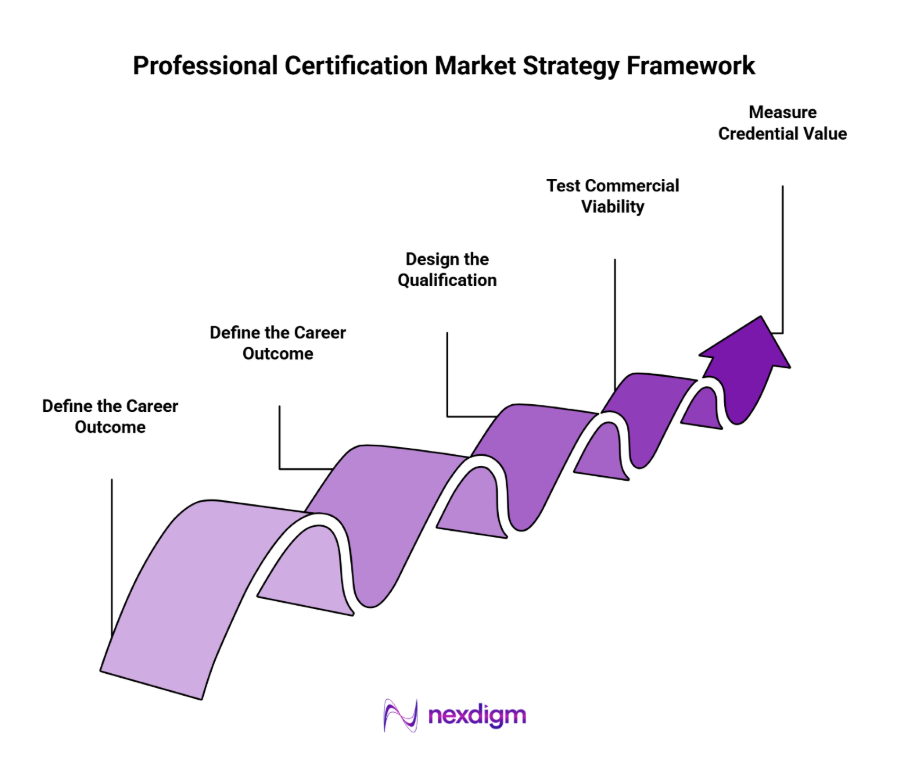
- Define the Career Outcome: Specify the role, promotion pathway or professional requirement the certification supports.
- Define the Career Outcome: Consult hiring managers and industry bodies about the skills and assessment standards they trust.
- Design the Qualification: Match course content, practical assessment and credential level to the intended outcome.
- Test Commercial Viability: Evaluate pricing, learner acquisition, examination costs and competing certifications.
- Measure Credential Value: Monitor completion, assessment results, learner progression and employer acceptance.
A certification should not be scaled simply because a topic is fashionable. Its value must remain credible to both the person paying for it and the employer evaluating it.
Nexdigm Case Study: Prioritising Certification Opportunities
Nexdigm assessed 24 professional certification categories across technology, finance and project management. Ten showed consistent learner interest, but only six combined clear employer relevance with feasible pricing and delivery economics. The provider prioritised four credentials for development, with employer validation and practical assessment built into the launch process.
To take the next step, simply visit our Request a Consultation page and share your requirements with us.
Harsh Mittal
+91-8422857704