

India’s education system spans government, government-aided, and private institutions, creating a diverse market with significant differences in affordability, infrastructure, curriculum, access, and perceived outcomes. In 2024–25, India recorded 24.69 crore school students across 14.71 lakh schools. Government schools accounted for 49% of students, while private schools accounted for 41%, illustrating the substantial role of private education alongside the public system.
The movement between these segments is influenced by more than household income. Parents may consider teaching quality, academic outcomes, school infrastructure, safety, accessibility, curriculum, peer environment, and perceived future opportunities. At the same time, government institutions remain critical to education access, particularly for households where affordability is a primary consideration.
For education operators, investors, policymakers, and market entrants, a Public vs private education market analysis can help identify where enrollment is shifting, understand the factors behind those shifts, and evaluate the implications for future education demand.
What Is Driving Public-to-Private Demand Shifts?
Demand between public and private education can change as household incomes, aspirations, urbanization, and school availability evolve. Private institutions may attract families seeking specific curricula, facilities, academic environments, or perceived employment and higher-education advantages.
However, private enrollment growth is not uniform. Affordability, fee structures, local competition, and the availability of government or government-aided alternatives can significantly influence decisions across geographies and household segments.
The Choice Is Increasingly About Perceived Value
Parents and students often compare education options based on the value they expect to receive relative to the cost. Academic performance, faculty quality, infrastructure, curriculum, location, safety, and extracurricular opportunities can influence this calculation.
Recent education research highlights the importance of understanding household education spending, premium private versus government institutions, parental decision-making, program attributes, and affordability when evaluating education demand.
Nexdigm’s Public Vs Private Education Market View
Nexdigm combines education-sector research, consumer insights, market sizing, competitive intelligence, affordability analysis, and strategic advisory to understand how demand is distributed across public and private education.
Its Public vs private education market analysis examines enrollment patterns, household expenditure, institution types, fee structures, learner preferences, and competitive dynamics. This enables stakeholders to assess public-private education shifts within the broader context of demographics, household economics, institutional capacity, and changing education preferences.
Rather than treating private enrollment growth as an isolated trend, Nexdigm examines why families shift, which segments are moving, where demand is strongest, and what factors could influence future enrollment.
Why Education Stakeholders Partner with Nexdigm
Education stakeholders partner with Nexdigm to combine market intelligence with consumer and institutional analysis. Nexdigm’s education research covers K-12, higher education, vocational education, EdTech, international education, and related segments.
Its research can integrate market sizing, enrollment analysis, household spending, competitive benchmarking, affordability, and stakeholder perspectives, helping clients understand both the demand-side drivers and supply-side conditions shaping education markets.
Nexdigm’s Public vs Private Education Market Analysis
Nexdigm’s Public vs private education market analysis conducts a thorough assessment focusing on demand and competitive dynamics across multiple dimensions, such as:
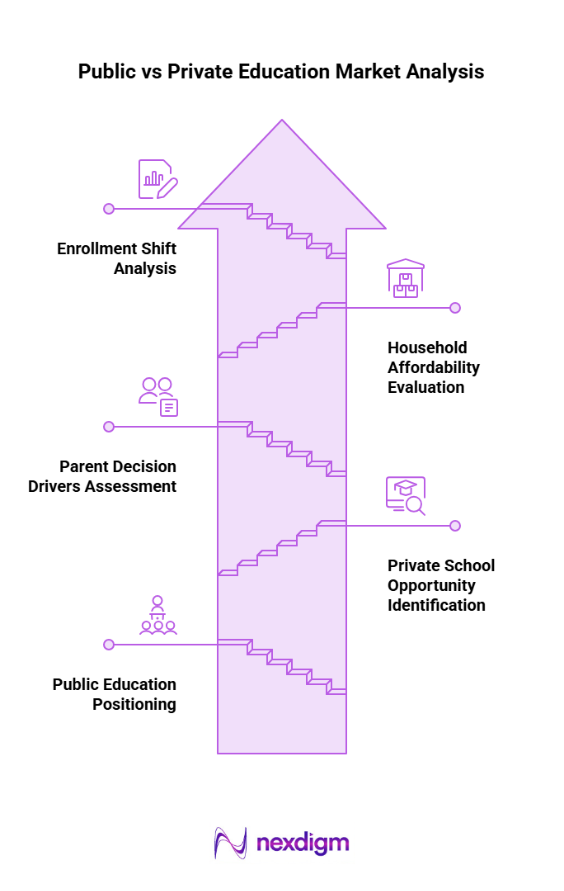
- Enrollment Shift Analysis: Nexdigm examines enrollment trends across government, government-aided, and private institutions to identify markets and student segments experiencing changes in institutional preference.
- Household Affordability: Evaluating household income, education expenditure, fee tolerance, and competing education costs to determine which families can realistically consider private education.
- Parent Decision Drivers: Nexdigm assesses factors such as academic quality, faculty, infrastructure, curriculum, safety, location, reputation, and perceived outcomes to understand what drives school-selection decisions.
- Private School Opportunity: Identifying catchments where demographic growth, household affordability, private-school penetration, and unmet demand could support additional private education capacity.
- Public Education Positioning: Evaluating government-aided institutions as part of the competitive landscape, helping stakeholders understand where public provision remains strong and where gaps may exist.
This provides stakeholders with a more detailed view of where demand is moving, why it is moving, and which education models are positioned to capture future enrollment.
Nexdigm in Prioritizing High-Potential Education Investment Opportunities
Identifying attractive education investment opportunities requires more than understanding enrollment demand. Through Market Analysis, Nexdigm help stakeholders prioritize locations and segments with stronger long-term growth and investment potential, by offering insights about:
- Enrollment Migration Patterns: Analyze shifts in student enrollment between public, private, and aided institutions to identify changing preferences, emerging demand pockets, and future growth opportunities.
- Demographic Trends: Assess population growth, school-age cohorts, urbanization patterns, and household formation trends to determine markets capable of supporting sustained education demand.
- Affordability Indicators : Evaluate household income levels, education spending capacity, fee tolerance, and economic conditions to understand the financial viability of education offerings.
By combining demand, demographic, affordability, and competitive analysis, Nexdigm helps stakeholders prioritize high-potential education investment opportunities, reduce market-entry risks, and support data-driven expansion and capital allocation decisions.
Nexdigm’s Case
Nexdigm supported an education stakeholder evaluating expansion across 9 potential catchments. The assessment identified 3 priority markets after examining student demand, existing capacity, and competitive conditions, helping focus expansion planning on locations with stronger potential for sustainable enrollment.
To take the next step, simply visit our Request a Consultation page and share your requirements with us.
Harsh Mittal
+91-8422857704