

Public hospitals and health facilities are typically responsible for maintaining access across population groups and geographies, including areas where commercial returns may be limited. Their investment decisions are therefore influenced by government budgets, public-health priorities, procurement rules, and capacity requirements.
This creates a different demand profile for suppliers of equipment, technology, pharmaceuticals, and healthcare services. Procurement volumes can be substantial, but purchasing cycles may be longer and subject to formal tenders, budget approvals, and predefined specifications.
Private Providers Compete on Capacity, Utilization, and Returns
Private providers operate under stronger commercial incentives. Decisions around new facilities, specialty expansion, equipment purchases, and technology adoption are influenced by expected patient volumes, reimbursement, pricing, competition, and capital requirements.
The U.S. hospital market illustrates the diversity within private provision. Of 5,121 community hospitals in FY2024, 2,984 were nongovernment nonprofit hospitals and 1,224 were investor-owned for-profit hospitals, while 913 were state and local government hospitals.
Private does not therefore mean synonymous with for-profit. Nonprofit providers can have different financial objectives and community obligations, while investor-owned providers are more directly exposed to profitability and returns.
The Economics Change Across the Same Care Pathway
The distinction becomes particularly important when a healthcare market includes both provider types.
A medical device company may face different procurement processes in a government hospital and a private hospital. A diagnostic company may find greater willingness to adopt premium technologies in private facilities, while public facilities may offer larger institutional volumes but operate under stricter budget constraints.
OECD data also show that hospitals account for 39% of healthcare spending across OECD countries, making provider-level economics particularly important when assessing healthcare markets. Ambulatory providers account for around one-quarter of spending.
A Provider Market Should Be Segmented Before It Is Sized
A market containing public and private providers can produce misleading headline estimates if these segments are treated as a single customer base.
A public hospital may have significant patient demand but limited discretionary capital. A private hospital may have greater investment capacity but face stronger competition and higher expectations for commercial returns. The same product or service can therefore have very different adoption potential across the two segments.
This makes provider segmentation a critical step in healthcare market assessment.
Nexdigm’s Provider Economics Framework
Nexdigm’s Public vs private healthcare market study determines how provider ownership affects demand, purchasing behavior, and commercial opportunities.
Nexdigm evaluates the market through a simple decision framework:
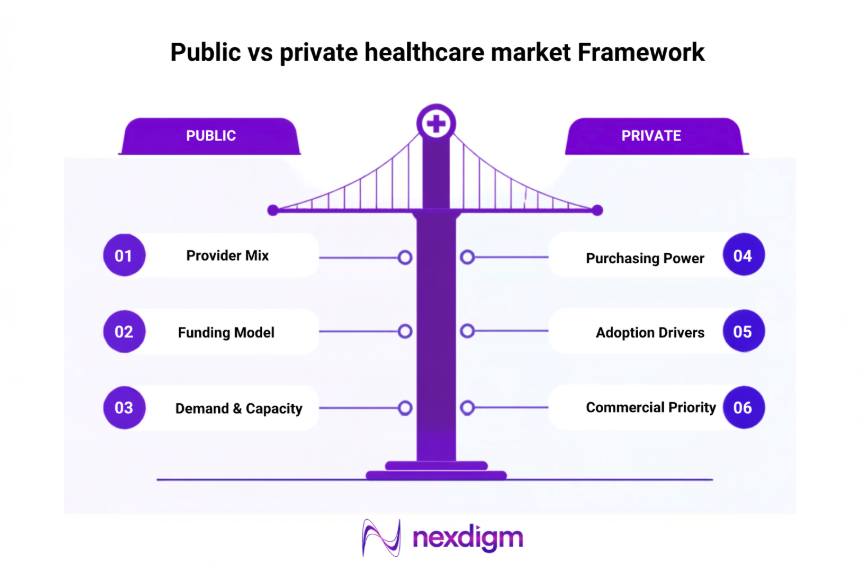
- Provider Mix: Public vs private facilities, ownership structure, geography, and specialty profile.
- Funding Model: Government budgets, insurance reimbursement, self-pay, private funding, and procurement mechanisms.
- Demand & Capacity: Patient volumes, procedure volumes, bed capacity, utilization, and unmet demand.
- Purchasing Power: Capital budgets, operating expenditure, reimbursement levels, and willingness to invest.
- Adoption Drivers: Technology maturity, clinical priorities, infrastructure, physician preferences, and competitive pressure.
- Commercial Priority: Rank provider segments by market size, accessibility, purchasing capacity, and growth potential.
This framework converts ownership data into actionable market priorities rather than treating public and private providers as interchangeable customers.
How Nexdigm Identifies the Right Provider Segments
A medical technology company assessed 1,200 hospitals across six markets. Initial sizing produced a USD 2.6 billion opportunity across public and private providers. After evaluating procurement access, capital capacity, utilization, and technology readiness, Nexdigm identified 310 hospitals representing USD 1.4 billion in immediately addressable demand, enabling the client to concentrate its commercial strategy on the highest-potential provider segments.
To take the next step, simply visit our Request a Consultation page and share your requirements with us.
Harsh Mittal
+91-8422857704
[email protected]