

QSR growth is often reduced to outlet expansion. That misses the more important question: why are customers choosing a quick-service format in the first place?
A customer buying breakfast before work has a different mission from someone ordering dinner for a family, picking up a snack between activities or using a delivery app for a late-night meal. Each occasion carries different expectations around price, speed, menu breadth and convenience.
QSR market assessment therefore needs to follow the customer mission rather than simply count outlets.
The Organised Foodservice Opportunity Is Expanding
India’s foodservice market is projected to reach US150billionbyFY31,upfromapproximatelyUS90 billion in FY26. Organised foodservice brands currently account for around 45% to 50% of the market and are expected to reach approximately 55% by 2030.
Within the organised segment, QSRs are among the faster-growing formats. The Kearney-Swiggy 2025 report cited by IBEF projects QSRs to grow at approximately 15% to 17% annually through 2030.
But national growth does not mean every QSR concept or location will perform equally.
Different Customer Missions Create Different Demand Pools
While overall demand for quick-service restaurants is expanding, success varies significantly depending on the specific location and concept. Operators can better capture this growth by understanding the distinct consumer motivations that form primary demand pools:
- Planned Meals: When diners seek out a specific, familiar brand, key factors like value, availability, and consistent quality drive their decision.
- Convenience-Driven Meals: For time-sensitive customers, swift service, accessible locations, reliable preparation, and delivery options take priority over menu variety.
- Social Outings: Group dining choices; particularly in high-traffic retail hubs and malls are guided by brand familiarity, shareable menu options, and affordability.
Affordability Is Becoming a Competitive Weapon
Consumer spending remains sensitive to price, particularly for high-frequency food purchases.
Swiggy introduced its ₹99 Store across more than 175 cities in 2025, offering meals at ₹99 with free delivery through its Eco Saver mode. The proposition was explicitly designed around affordability and high-frequency users.
This does not mean every QSR needs to compete at ₹99. It demonstrates the importance of price architecture.
QSR operators can create multiple entry points through:
- Value meals
- Small-format portions
- Combo pricing
- Premium upgrades
- Family bundles
- Beverage or dessert add-ons
- Time-specific promotions
The objective is to manage affordability without undermining the average order value.
Health Is Creating Another QSR Demand Layer
Health-conscious eating is increasingly entering mainstream foodservice.
Swiggy reported in January 2026 that one in nine food orders on its platform was an EatRight order. The category included more than 180,000 restaurants and over 2 million items, with 45g-plus protein options showing particularly strong traction.
This suggests that health-oriented demand is no longer confined to specialist salad or fitness brands.
QSR operators can respond through protein-rich meals, lower-calorie choices, no-added-sugar beverages or clearer nutritional positioning.
The opportunity needs to be tested by customer mission and willingness to pay rather than assuming every consumer will trade taste for health.
Location and Delivery Are Converging
QSR demand increasingly comes from both physical and digital access.
Bolt service expanded to 500-plus cities and 45,000-plus restaurant brands by May 2025, accounting for more than one in ten Swiggy food-delivery orders.
This changes the way markets should be evaluated.
A location with strong footfall may also provide an attractive delivery catchment. A lower-rent location may perform better if delivery demand is sufficiently dense. Conversely, high delivery commissions or weak kitchen throughput can undermine an apparently attractive market.
QSR feasibility therefore needs to model both physical and digital demand.
Competition Is Becoming More Diverse
Regional brands, Indian cuisine-led chains, cafés, cloud kitchens and delivery-first operators increasingly compete for the same occasions. India’s restaurant sector is also experiencing consolidation. In January 2026, NRAI reported that Devyani International’s proposed combination with Sapphire Foods would create a platform operating more than 3,000 outlets globally, illustrating the scale at which organised players are consolidating.
This makes competitive mapping essential before entering a city or neighbourhood.
Nexdigm’s QSR market assessment consulting helps companies evaluate customer demand, pricing, catchment potential, format economics, competitive intensity and expansion opportunities.
Nexdigm’s QSR Demand Assessment Matrix
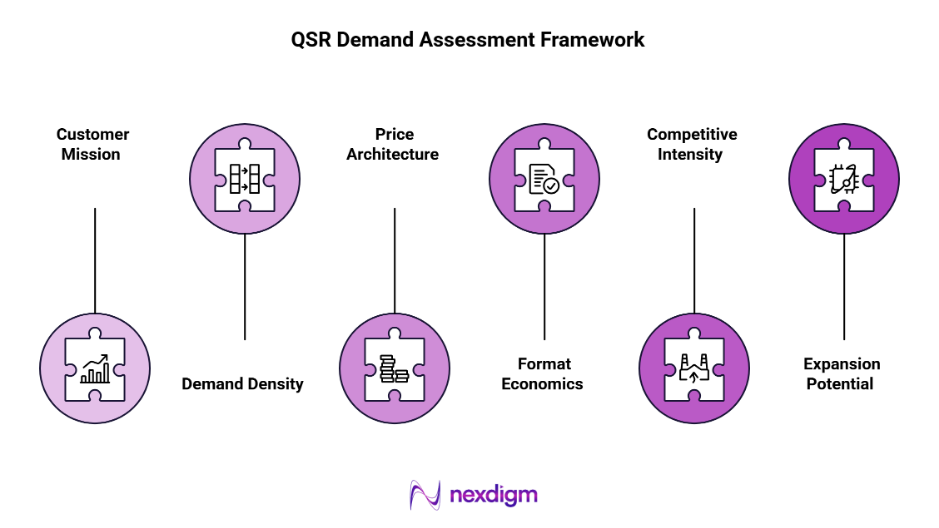
- Customer Mission
Identify meal, snack, social, convenience, delivery and impulse occasions. - Demand Density
Map customers, footfall, residential and commercial catchments, and order frequency. - Price Architecture
Benchmark entry prices, combos, average order values, promotions and premiumization opportunities. - Format Economics
Compare dine-in, takeaway, delivery-led, kiosk and compact-store formats. - Competitive Intensity
Assess local and national chains, regional players, delivery brands, pricing and promotional activity. - Expansion Potential
Evaluate city, catchment and location-level demand alongside rental costs, delivery reach and operating economics.
The matrix helps distinguish markets with genuine QSR demand from those where outlet density is already absorbing most of the available opportunity.
Nexdigm Case: Mapping QSR Demand Across Formats and Locations
Nexdigm assessed 8 QSR formats across 6 cities, benchmarking 56 outlets and 3,200 consumers. The analysis identified value-led formats as the strongest expansion opportunity, supporting a rollout plan targeting 22% higher outlet-level revenue.
To take the next step, simply visit our Request a Consultation page and share your requirements with us.
Harsh Mittal
+91-8422857704