

QSR pricing optimization and benchmarking help quick-service restaurants balance affordability, margin protection, and customer loyalty in highly competitive markets. Through structured Pricing Analysis, operators can evaluate item-level profitability, competitor pricing, customer price sensitivity, promotional effectiveness, channel costs, and basket composition.
These insights support smarter price points, meal bundles, portion architecture, and value menus while improving average order value. A data-driven QSR pricing strategy also helps reduce discount dependency, strengthen customer retention, and maintain consistent pricing across dine-in, takeaway, delivery, and digital ordering channels.
Illustrative QSR pricing programs have delivered measurable gains, including a 6.8% increase in average basket size, margin improvement, 9.5% higher repeat purchases, and 12% stronger promotional returns after refining bundles, price ladders, and channel-specific offers across priority markets.
Pricing Analysis Strategies for QSR Revenue, Retention, and Basket Growth
Pricing analysis helps QSR brands improve revenue, retention, and basket growth by aligning menu prices, bundles, promotions, customer value, and channel economics with changing demand and competitive market conditions effectively. Some important strategies for QSR revenue growth are:
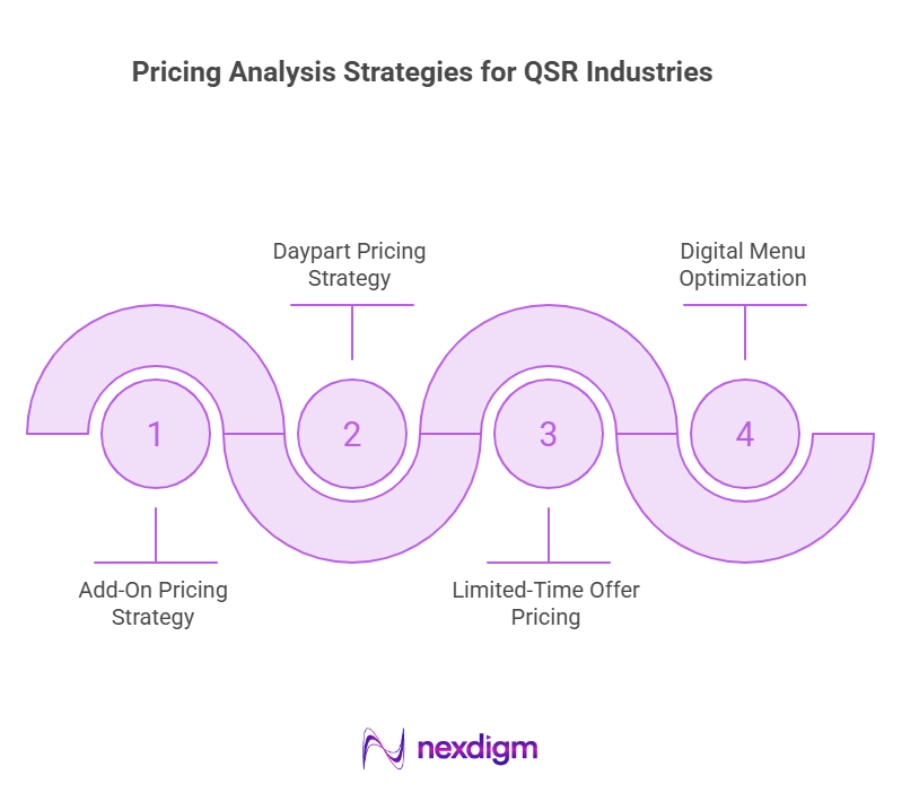
- Add-On Pricing Strategy: Price sides, beverages, desserts, and extras to encourage incremental purchases, increase basket value, and improve contribution margins across common ordering occasions.
- Daypart Pricing Strategy: Adjust offers and price points for breakfast, lunch, dinner, and late-night demand to improve traffic, capacity use, and profitability throughout the day.
- Limited-Time Offer Pricing: Use temporary products and targeted price points to create urgency, test demand, attract visits, and generate incremental revenue without changing the core menu.
- Digital Menu Optimization: Test product placement, price presentation, recommendations, and upgrade prompts across apps and kiosks to improve conversion, order value, and customer convenience.
Nexdigm’s Pricing Analysis Support for Stronger QSR Performance
Nexdigm helps quick-service restaurant brands strengthen commercial performance through data-driven QSR pricing analysis, competitive benchmarking, and menu price optimization. Its pricing analysis services assess customer demand, price elasticity, basket composition, promotional effectiveness, channel costs, and competitor positioning. These insights support smarter pricing decisions, larger basket sizes, stronger customer retention, improved margins, and sustainable revenue growth across locations and ordering channels.
Nexdigm’s QSR Pricing Strategy Architecture for Revenue Growth
Nexdigm’s QSR pricing strategy architecture combines market intelligence, customer insights, menu economics, and performance tracking to support stronger revenue growth, basket expansion, margin protection, and customer retention across channels consistently. Some important strategic steps followed here are:
- Diagnose Pricing Opportunities: Assess demand, competitor prices, menu performance, and channel economics to identify pricing gaps, value opportunities, margin pressures, and growth priorities across locations and customer segments.
- Structure the Menu Portfolio: Segment products by popularity, profitability, and customer role to create clear price ladders, balanced meal options, and stronger trade-up opportunities across the QSR menu portfolio.
- Optimize Prices and Offers: Develop optimal prices, bundles, and promotional structures using elasticity, cost, and willingness-to-pay insights to improve basket size while maintaining affordability and overall customer value perception.
- Execute Across Channels: Implement pricing changes across dine-in, delivery, drive-through, kiosks, and digital channels with clear governance, staff communication, and consistent execution standards for every location marketwide effectively.
- Monitor and Refine Performance: Track revenue, margin, transaction volume, basket size, and retention to measure impact, refine pricing decisions, and respond quickly to competitor moves and changing customer behavior.
Nexdigm’s Case
In a QSR pricing engagement, Nexdigm assessed menu architecture, loyalty behavior, store clusters, and digital ordering patterns. Targeted price ladders and personalized bundles increased digital conversion by 10.6%, raised transactions per customer by 7.2%, reduced discount leakage, and improved quarterly EBITDA by 5.4% across participating locations overall.
To take the next step, simply visit our Request a Consultation page and share your requirements with us.
Harsh Mittal
+91-8422857704