

Quick-service restaurant (QSR) procurement operates under a demanding combination of high order frequency, standardised menus, tight preparation times, and multiple outlet locations. A small difference in ingredient cost can become commercially significant across a large chain, but switching to the cheapest supplier can also introduce inconsistent portions, quality variation, or delivery failures.
Procurement analysis should examine how sourcing models, supplier markets, and contract terms affect cost per serving and the consistency of restaurant operations.
Map the Sourcing Model
QSR chains typically combine direct manufacturer relationships, regional distributors, local suppliers, and centralised procurement arrangements. Direct sourcing can improve visibility into production and pricing, while distributors can consolidate deliveries and provide broader product coverage. The trade-off depends on order density, cold-chain needs, delivery frequency, and the chain’s ability to manage suppliers directly.
The US Department of Agriculture’s Economic Research Service reported that inflation-adjusted food sales at limited-service establishments reached $516.1 billion in 2025, compared with $273.8 billion in 1997. This long-term expansion underlines the scale of the foodservice supply ecosystem, but procurement economics still depend on individual menu categories and operating models.
Compare Cost Per Serving
Supplier quotations should be converted into comparable costs per usable kilogram, portion, or menu item. Purchase price alone can conceal differences in product yield, trim loss, pack size, freight, minimum order quantities, and wastage.
For QSR procurement research, the analysis should also separate national contracts from regional buying. A national supplier may offer consistent specifications and consolidated pricing, while regional suppliers may provide fresher products, shorter lead times, or better coverage in specific markets.
Evaluate Supplier Performance
QSR menus depend on consistency. Variations in bun dimensions, patty weight, cooking performance, oil quality, or sauce formulation can affect preparation time and the final product. Supplier evaluation should therefore combine commercial terms with quality records, delivery reliability, production capacity, and corrective-action procedures.
Chains should also assess whether vendors can meet promotional peaks, new-store openings, and seasonal demand without excessive substitutions or emergency orders.
QSR Procurement Benchmarking Framework
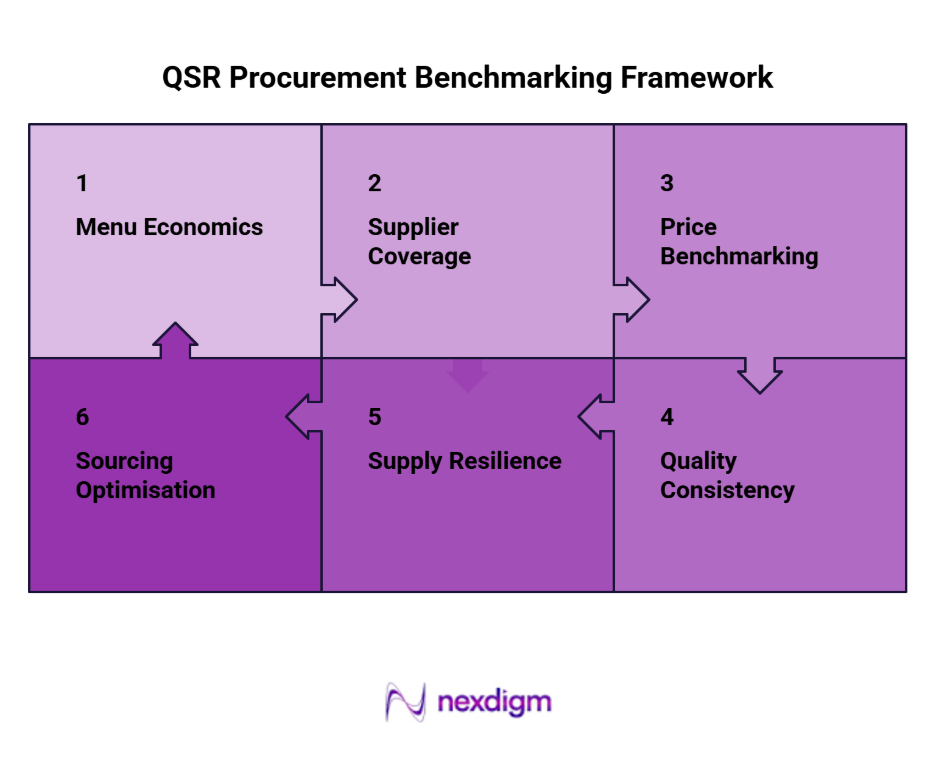
- Menu Economics: Compare supplier costs against usable yield, portion specifications, wastage, and preparation requirements to establish the real cost of each menu input.
- Supplier Coverage: Map manufacturers, distributors, and local vendors by category, production capacity, delivery radius, and ability to support the full restaurant network.
- Price Benchmarking: Compare equivalent product specifications, freight, rebates, minimum orders, payment terms, and contract escalation clauses across shortlisted suppliers.
- Quality Consistency: Review batch variation, rejection rates, shelf life, food safety documentation, and corrective-action records for ingredients critical to menu consistency.
- Supply Resilience: Identify single-source ingredients, constrained production capacity, cold-chain dependencies, and backup vendors that can meet approved specifications.
- Sourcing Optimisation: Allocate categories across national, regional, and local suppliers according to cost, quality, delivery density, and operational risk.
Improve Procurement Without Compromising the Menu
The strongest sourcing model is category-specific. Ambient ingredients may suit consolidated purchasing, while fresh produce or highly perishable products may require shorter supply routes. Contract changes should be tested against kitchen performance, not evaluated solely through quoted savings.
Nexdigm’s Case Study
A QSR chain operating 85 outlets reviewed sourcing for poultry, buns, cooking oil, and sauces. Comparing delivered costs, yield, and order fulfilment identified inconsistent regional pricing. Revised supplier allocation and consolidated negotiations reduced the targeted categories’ procurement costs by 4.2% over six months while maintaining product specifications and delivery standards.
To take the next step, simply visit our Request a Consultation page and share your requirements with us.
Harsh Mittal
+91-8422857704