

Quick-service restaurant chains are built around repeatable operations. A customer expects the same product, portion, taste and service whether they visit an outlet in Delhi, Pune or Bengaluru. Maintaining that consistency becomes harder as a chain expands its outlet network and adds vendors across different regions.
The supplier base can include poultry processors, dairy distributors, frozen-food manufacturers, produce aggregators, packaging companies and logistics providers. Each category brings different quality, regulatory and delivery requirements. A vendor capable of serving 10 outlets may not have the production capacity, documentation systems or distribution network needed to support 100.
For QSR operators, vendor assessment needs to establish whether suppliers can support expansion without creating new operational vulnerabilities.
QSR Expansion Changes the Supplier Risk Profile
India’s organised food-service market has been expanding alongside changing urban consumption patterns, delivery platforms and the growth of branded restaurant chains. This expansion increases the need for suppliers that can serve multiple outlets while maintaining consistent product specifications.
The challenge is particularly visible in high-volume categories. Poultry, dairy, edible oils, potatoes and frozen products may be sourced from different production clusters, each with its own seasonal and logistical constraints. A supplier’s ability to meet current orders does not necessarily establish its readiness to support a new city or a larger outlet network.
QSR operators should therefore examine vendor capacity against projected outlet growth, rather than relying only on present-day fulfilment.
Five Vendor Risks That Can Disrupt QSR Operations
- Food Safety and Category-Specific Compliance
QSR suppliers handle products with different food safety requirements. Poultry and meat vendors need reliable processing, hygiene and temperature controls. Dairy suppliers must maintain product quality through storage and transport, while packaging vendors need to meet applicable food-contact requirements.
FSSAI’s enforcement data for FY2024–25 recorded 170,535 food samples analysed, of which 34,388 were non-conforming. This is not a supplier failure rate, but it demonstrates the scale of food safety monitoring and the importance of verifiable quality controls. - Production Capacity and Multi-Location Readiness
A vendor’s installed capacity should be assessed against actual output, utilisation and the ability to increase production. QSR expansion can create sharp changes in demand when new outlets open or promotional campaigns increase order volumes.
The assessment should also consider whether suppliers operate multiple facilities, maintain backup production arrangements and have sufficient inventory to handle temporary demand spikes. - Cold-Chain and Delivery Reliability
Frozen patties, dairy ingredients, meat and prepared components require appropriate temperature management. A supplier may produce compliant goods but still expose the restaurant chain to risk through inadequate storage, vehicle availability or long delivery routes. - Geographic Concentration
Dependence on one supplier or production cluster can make an entire outlet network vulnerable to local disruptions. QSR businesses should map where critical ingredients originate and whether alternative suppliers can meet the same specifications. - Documentation and Corrective-Action Discipline
Supplier records should include valid licences, testing reports, batch traceability, product specifications and documented procedures for managing deviations. The ability to investigate a quality issue quickly is especially important when the same ingredient is distributed across many outlets.
What Should a QSR Vendor Readiness Review Measure?
A useful assessment compares vendors against the operating requirements of the restaurant network. Important indicators include:
- Percentage of orders fulfilled within the agreed delivery window.
- Production capacity available for additional outlet demand.
- Number of qualified alternative suppliers for critical ingredients.
- Frequency of product rejection and quality deviations.
- Validity and completeness of regulatory documentation.
- Cold-storage and transport coverage across target cities.
The indicators should be interpreted by category. A packaging vendor’s operational risk differs from that of a fresh poultry supplier, and a single scoring model should not obscure those differences.
How Nexdigm Can Help Assess QSR Supplier Readiness
A QSR vendor compliance assessment consulting engagement can combine supplier landscape mapping, regional market research, production-capacity analysis and review of relevant regulatory conditions. Nexdigm can help restaurant businesses compare vendor availability across markets, identify concentrated supply dependencies and understand whether the existing supplier ecosystem can support planned expansion.
The resulting assessment gives management a clearer view of which categories require additional supplier coverage, which regions offer stronger alternatives and where operational readiness may constrain growth.
QSR Vendor Compliance and Operational Readiness Framework
The assessment can be organised around five decisions:
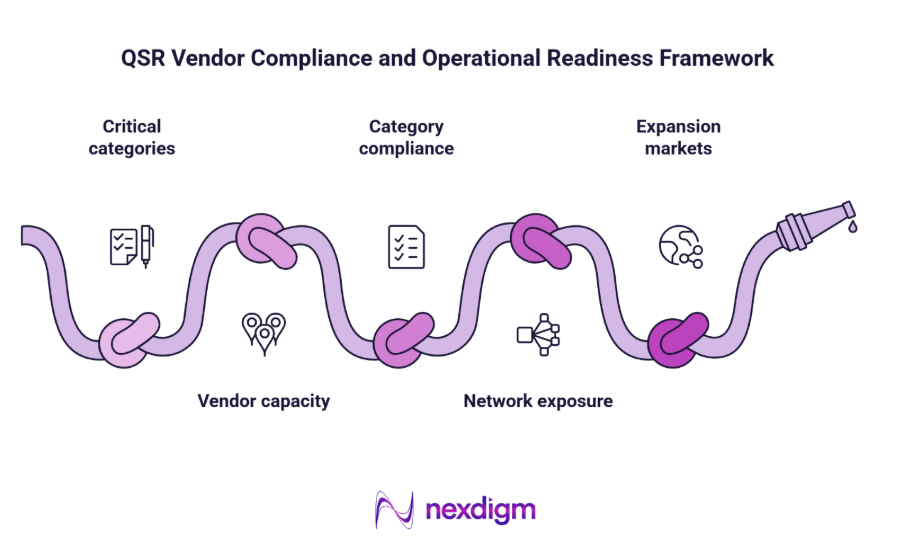
- Identify critical categories: Determine which ingredients and services could interrupt menu availability if supply fails.
- Map vendor capacity: Compare production locations, current output, utilisation and ability to serve additional outlets.
- Verify category compliance: Review licences, product standards, testing arrangements and traceability requirements.
- Measure network exposure: Examine supplier concentration, transport distances, cold-chain coverage and alternative sources.
- Prioritise expansion markets: Match vendor readiness against the chain’s planned outlet locations and expected demand.
This approach connects supplier assessment directly to the expansion plan. It also helps distinguish a market with adequate customer demand from one where the supply ecosystem may not yet be ready.
Nexdigm’s Case Study
A QSR chain planning to expand from 48 to 90 outlets assessed 32 vendors across 5 ingredient categories and 4 regions. The review identified 7 suppliers with insufficient expansion capacity. After qualifying alternate vendors in 3 markets, projected category-level supply coverage increased from 76% to 93%.
To take the next step, simply visit our Request a Consultation page and share your requirements with us.
Harsh Mittal
+91-8422857704