

Quantum computing investments are accelerating as advanced research expands globally and organizations explore new ways to solve complex computational problems. Unlike traditional computing, quantum technologies can support faster analysis for areas such as optimization, simulation, encryption, materials research, and advanced data modeling. This growing interest creates opportunities for technology providers, research-led firms, and solution developers to build a focused market entry strategy that addresses enterprise readiness, technical maturity, infrastructure needs, and commercial use cases.
A successful Quantum computing market entry strategy should align innovation capabilities with industry demand, partnership ecosystems, regulatory considerations, and long-term adoption potential.
The global quantum computing market is projected to grow from USD 2.04 billion in 2026 to USD 18.33 billion by 2034, at a CAGR of 31.60%. Another estimate projects growth from USD 1.88 billion in 2026 to USD 19.44 billion by 2035. These figures support a Quantum computing market entry strategy focused on research partnerships, infrastructure readiness, and commercial use cases.
Quantum Computing Market Entry Strategy for Research-Driven Industries
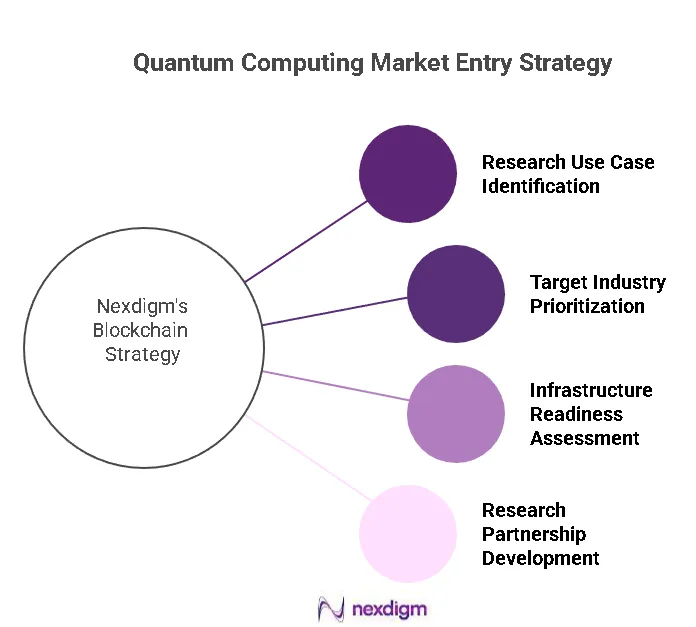
Quantum Computing Market Entry Strategy for Research-Driven Industries focuses on identifying commercial use cases, building research partnerships, assessing infrastructure readiness, and aligning quantum capabilities with complex enterprise problem-solving needs:
-
Research Use Case Identification
Identify quantum applications in optimization, simulation, encryption, materials research, data modeling, and complex scientific problem-solving.
-
Target Industry Prioritization
Focus on research-driven industries with high computational needs, technical maturity, innovation budgets, and readiness for quantum experimentation.
-
Infrastructure Readiness Assessment
Evaluate computing infrastructure, data availability, integration needs, cloud access, and technical preparedness for quantum adoption.
-
Research Partnership Development
Build partnerships with research institutions, innovation labs, technical experts, and enterprise teams to support solution validation.
Nexdigm’s Go-to-Market Planning for Quantum Computing Solutions
Nexdigm’s Go-to-Market Planning for Quantum Computing Solutions helps providers define target research-driven industries, assess commercial use cases, shape positioning, identify partner ecosystems, and plan launch channels. It supports market entry by aligning quantum capabilities with infrastructure readiness, enterprise problem-solving needs, proof-of-concept opportunities, and scalable adoption pathways.
Nexdigm’s Evaluation of Commercial Use Cases for Quantum Computing Solutions
Nexdigm’s Evaluation of Commercial Use Cases for Quantum Computing Solutions helps providers assess high-value applications, enterprise readiness, technical feasibility, adoption barriers, and commercialization potential across research-driven markets.
-
Technical Feasibility Review
Assess algorithm readiness, infrastructure needs, data quality, computing access, integration complexity, and deployment limitations.
-
Enterprise Readiness Evaluation
Analyze customer awareness, innovation maturity, budget availability, technical capability, and willingness to test quantum solutions.
-
Adoption Barrier Analysis
Review cost, talent shortages, infrastructure gaps, uncertainty, regulatory concerns, and limited proven commercial outcomes.
-
Proof-of-Concept Planning
Design pilots, simulations, benchmarks, and controlled testing models to validate quantum solution performance and practical business relevance.
Nexdigm’s case:
Nexdigm supported a quantum computing solution provider evaluate commercial use cases across research-driven industries. Through market assessment, technical feasibility review, customer segmentation, partnership mapping, and proof-of-concept planning, Nexdigm helped the company identify three priority applications and refine its commercialization roadmap.
The company improved qualified research-led opportunities by 28%, reduced use case evaluation time by 30%, and increased pilot discussions by 24% within the first year.
To take the next step, simply visit our Request a Consultation page and share your requirements with us.
Harsh Mittal
+91-8422857704