

Quantum computing is moving from laboratory research toward structured enterprise experimentation. More than 300 companies have adopted quantum technologies, while private investment in quantum startups reached $12.6 billion in 2025, 6.3 times the 2024 level. The capital is flowing across hardware, quantum software, and hybrid quantum-classical computing, but commercial adoption remains selective. The key question for enterprises is no longer whether quantum computing will matter, but which business problems can justify investment first.
Commercial Adoption Is Starting with Targeted Experiments
Most enterprises are still evaluating quantum computing through proofs of concept, cloud-based experimentation, and partnerships with technology providers. This approach reduces the need for immediate investment in dedicated hardware while allowing companies to test algorithms against real business problems.
The most promising opportunities share a common characteristic: they involve computational complexity that increases sharply as the number of variables grows. Portfolio optimization, molecular simulation, logistics routing, materials discovery, and energy-grid balancing can all involve large combinations of possible outcomes. Quantum algorithms may eventually provide advantages in selected areas, but the commercial case depends on outperforming increasingly capable classical alternatives.
Where Quantum Computing Could Create Value First
Molecular simulation could support drug discovery by modelling molecular structures, binding interactions, and reaction pathways, potentially reducing expensive laboratory iterations. Materials research offers similar opportunities in batteries, catalysts, and other complex molecular systems where faster simulation could shorten discovery cycles.
Financial services can apply quantum optimization to multi-asset portfolios, risk constraints, and complex allocation problems, while logistics can target vehicle routing, freight allocation, and scheduling across large networks. Energy applications include grid balancing, renewable generation, and storage dispatch, where optimization must account for multiple interacting variables and changing demand.
The Classical Baseline Determines Commercial Feasibility
Quantum performance cannot be assessed in isolation. Classical HPC environments, GPUs, TPUs, heuristics, and optimization algorithms continue to improve, and many enterprise problems already have solutions that are sufficiently fast and accurate.
A quantum computing market feasibility study therefore needs to establish a classical baseline before calculating potential quantum value. The assessment should compare algorithm execution time, solution quality, infrastructure costs, energy consumption, data-transfer requirements, and integration complexity.
Hardware characteristics also matter. Superconducting systems offer high physical qubit counts but require extreme cryogenic environments and contend with short coherence times. Trapped-ion systems provide long coherence and high gate fidelity, while neutral-atom systems offer reconfigurable architectures and potential scalability. Photonic systems operate largely at room temperature and are particularly relevant to quantum communications, while quantum annealers target specific optimization problems rather than general-purpose computation.
The relevant question is consequently not which architecture has the largest qubit count. It is which architecture can solve a defined commercial problem at a cost and performance level that improves on the existing alternative.
Measuring the Gap Between Technical Progress and Business Value
Quantum investment becomes difficult to justify when technical milestones are treated as commercial milestones. More physical qubits do not automatically produce useful enterprise computation. Gate fidelity, coherence, error correction, algorithmic depth, data loading, and hybrid-system integration can all determine whether an application is viable.
Enterprises should quantify value before committing significant capital. For a logistics company, this could mean measuring the financial impact of improved routing against the cost of quantum computation. For a pharmaceutical company, it could mean calculating the value of reducing experimental cycles. For a bank, it could mean comparing portfolio optimization quality and execution time with existing classical systems.
This creates a clearer investment threshold: quantum technology should progress when the expected improvement in speed, accuracy, energy efficiency, or solution quality is material enough to offset implementation and operating costs.
Four Routes to Quantum Readiness
Enterprises can approach the market through different levels of commitment:
- Active experimentation: Use cloud-accessible quantum systems to test selected algorithms and establish internal capabilities.
- Internal capability building: Develop a quantum centre of excellence combining domain specialists, quantum researchers, and software engineers.
- Joint development: Partner with hardware and software providers to build industry-specific applications and share development risk.
- Technology monitoring: Track logical-qubit scaling, error correction, algorithmic breakthroughs, and evidence of quantum advantage before making larger commitments.
The appropriate route depends on the organization’s computational exposure, available technical talent, strategic priorities, and tolerance for technology risk.
Nexdigm Quantum Opportunity Assessment Framework
Nexdigm can structure quantum investment evaluation through six decision stages:
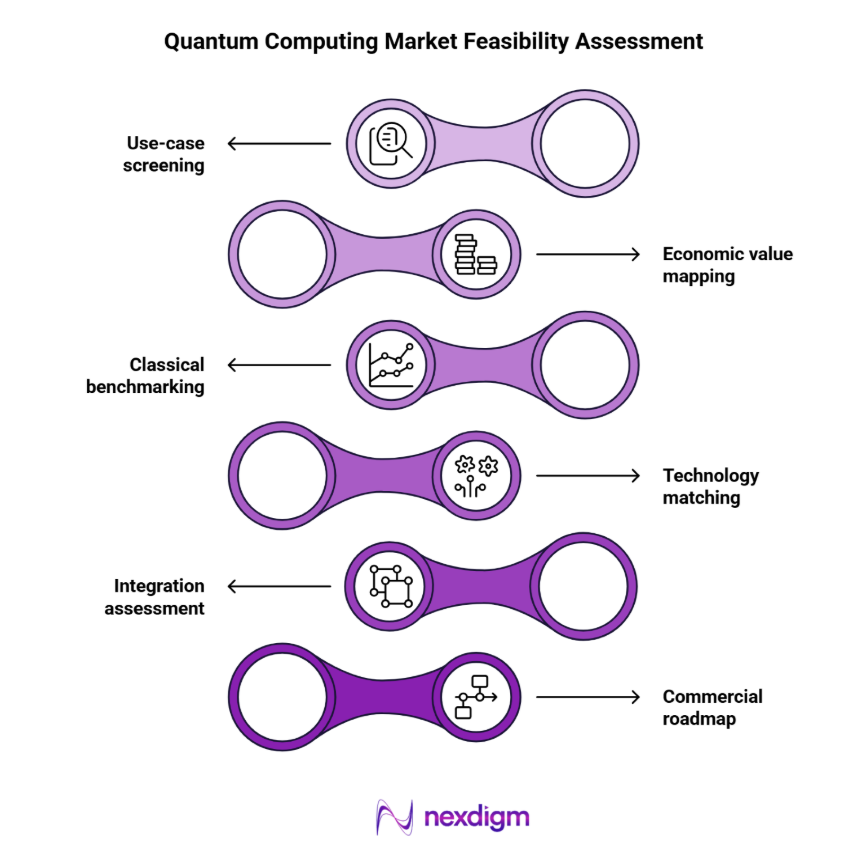
- Use-case screening: Identify workflows with significant computational complexity.
- Economic value mapping: Quantify the financial value of faster or better solutions.
- Classical benchmarking: Establish performance and cost baselines using existing HPC and optimization methods.
- Technology matching: Compare superconducting, trapped-ion, neutral-atom, photonic, and annealing architectures against the use case.
- Integration assessment: Evaluate data pipelines, cloud infrastructure, security, and hybrid computing requirements.
- Commercial roadmap: Define investment milestones linked to measurable technical and economic thresholds.
Nexdigm Quantum Commercialization Lens
The opportunity can be quantified across problem complexity, computational advantage, and economic value, ranking use cases by technology readiness, investment requirements, and time to commercialization. With 300+ enterprises evaluating quantum and $12.6B invested in 2025, the priority is identifying applications where technical gains translate into measurable business value.
To take the next step, simply visit our Request a Consultation page and share your requirements with us.
Harsh Mittal
+91-8422857704