
As global logistics networks expand, rail freight benchmarking becomes essential for measuring performance, identifying cost-saving opportunities, and optimizing operational efficiency. Integrating rail freight benchmarking with competitive intelligence allows companies to make data-driven decisions, reduce expenses, improve reliability, and maintain a strategic advantage in increasingly complex and cost-sensitive supply chains.
By leveraging competitive intelligence, businesses can compare rail performance against road and other transport modes, analyze transit times, costs, and network utilization, and uncover best practices.
Rail freight remains significantly more cost‑efficient than road transport for long‑distance shipments. In India, average rail freight costs about ₹1.96 per tonne‑km, while road transport costs around ₹11.03 per tonne‑km, highlighting rail’s cost advantage in logistics networks. Overall logistics costs in India stood at 7.97 % of GDP as rail emerged the most efficient mode, underscoring the value of benchmarking rail performance against road alternatives.
Analyzing Cost Advantages of Rail Freight with Competitive Intelligence
Analyzing cost advantages of rail freight with competitive intelligence involves comparing rail and road expenses, optimizing routes, identifying inefficiencies, and leveraging data to reduce costs while improving supply chain performance.
-
Identifying Operational Inefficiencies
Benchmarking uncovers delays, bottlenecks, or underperforming segments to streamline rail logistics and reduce unnecessary expenses.
-
Route and Schedule Planning
Competitive analysis guides optimal route selection and scheduling, minimizing transit times and associated operational costs.
-
Cost-Benefit of Modal Shifts
Intelligence helps assess scenarios where shifting freight from road to rail yields significant savings and efficiency gains.
-
Predictive Analytics for Demand Planning
Analyzing historical data forecasts cargo volumes, ensuring resources are allocated efficiently, reducing costs and service delays.
-
Monitoring Competitor Practices
Tracking competitor rail strategies and pricing informs benchmarking, enabling better strategic decision-making in multi-modal logistics.
Analyzing Rail and Road Freight Performance with Nexdigm
Nexdigm helps businesses analyze rail and road freight performance by benchmarking costs, transit times, and network efficiency. Using competitive intelligence and data analytics, Nexdigm identifies inefficiencies, highlights cost-saving opportunities, and recommends optimal modal allocation. This enables organizations to reduce operational expenses, improve delivery reliability, and make informed strategic decisions, ensuring enhanced performance across multi-modal logistics networks.
How Nexdigm Helps in Optimizing Rail Freight Costs Efficiently?
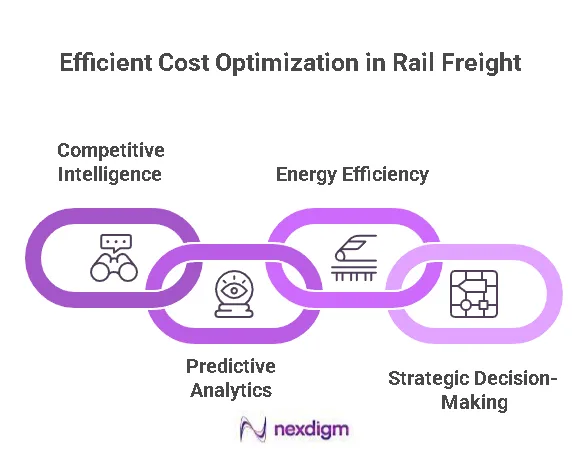
Nexdigm helps optimize rail freight costs efficiently by analyzing network performance, benchmarking against road transport, leveraging competitive intelligence, and recommending route, capacity, and modal strategies to reduce expenses and improve efficiency:
-
Leveraging Competitive Intelligence
Monitoring competitor strategies and market trends helps refine cost and pricing approaches for rail freight.
-
Predictive Analytics for Demand Planning
Forecasting cargo volumes allows proactive allocation of resources, reducing underutilization and improving efficiency.
-
Reducing Energy and Fuel Costs
Identifying energy-efficient modes and practices decreases fuel consumption and overall freight expenses.
-
Supporting Strategic Decision-Making
Insights guide management in contract negotiations, network expansion, and modal strategy to optimize rail freight costs.
Nexdigm’s case:
Nexdigm worked with Cardinal Health’s Australian operations to review logistics costs and supply chain performance. By analyzing operations, designing performance dashboards, and identifying optimization levers, Nexdigm’s recommendations delivered potential logistics cost savings of over AUD 0.8 million annually, reduced order receiving costs by up to 89 %, and improved inventory efficiency through smarter palletization and pruning of low‑value stock. These outcomes strengthened cost control and operational visibility.
To take the next step, simply visit our Request a Consultation page and share your requirements with us.
Harsh Mittal
+91-8422857704