

Road freight remains the dominant mode for moving goods in India, carrying 66% of freight transport demand in 2025, compared with 22% for rail. Yet this does not mean every road movement represents a realistic rail opportunity. Rail becomes commercially attractive only when cargo characteristics, distance, volume, infrastructure, and service requirements align.
For shippers and logistics providers, the question is therefore not whether rail is cheaper in general. It is which road freight flows can be shifted without sacrificing the reliability and flexibility customers require.
Distance Creates the First Screening Point
Rail’s economics improve as haul distances increase because fixed terminal and handling costs are spread across more kilometres.
The research indicates that for containerised industrial cargo in India, the road-to-rail break-even point can fall around 500–600 km, depending on cargo and handling conditions.
Below that range, first- and last-mile movements can erode the line-haul cost advantage of rail. Beyond it, rail becomes increasingly competitive where sufficient volumes can be consolidated.
Distance should therefore be treated as a screening variable rather than a universal threshold. A 400-km movement with very high volume and strong terminal access may be viable, while a 700-km movement with fragmented shipments may not be.
Volume Density Determines Whether the Economics Work
A manufacturer moving several hundred tonnes every week between two fixed locations presents a stronger opportunity than a shipper sending small consignments to multiple destinations.
Full-train or container consolidation can spread terminal, handling, and scheduling costs across larger volumes.
This is why commodities such as steel, cement, coal, minerals, fertilizers, and other bulk products have historically been well suited to rail. Non-bulk cargo can also shift when container volumes are sufficiently dense, and an effective intermodal network connects the origin and destination.
The commercial test is therefore not simply annual tonnage. It is the volume available per corridor, shipment frequency, consistency, and ability to consolidate it into economically viable movements.
Infrastructure Can Decide the Outcome
Even where distance and volume support rail, infrastructure can prevent the shift.
A shipper needs access to suitable terminals, sidings, handling equipment, containers or wagons, and reliable first- and last-mile connections. If cargo must travel a long distance by truck before or after the rail leg, the cost advantage can disappear.
Dedicated Freight Corridors are changing this equation. India’s DFC network is designed to separate freight movement from passenger traffic on key routes, while higher freight-train speeds and improved terminal infrastructure are intended to make rail more competitive.
NITI Aayog’s current transport scenarios project rail’s freight share rising from 22% in 2025 to 25% by 2070 under the Current Policy Scenario and to 30% under its Net Zero Scenario. The same analysis projects 4.7–5.2 billion tonnes of rail freight by 2050.
The opportunity is therefore expanding, but only along corridors where infrastructure can support commercially viable service.
Cost Is Not the Only Reason Shippers Choose Road
Road retains an important advantage: flexibility.
Trucks can collect smaller loads, provide direct door-to-door movement, change routes quickly, and serve locations without rail connectivity. For fragmented cargo, these advantages can outweigh a lower rail line-haul rate.
Service reliability also matters. A shipper may accept a higher freight cost if predictable delivery prevents production delays or inventory disruption.
A viable mode-shift assessment therefore needs to compare total logistics cost, not simply the rail tariff. Terminal handling, drayage, inventory carrying costs, transit time, reliability, and shipment frequency all need to be included.
Where Is the Strongest Mode-Shift Potential?
The most attractive road-to-rail opportunities tend to have several characteristics:
- Long-distance movement with limited route fragmentation
- High and recurring shipment volumes
- Predictable origin-destination flows
- Low-to-medium value-density cargo where freight cost matters
- Accessible rail terminals or private sidings
- Strong first- and last-mile connectivity
- Service requirements that rail can reliably meet
This makes corridor-level screening more useful than applying a blanket rail-share target to an entire industry.
How Nexdigm Screens Road Freight for Rail Conversion
Nexdigm’s rail freight market assessment evaluates individual freight flows against the practical conditions required for a successful mode shift.
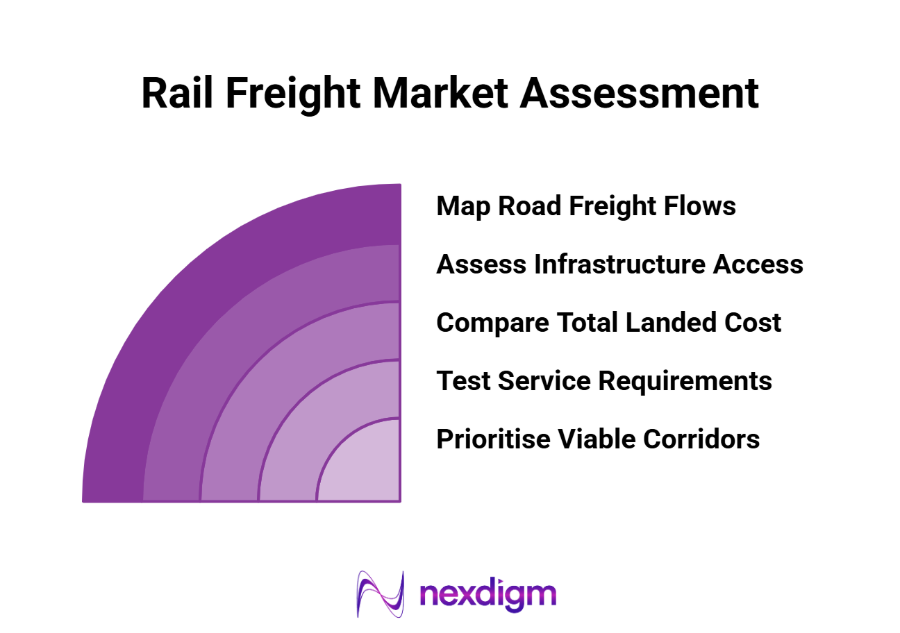
- Map road freight flows: Identify cargo volumes, origins, destinations, shipment frequency, commodity type, and current road costs.
- Screen by distance and density: Determine whether each corridor has sufficient haul length and recurring volume to absorb rail’s fixed handling and terminal costs.
- Assess infrastructure access: Evaluate terminals, sidings, loading facilities, rail connectivity, drayage requirements, and potential bottlenecks.
- Compare total landed cost: Benchmark Road and rail after incorporating line-haul rates, first- and last-mile transport, handling, inventory costs, and expected transit time.
- Test service requirements: Assess delivery frequency, reliability, shipment flexibility, and customer tolerance for longer or less flexible operating windows.
- Prioritise viable corridors: Rank opportunities according to addressable volume, achievable cost savings, infrastructure readiness, service feasibility, and investment required.
How Nexdigm Identified Practical Road-to-Rail Opportunities
A manufacturer moving 1.3 million tonnes annually across 10 interstate corridors wanted to reduce dependence on road freight. Nexdigm screened distance, shipment density, terminal access, rates, and service requirements and identified four corridors suitable for rail conversion. Shifting 720,000 tonnes reduced annual freight costs by ₹92 crore, while average transit time fell by 18% on the DFC-connected routes.
To take the next step, simply visit our Request a Consultation page and share your requirements with us.
Harsh Mittal
+91-8422857704