

Rail freight is an important transportation option for businesses moving bulk commodities, industrial materials, agricultural products and containerised cargo over long distances. Its suitability depends on more than the availability of railway infrastructure. Network connectivity, terminal access, rolling stock, freight handling capacity and service reliability all influence the effectiveness of rail transportation.
For procurement teams, selecting a rail cargo provider requires an understanding of how its network and operating capabilities align with the organisation’s shipment requirements.
Why Rail Freight Supplier Evaluation Matters
Rail freight providers operate across different network structures, geographical markets and service models. Some specialise in bulk commodities, while others focus on containerised freight, intermodal transportation or industrial supply chains.
In India, freight transportation has received significant infrastructure investment through dedicated freight corridors, terminal development and rolling stock augmentation.
The World Bank reported that India’s dedicated freight infrastructure development between 2011 and 2024 included 1,200 kilometres of new dedicated freight tracks. The programme also supported improvements in freight train capacity and operating speeds.
These developments create opportunities for businesses to reassess transportation sourcing and evaluate rail as part of their logistics strategy.
Evaluating Network Reach and Equipment Availability
Network reach is one of the most important factors in rail supplier selection.
A provider’s geographical coverage should be assessed based on origin and destination terminals, industrial connectivity, port access and first- and last-mile transportation arrangements.
Procurement teams should examine:
- Network connectivity: Availability of freight routes connecting manufacturing hubs, warehouses and consumption markets.
- Terminal infrastructure: Access to container terminals, private freight terminals and goods sheds.
- Equipment availability: Availability of covered wagons, flat wagons, tank wagons, container platforms and specialised rolling stock.
- Loading capacity: Ability to accommodate shipment volumes and peak-period requirements.
- Intermodal integration: Availability of road transportation and handling services at origin and destination.
Equipment availability deserves particular attention. A provider may offer extensive network coverage but have limited access to the wagon types required for specific cargo categories.
Comparing Service Performance and Operational Scale
Rail freight performance depends on several interconnected operational factors.
Transit time, train frequency, wagon turnaround and terminal handling influence the reliability of the overall transportation service.
A structured evaluation should examine:
- Transit performance: Compare scheduled and actual delivery timelines across routes.
- Wagon turnaround: Assess loading, unloading and equipment repositioning times.
- Capacity utilisation: Determine the provider’s ability to handle regular and seasonal shipment volumes.
- Shipment visibility: Review tracking systems, consignment updates and exception notifications.
- Operational resilience: Examine alternative routes, contingency arrangements and disruption management.
Scale should not be measured solely through total network length or fleet size. A supplier’s ability to provide consistent capacity on commercially important routes is often more relevant to procurement decisions.
Cost benchmarking should include freight charges, terminal handling, wagon detention, loading and unloading expenses, and first- and last-mile transportation.
Rail Freight Vendor Analysis Framework
A structured rail freight vendor analysis exercise can help organisations compare suppliers using consistent operational and commercial criteria.
The assessment should follow six stages:
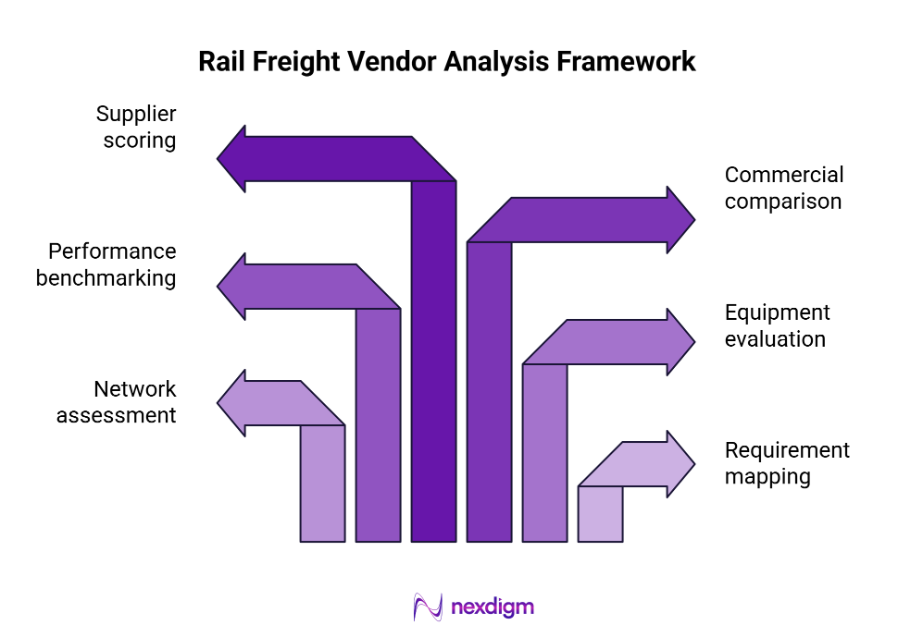
- Requirement mapping: Identify cargo categories, shipment volumes, origin-destination pairs and delivery schedules.
- Network assessment: Compare route coverage, terminal access and industrial connectivity.
- Equipment evaluation: Review wagon availability, equipment suitability and capacity commitments.
- Performance benchmarking: Assess transit times, turnaround, delivery reliability and tracking.
- Commercial comparison: Evaluate freight tariffs, handling costs and additional charges.
- Supplier scoring: Rank providers based on operational fit, capacity, service quality and total transportation cost.
Nexdigm can support organisations through rail logistics market research, supplier identification, network benchmarking and commercial assessments. These exercises help procurement teams evaluate available providers and identify opportunities to improve transportation efficiency through better supplier selection.
Nexdigm’s Case Study
Nexdigm assessed 9 rail freight providers across 5 industrial corridors, comparing wagon availability, terminal access, transit times and commercial terms. The research identified 3 preferred suppliers, highlighted a 14% variation in comparable route costs and helped the client establish route-specific capacity and service benchmarks.
To take the next step, simply visit our Request a Consultation page and share your requirements with us.
Harsh Mittal
+91-8422857704