

Rare earth demand is often described through the growth of electric vehicles and renewable energy. That is directionally correct, but it misses where the market’s value is actually concentrated.
Permanent magnets account for around 95% of rare earth consumption by value, with neodymium, praseodymium, dysprosium and terbium playing particularly important roles. These materials are used in electric motors, wind turbines, industrial equipment, robotics and a growing range of high-performance technologies.
The result is a market where demand is being created by several industries at once, but not all applications require the same rare earths or generate the same commercial opportunity.
Permanent Magnets Are Driving the Market
Electric vehicles are one of the most visible sources of demand. Permanent-magnet motors offer high power density and efficiency, making them attractive for many EV drivetrains. Wind generation provides another major application, particularly in turbine designs that use permanent-magnet generators.
Industrial equipment is less visible but potentially broader.
Motors used in factory automation, pumps, compressors and robotics increasingly require greater efficiency and power density. Aerospace and defence applications add smaller but strategically important demand.
The demand picture therefore extends across:
- Electric vehicles and hybrid vehicles
- Wind turbines
- Industrial motors and automation
- Robotics
- Aerospace and defence equipment
- Advanced electronics and other high-performance applications
The important variable is not simply how many EVs or wind turbines are produced. Motor design determines whether a particular application uses permanent magnets, how much magnet material it requires and which rare earth elements are needed.
That makes technology adoption a more useful starting point for demand analysis than a broad clean-energy forecast.
Not Every Rare Earth Benefits Equally
The term “rare earths” covers 17 elements with very different markets and prices. A deposit containing a high total rare earth oxide grade does not necessarily have an attractive commercial profile.
- Neodymium and praseodymium form the basis of many high-performance permanent magnets.
- Dysprosium and terbium are used in smaller quantities, particularly where magnets need to maintain performance at high temperatures.
- Cerium and lanthanum have larger-volume applications but generally lower economic value.
A project containing a relatively modest total REE grade may be more commercially relevant if a large share of its contained material is NdPr. Conversely, a high-grade deposit dominated by lower-value elements may struggle to generate sufficient revenue to justify complex processing.
Recycling and magnet design can further alter the balance. Changes in motor architecture, material efficiency and recovery of rare earths from end-of-life products can affect demand for individual elements even while the broader market continues to expand.
The Bigger Constraint Sits Further Downstream
Mining is only the first stage of the rare earth value chain. Ore must be concentrated, chemically upgraded and separated into individual oxides before the material can move into metal, alloy and magnet production. Separation is particularly difficult because rare earth elements have similar chemical properties.
The concentration of this processing capacity remains extreme.
China accounted for around 60% of mined magnet rare earth production in 2024, but its share rose to 91% of refined output and 94% of sintered permanent-magnet production.
That difference between mining and manufacturing is commercially important. A new mine outside China can diversify the source of raw material without necessarily providing an alternative supply of finished magnet material.
By 2035, announced mining projects outside the leading producer could provide nearly 50 kt of magnet rare earth capacity. Planned refining and separation capacity is below 40 kt, while downstream metals, alloys and magnets represent only around 18 kt of capacity on a rare-earth-content basis. Upstream development is moving faster than the facilities required to convert that material into products customers actually need.
Where the Commercial Opportunity May Move
A new mining project still needs a resource with an attractive element mix, credible recovery rates and a manageable processing route. But projects that can connect production to separation facilities, refiners or magnet manufacturers may have a stronger route to market.
Processing itself could become a more valuable point of intervention. Countries seeking supply-chain diversification need separation capacity as much as additional ore. Further downstream, metal and alloy production and permanent-magnet manufacturing provide additional opportunities to capture value and reduce dependence on a concentrated supplier base.
For companies evaluating the market, this means the relevant question is increasingly where the bottleneck sits. In some markets it may be mine supply. In others, it may be separation capacity, qualified processing facilities or access to magnet manufacturers.
That is where rare earth demand and adoption analysis becomes useful: demand forecasts need to be connected to the actual technologies consuming each element and to the capacity available at every stage between mine and end user.
A Demand Model Built Around Technology, Not Tonnes
Nexdigm can assess rare earth demand by starting with the technologies responsible for consumption and working backwards into mineral requirements.
The analysis can examine:
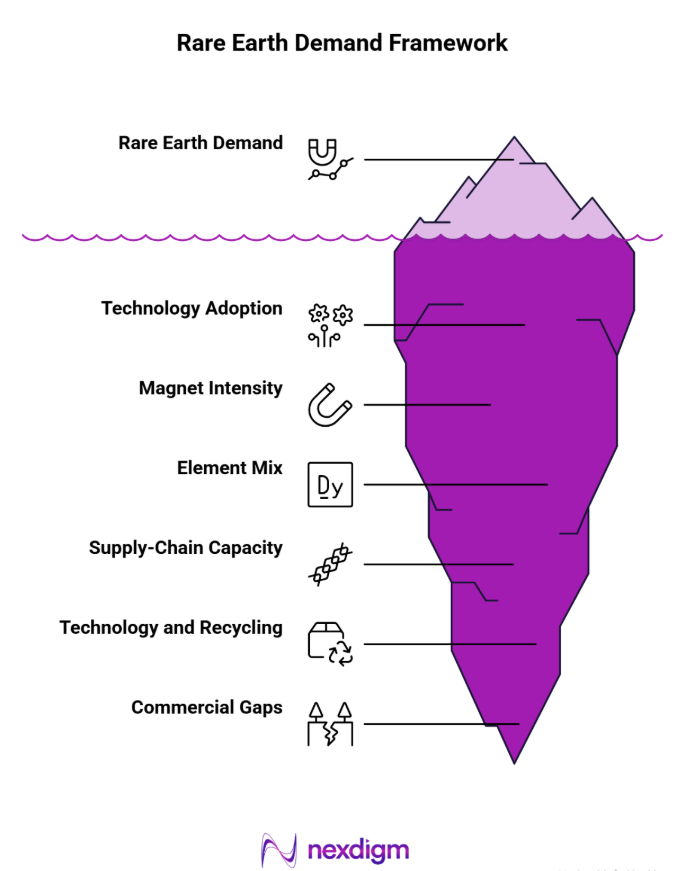
- Technology adoption: Forecast EV production, wind installations, industrial automation, robotics and other magnet-intensive applications.
- Magnet intensity: Assess how much rare earth material different motor and generator technologies require.
- Element mix: Separate the outlook for NdPr, dysprosium, terbium and other rare earths rather than treating REEs as one market.
- Supply-chain capacity: Compare mining, separation, refining, alloy and magnet capacity across regions.
- Technology and recycling effects: Test material efficiency, alternative magnet designs and secondary supply.
- Commercial gaps: Identify where demand is likely to outpace processing or manufacturing capacity.
The resulting market view is more useful than a single rare earth demand forecast. It shows which technologies are creating consumption, which elements are most exposed to that growth and where supply-chain constraints could create commercially attractive opportunities.
Nexdigm Case: Rare Earth Demand Assessment
A technology-focused investor screened seven rare earth applications across EVs, wind, industrial motors and robotics. Nexdigm modelled technology adoption, magnet intensity, element demand and processing capacity, identifying three applications expected to account for more than 70% of incremental magnet-rare-earth demand through 2035.
To take the next step, simply visit our Request a Consultation page and share your requirements with us.
Harsh Mittal
+91-8422857704