

Rare earth supply chains are becoming strategically important as electric vehicles, wind turbines, electronics, defence systems, and advanced manufacturing increase demand for high-performance materials. Building resilient supply, however, requires more than access to mineral deposits. Companies must consider extraction economics, processing capabilities, regulatory requirements, logistics, technology, and downstream market access.
India has a substantial resource base but significant midstream and downstream gaps. As of 2026, India had approximately 7.23 million tonnes of in-situ rare-earth oxide equivalent in monazite resources, plus 1.29 million tonnes in hard-rock resources. Yet industrial-scale capabilities for converting oxides into metals, alloys, and magnets remain limited. The Government has therefore approved a ₹7,280 crore scheme targeting 6,000 MTPA of integrated sintered rare-earth permanent-magnet capacity.
For mining companies, processors, manufacturers, investors, and technology providers, rare earth mineral supply chain entry consulting can help identify viable sourcing regions, evaluate processing opportunities, map downstream demand, and develop networks that balance resource access with commercial and supply-chain resilience.
Securing Supply Requires More Than Resource Availability
The presence of mineral resources alone does not guarantee a resilient rare earth supply chain. Businesses must evaluate mining economics, resource quality, regulatory frameworks, infrastructure availability, geopolitical exposure, and long-term supply security before committing capital. A sustainable entry strategy therefore depends on identifying sourcing ecosystems that can support consistent and commercially viable production.
Value Creation Depends on Processing and Ecosystem Development
Much of the value in the rare earth industry is generated beyond extraction through refining, separation, metal production, alloy manufacturing, and magnet fabrication. Companies entering the sector must therefore assess processing capabilities, technology requirements, industrial ecosystems, and downstream demand to determine where the greatest opportunities for value creation exist.
Nexdigm’s Expertise in Rare Earth Mineral Supply Chain Strategy
Building resilient rare earth supply chains requires balancing resource access, processing capabilities, infrastructure readiness, and downstream market opportunities. Nexdigm helps mining companies, processors, manufacturers, investors, and technology providers evaluate these interconnected factors through:
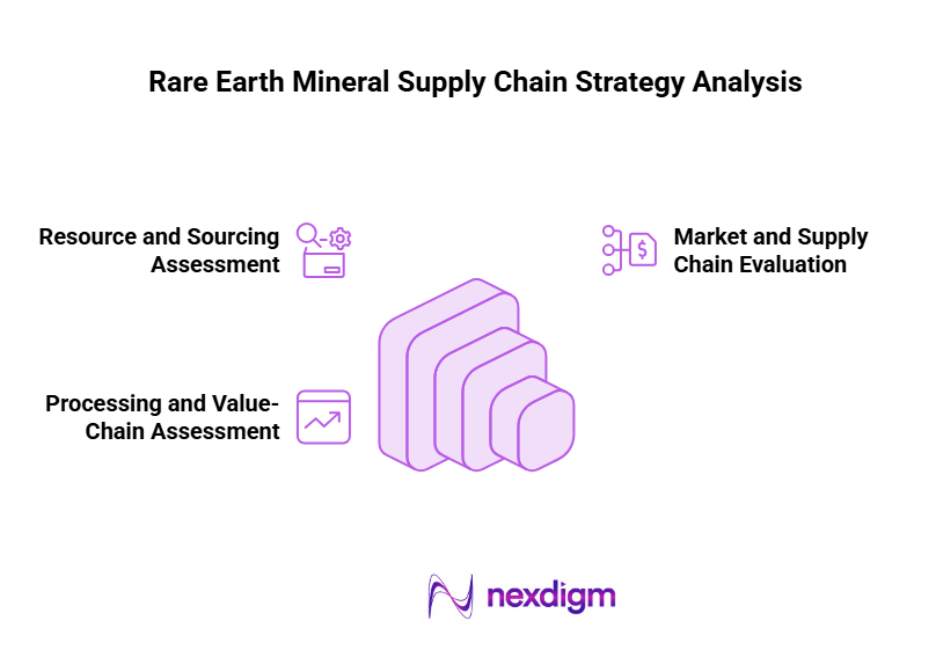
- Resource and Sourcing Assessment: Evaluation of mineral availability, supply security, extraction economics, and sourcing alternatives across potential regions.
- Processing and Value-Chain Assessment: Analysis of refining, separation, metal conversion, alloy production, and magnet-manufacturing opportunities to identify value-creation potential.
- Market and Supply Chain Evaluation: Assessment of downstream demand, industrial ecosystems, logistics networks, and commercialization pathways across target markets.
With the supply-chain expertise, Nexdigm helps businesses develop rare earth strategies that support sourcing resilience, operational scalability, and long-term growth.
Why Businesses Partner with Nexdigm for Rare Earth Mineral Supply Chain Entry Consulting
Rare earth supply chains involve complex decisions spanning resource access, processing capabilities, logistics networks, technology requirements, and downstream market opportunities. Through its rare earth mineral supply chain entry consulting capabilities, Nexdigm helps businesses with:
- End-to-End Value Chain Perspective: Assessing opportunities across mining, processing, refining, metal production, alloy manufacturing, and downstream applications to identify the most attractive entry points.
- Supply Chain Resilience Focus: Evaluating sourcing risks, processing dependencies, infrastructure constraints, and geopolitical considerations that could affect long-term supply security.
- Market and Commercial Intelligence: Analyzing demand trends, end-use industries, competitive dynamics, and growth opportunities across electric vehicles, renewable energy, electronics, and advanced manufacturing.
- Strategic Investment Support: Helping prioritize sourcing, processing, and expansion opportunities based on commercial viability, operational feasibility, and long-term value creation potential.
By combining industry intelligence and strategic assessment, Nexdigm helps companies develop rare earth supply-chain networks that balance resource access, processing capabilities, market opportunities, and long-term resilience.
How Nexdigm Helps Build Resilient Rare Earth Supply Chain Networks
Building a successful rare earth supply chain requires aligning resource access, processing capabilities, infrastructure, and downstream demand within a single operating model. With the help of its rare earth mineral supply chain entry consulting capabilities, Nexdigm helps businesses in:
- Strengthening Sourcing Resilience: Identify diversified sourcing opportunities and assess supply risks to reduce dependence on individual regions, suppliers, or processing hubs.
- Enhancing Value-Chain Integration: Evaluate opportunities across mining, refining, metal production, alloy manufacturing, and end-use applications to maximize value creation.
- Improving Commercial Viability: Assess demand dynamics, customer industries, market access pathways, and growth opportunities to support sustainable revenue generation.
- Supporting Strategic Expansion: Identify investment priorities, ecosystem partnerships, and operational capabilities that can strengthen long-term market positioning.
These benefits help businesses develop rare earth networks that are resilient, commercially viable, and positioned for long-term growth.
Nexdigm’s Case
Nexdigm supported a global pharmaceutical company that relied on an intermediary for key chemical raw materials. By analyzing spend and volumes and transitioning selected materials to direct manufacturer sourcing, Nexdigm delivered approximately 23% reduction in raw-material costs and up to 30% faster deliveries. The engagement demonstrates how supplier diversification and direct sourcing can strengthen resilience while improving supply economics.
To take the next step, simply visit our Request a Consultation page and share your requirements with us.
Harsh Mittal
+91-8422857704