
A rare earth deposit can be strategically important without being commercially viable. The distinction is particularly relevant for magnet rare earths, including neodymium, praseodymium, dysprosium and terbium, where demand is rising but the value chain remains heavily concentrated beyond the mine.
Permanent magnets account for around 95% of rare earth consumption by value, with applications spanning electric vehicles, wind turbines, industrial motors, robotics, data centres and defence equipment. In 2024, China accounted for around 60% of global mined magnet rare earth production, 91% of refined output and 94% of sintered permanent magnet production. A new project therefore has to compete with an established processing and manufacturing ecosystem, not simply with other mining operations.
The commercial question is whether a deposit can produce the right elements, recover them efficiently and connect them to a processing and customer network at a competitive delivered cost.
Grade Is Only the First Filter
Rare earth deposits are usually assessed on total rare earth oxide content, but the distribution of individual elements can have a much greater bearing on value. Magnet materials such as neodymium and praseodymium command the greatest strategic relevance for permanent-magnet production, while cerium and lanthanum can account for substantial portions of some deposits but generally have lower commercial value.
A feasibility assessment should therefore examine:
- Element distribution: Determine the proportion of Nd, Pr, Dy and Tb relative to lower-value rare earths.
- Mineralogy: Establish how the valuable elements occur and how readily they can be liberated.
- Resource confidence: Assess grade continuity, tonnage and geological confidence across the mine plan.
- Recoverability: Determine how much of the contained material can realistically reach the final saleable product.
- By-products: Evaluate whether additional minerals can generate revenue or create processing complications.
This distinction can materially change the economics of two deposits with similar headline REE grades. A project with a stronger concentration of valuable magnet elements and a simpler mineralogy can have a more attractive revenue profile than a higher-grade resource dominated by lower-value elements.
Processing Is the Commercial Bottleneck
Rare earth processing is unusually complex because chemically similar elements must be separated from one another. The value chain extends from mining and beneficiation through chemical upgrading, separation into individual oxides, metal refining, alloy production and magnet manufacturing.
That makes the processing route one of the most important determinants of project viability.
A project assessment needs to establish:
- Whether beneficiation can produce a sufficiently concentrated feed.
- Which separation technology is technically appropriate.
- Expected recovery at each processing stage.
- Reagent, water and energy requirements.
- Waste and residue-management requirements.
- Availability of specialist equipment, technical skills and operating expertise.
- Whether the project can produce specifications acceptable to downstream customers.
The challenge is illustrated by the structure of the current project pipeline. The IEA’s 2026 outlook estimates that announced rare earth mining projects outside the leading producer could provide nearly 50 kt of capacity by 2035. Planned refining and separation capacity remains below 40 kt, while downstream rare earth metals, alloys and magnets account for only around 18 kt of capacity on a rare-earth-content basis.
The implication is important for mine developers: adding mining capacity alone does not necessarily create a diversified supply chain. Processing capacity can become the constraint that determines whether additional mined material has a viable route to market.
Infrastructure and the Path to Customer
Rare earth projects face far steeper infrastructure hurdles than typical concentrate mines. Keeping operations running depends on dependable power, process water, steady reagent supply, transport links, and strict waste management.
Geography only works if the entire supply chain holds up. A solid deposit quickly loses its commercial edge if concentrate has to travel thousands of miles to reach a separation plant, or if local utilities fail to deliver reliable power and reagents.
Reaching buyers is the second bottleneck. Magnet makers and other end-users demand tight chemical purity, predictable volumes, and lengthy product qualification. As Deloitte’s 2026 mining outlook points out, securing a viable “path to customer”, through multiyear offtakes, tolling deals, and strategic partnerships, is just as vital as proving the resource itself.
For a rare earth mining feasibility research assessment, the commercial case should therefore extend beyond resource and mine planning to include processing, infrastructure and customer qualification.
The Competitive-Mine Test
Nexdigm can evaluate a rare earth project across the stages that determine whether geological potential can become commercially saleable material:
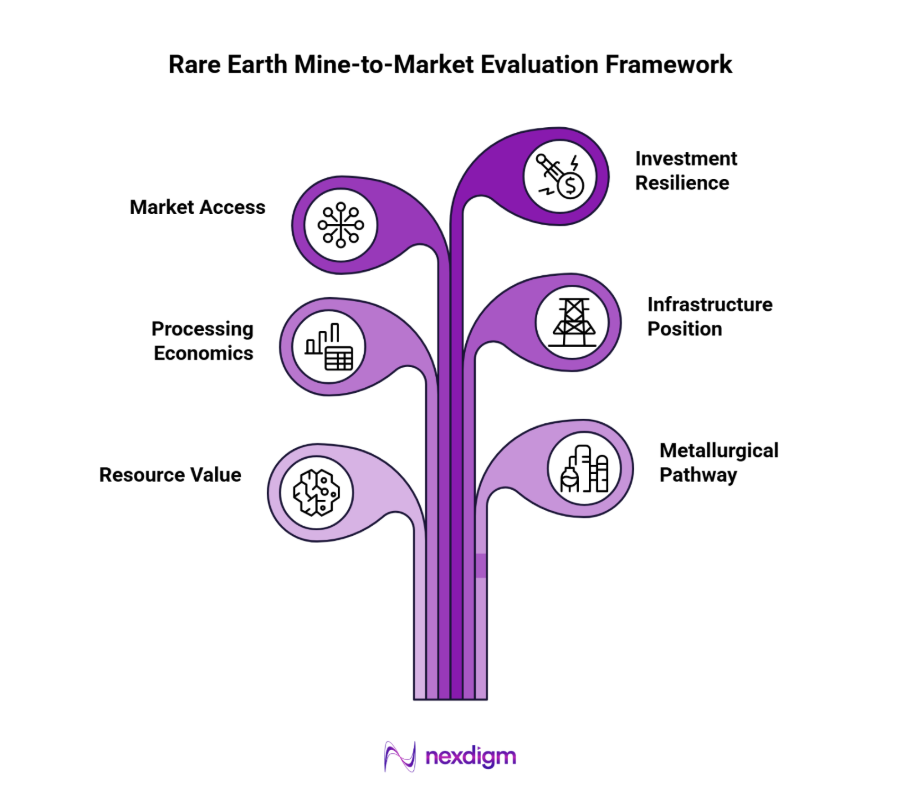
- Resource value: Quantify the contained REE basket, with particular focus on commercially valuable magnet elements and geological confidence.
- Metallurgical pathway: Test beneficiation, recovery and separation requirements and identify the principal technical risks.
- Processing economics: Estimate capital and operating requirements for chemical processing, separation and downstream conversion.
- Infrastructure position: Assess power, water, reagents, transport and waste-management requirements against available infrastructure.
- Market access: Map potential refiners, alloy producers, magnet manufacturers and industrial customers, including offtake and partnership opportunities.
- Investment resilience: Stress-test economics against recovery rates, processing costs, product prices, project delays and changes in downstream demand.
The strongest project is therefore not necessarily the deposit with the highest REE grade. It is the one that can consistently convert its most valuable elements into a specification that customers will buy, at a cost that remains competitive after processing and logistics.
Nexdigm Case: Rare Earth Project Screening
A mining investor screened nine rare earth deposits across three jurisdictions. Nexdigm assessed NdPr content, recovery pathways, processing infrastructure, logistics and customer access, narrowing the portfolio to two projects with projected post-tax IRRs above 15%.
To take the next step, simply visit our Request a Consultation page and share your requirements with us.
Harsh Mittal
+91-8422857704