

A rare earth deposit can contain valuable elements and still fail to support a commercially viable mining operation. The economic case depends on which elements occur in the deposit, how efficiently they can be separated, whether buyers need the resulting products and what it costs to deliver them. These variables matter because rare earths are traded through specialised value chains, not as a single interchangeable commodity.
For investors assessing a new deposit, the priority is to connect geological evidence with processing performance, customer specifications and the resilience of the proposed supply chain.
Rare Earth Demand Is Growing, but Value Varies by Element
Rare earth elements serve applications ranging from permanent magnets and electric motors to wind turbines, electronics and specialised industrial equipment. Their commercial importance differs considerably. Neodymium and praseodymium are important for high-performance magnets, while dysprosium and terbium can support magnet performance in demanding operating conditions. A deposit containing a high proportion of less commercially attractive elements may therefore have a different value profile from one with a smaller quantity of sought-after elements.
The International Energy Agency’s 2025 outlook estimated that demand for magnet rare earths had nearly doubled since 2015, exceeding 90,000 tonnes in 2024. Under its Stated Policies Scenario, demand was projected to surpass 120,000 tonnes by 2030. The IEA’s 2026 outlook continued to identify strong demand growth for rare earths through 2040.
These projections indicate a growing market for relevant materials, but they do not establish an automatic market for every deposit. Commercial viability depends on whether the project’s specific product mix matches buyer requirements and can compete with established supply.
Resource Grade Is Only the First Commercial Test
A headline grade expressed as total rare earth oxides can conceal substantial differences in value and processing difficulty. The assessment should examine individual element distribution, mineralogy, impurities, particle size and how consistently these characteristics appear across the deposit.
The next question is how much saleable product can be recovered. A deposit may have a promising grade but require extensive beneficiation, chemical separation or impurity removal. Lower recovery reduces saleable output, while complex processing can increase reagent consumption, energy requirements, waste-management costs and capital expenditure.
A feasibility study should therefore connect geological sampling to representative metallurgical testing. It should establish recovery rates by relevant element, expected product specifications and the sensitivity of results to changes in ore characteristics. Testing only a favourable sample can overstate performance across the full mine plan.
Processing Capacity and Supply Concentration Shape the Opportunity
Rare earth supply chains are particularly sensitive to the availability of separation and refining capacity. The IEA’s 2025 analysis estimated that the top three countries accounted for 97% of rare earth refining in 2024. Although announced projects were expected to reduce concentration, the forecast remained highly concentrated through 2030.
For a new entrant, this creates both an opportunity and a constraint. Buyers seeking supply diversification may consider additional sources, but they still need consistent product quality, dependable volumes and credible processing routes. A mine without access to suitable separation capacity may struggle to convert ore into the refined materials customers actually purchase.
Processing feasibility should examine whether the project will build its own facilities, use a third-party processor or develop a partnership. Each route changes the investment requirement, control over product quality, dependence on external capacity and exposure to processing charges.
What Buyers and Investors Should Validate Before Development
A rare earth mining feasibility study entry reports assessment should connect the deposit’s technical characteristics to a defined commercial product and buyer market. Four areas deserve close examination:
- Element-specific value: Estimate the recoverable quantities of individual elements rather than relying only on total rare earth content.
- Metallurgical performance: Verify recovery, product purity, reagent use and waste characteristics through representative test work.
- Processing access: Confirm the availability, cost and technical suitability of separation and refining facilities.
- Offtake and supply risk: Test buyer specifications, potential contract structures, price exposure and dependence on concentrated processing routes.
Environmental and regulatory requirements also affect feasibility. Depending on the deposit, radioactive minerals, tailings, water consumption and chemical handling may create additional obligations. These should be incorporated into the development plan and financial model from the outset.
When a Rare Earth Project Can Move Forward
A project becomes more credible when resource confidence, processing evidence and buyer demand support the same commercial case. The financial model should estimate saleable output, capital requirements, operating costs, transport and processing charges, and the time needed to qualify products with customers.
Scenario analysis should test lower recovery, delays in processing access, weaker prices and slower customer qualification. It should also examine whether the project remains viable if anticipated policy support or supply-diversification premiums do not materialise.
Rare Earth Commercial Feasibility Framework
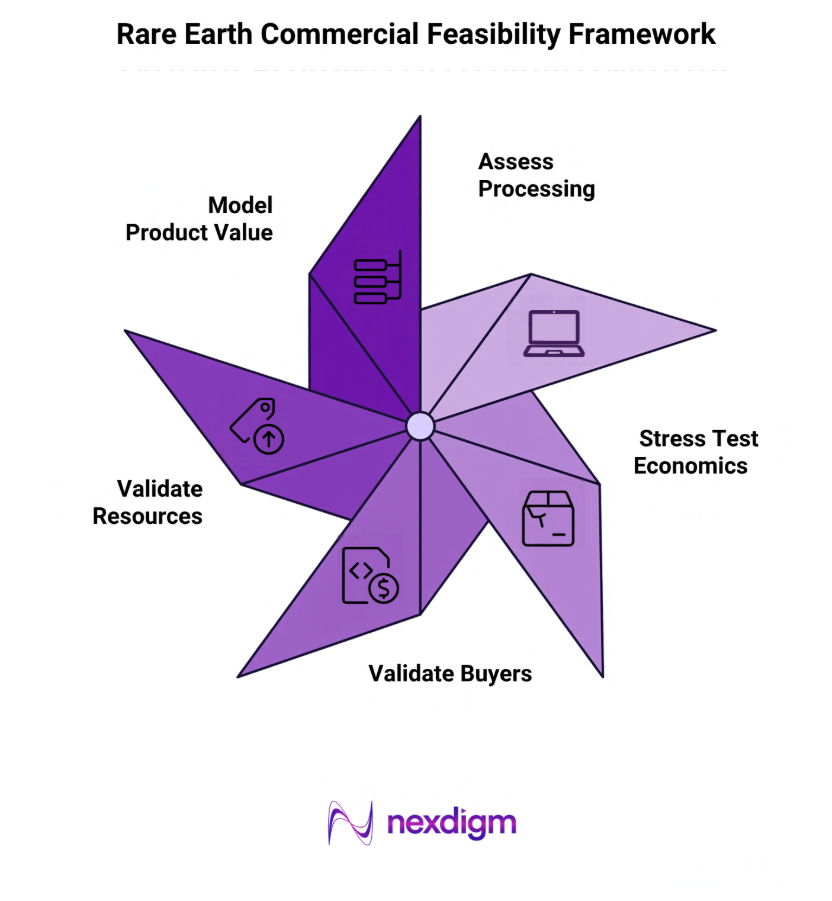
- Validate Resources: Assess resource estimates, mineralogy and element distribution to establish the reliability of the deposit and identify minerals or elements with commercial potential.
- Model Product Value: Estimate recoverable quantities for each target element, accounting for grade variability, recovery rates and market prices to determine potential revenue.
- Assess Processing: Evaluate suitable processing technologies, expected recovery performance, infrastructure requirements and waste management obligations to establish operational feasibility and environmental compliance.
- Validate Buyers: Identify qualified buyers, assess product purity and quality specifications, and confirm offtake requirements to determine whether recovered materials can meet market demand.
- Stress Test Economics: Evaluate the impact of capital expenditure, commodity price fluctuations, processing constraints and supply chain disruptions on project profitability and long term commercial viability.
Nexdigm Case Study
A critical-minerals investor assessed three rare earth deposits across resource confidence, element distribution, recovery assumptions and processing access. One deposit was deprioritised because its product mix and separation costs weakened projected returns. A second advanced to further metallurgical testing and buyer validation before any development capital was approved.
To take the next step, simply visit our Request a Consultation page and share your requirements with us.
Harsh Mittal
+91-8422857704