

Rare earth mining is becoming strategically important as demand grows across electric vehicles, wind turbines, electronics, defence, aerospace, and advanced manufacturing. For companies seeking entry, acquiring an existing asset is only one option. Buying, partnering, or developing a project independently can produce very different outcomes in terms of speed, capital exposure, resource access, processing capability, and control.
The opportunity is significant, but supply chains remain concentrated. The IEA estimates that the average share of the top three countries in mining production for key energy minerals reached 77% in 2024, up from 73% in 2020. For rare earth elements, refining is even more concentrated, creating strategic incentives to diversify sourcing and processing capacity.
India is also seeking to strengthen its position. The Government has approved a ₹7,280 crore scheme to establish 6,000 tonnes per annum of integrated sintered rare-earth permanent-magnet capacity, targeting a more complete domestic value chain.
For mining companies, strategic investors, industrial manufacturers, and resource funds, rare earth mining M&A entry consulting can help determine whether acquisition, partnership, or greenfield development provides the strongest route into this strategically important market.
Why Rare Earth Market Entry Requires Strategic Planning
Entering the rare earth mining sector involves more than securing mineral resources. Organizations must evaluate supply chain positioning, processing and refining capabilities, investment requirements, market access, and geopolitical considerations to determine the most effective route into a highly strategic and increasingly competitive industry.
Assessing Acquisition, Partnership, and Development Routes
Each entry pathway presents a different balance of speed, investment, operational control, and long-term value. A structured assessment helps stakeholders identify the approach best aligned with their strategic objectives:
- Acquisition: Provides immediate access to resources, infrastructure, permits, and market presence, enabling faster entry while reducing development timelines and execution uncertainty.
- Partnership or Greenfield Development: Offers opportunities to share risks, leverage technical expertise, or build customized operations, though timelines, capital commitments, and project complexity may be higher.
Comparing acquisition, partnership, and development options enables organizations to pursue a rare earth market entry strategy that balances growth ambitions, risk exposure, and long-term value creation.
How Nexdigm Supports Rare Earth Mining Entry Decisions
Determining whether to acquire, partner, or develop a rare earth mining asset requires a thorough understanding of market dynamics, resource potential, commercial viability, and execution risks.
Nexdigm helps mining companies, investors, and industrial stakeholders evaluate each pathway through a structured, rare earth mining M&A entry consulting approach that aligns entry strategies with long-term growth objectives and value creation priorities.
This enables organizations to make more informed investment decisions, optimize capital allocation, and pursue the market entry model best suited to their strategic, operational, and financial goals.
Nexdigm’s Approach to Evaluating Rare Earth Mining Entry Options
Nexdigm helps mining companies, investors, manufacturers, and resource-focused stakeholders assess acquisition, partnership, and greenfield development opportunities through a structured evaluation. It involves:
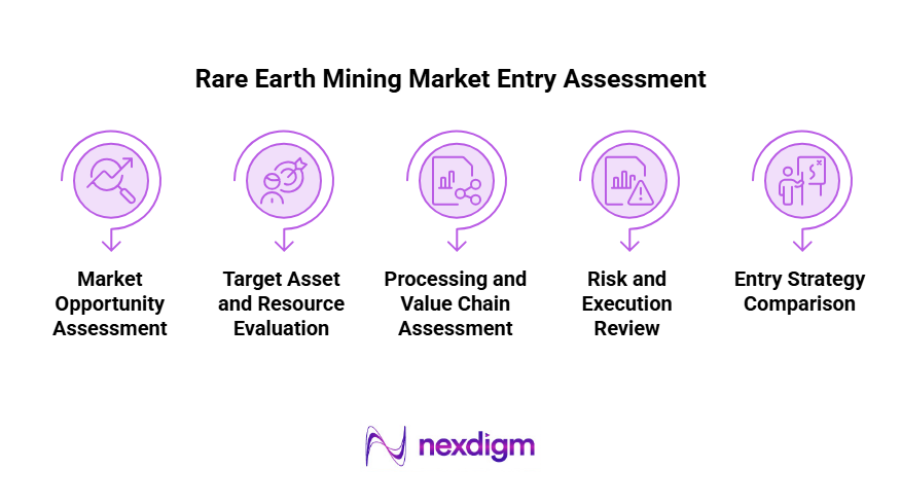
- Market Opportunity Assessment: Analysis of rare earth demand trends, end-use industries, supply chain dynamics, and regional market conditions to identify attractive investment opportunities and growth potential.
- Target Asset and Resource Evaluation: Assessment of resource quality, reserve potential, project maturity, production capabilities, and development readiness to determine the strategic value of mining assets.
- Processing and Value Chain Assessment: Review of downstream processing, refining, and integration opportunities to enhance supply security, capture additional value, and strengthen competitive positioning.
- Risk and Execution Review: Identification of operational, regulatory, geopolitical, environmental, and market risks that could impact project development, investment outcomes, and long-term performance.
- Entry Strategy Comparison: Comparison of acquisition, partnership, and greenfield development pathways against business objectives, timeline expectations, risk tolerance, and desired level of control.
By combining commercial, technical, and strategic analysis, Nexdigm helps organizations select the rare earth mining entry approach that best supports sustainable growth, supply chain resilience, and long-term value creation.
Nexdigm’s Approach Creating Long-Term Success in the Rare Earth Mining Industry
Beyond evaluating acquisition, partnership, and development opportunities, Nexdigm helps organizations establish a strong and sustainable position within the rare earth value chain. The focus is on creating long-term competitive advantage, supply chain resilience, and growth potential through:
- Value Chain Participation Strategy: Assesses opportunities across mining, processing, refining, and downstream applications to help organizations capture greater value and strengthen strategic market positioning.
- Supply Chain Resilience Planning: Identifies sourcing, logistics, and market concentration risks while developing strategies to strengthen supply continuity and reduce dependency on limited suppliers.
- Strategic Growth Pathway Development: Aligns entry decisions with future expansion objectives, enabling organizations to pursue scalable growth opportunities across the rare earth ecosystem.
By linking entry decisions with broader value chain opportunities, Nexdigm helps organizations build a sustainable presence in the rare earth sector while supporting long-term growth, resilience, and value creation.
Nexdigm’s Case
Nexdigm supported a global manufacturer facing supply-chain concentration by evaluating 14 alternative suppliers across five regions. Within four months, three new suppliers were onboarded, reducing lead-time volatility by 27% and category-level dependency risk by 40%.
To take the next step, simply visit our Request a Consultation page and share your requirements with us.
Harsh Mittal
+91-8422857704