
Rare earth mining is becoming strategically important for a reason that extends beyond the value of the ore itself. The strongest opportunities may emerge where a new project can solve a specific weakness in the global supply chain, whether that weakness is mining, separation, metal production or magnets.
The concentration is substantial. China accounted for around 60% of global mined magnet rare earth production in 2024, approximately 91% of refined output and 94% of sintered permanent-magnet production. At the same time, demand for magnet rare earths is being supported by electric vehicles, wind turbines, industrial motors, robotics and other high-performance applications. The IEA expects demand for magnet rare earths outside China to rise significantly through 2035.
The opportunity, therefore, has to be assessed against future supply requirements rather than today’s mine output alone.
Resource Size Does Not Tell the Full Story
Rare earth deposits contain different combinations of elements, and those combinations determine their commercial relevance.
Neodymium and praseodymium are central to high-performance permanent magnets. Dysprosium and terbium become particularly important where magnets need to maintain performance at high temperatures. A deposit with a smaller overall rare earth resource can therefore be strategically more valuable than a larger deposit dominated by lower-value elements.
A resource assessment needs to establish:
- contained magnet rare earths;
- recoverable grades and expected recovery rates;
- mineralogy and processing complexity;
- expected product mix; and
- potential saleable products and customers.
This converts geological potential into an estimate of actual commercial supply. It also provides the starting point for determining whether a deposit fits the parts of the rare earth value chain expected to experience the strongest future demand.
The Largest Supply Gap May Sit Beyond Mining
The global project pipeline reveals a significant imbalance. The IEA estimates that existing and announced projects outside China could provide nearly 50 kt of rare earth mining capacity by 2035. Planned refining and separation capacity remains below 40 kt, while downstream metals, alloys and magnets account for only around 18 kt of rare-earth content.
That gap matters because additional mining capacity does not automatically create diversified supply of the products manufacturers need.
Four strategic positions therefore emerge across the value chain.
- Mine development can diversify the geographic source of rare earth feedstock and reduce dependence on concentrated mining supply.
- Separation and refining can address the processing constraint between mineral concentrates and usable rare earth oxides.
- Metallisation and alloys can connect separated rare earths with the materials required by permanent-magnet producers.
- Magnet manufacturing can address one of the most concentrated downstream stages and bring production closer to customers seeking alternative sources.
The investment question is consequently broader than whether a mine can produce rare earths. It is whether the project occupies a part of the value chain where future supply is likely to remain constrained.
Future Demand Needs to Be Mapped Back to the Deposit
Rare earth demand is closely connected to technology adoption. Electric vehicle motors, wind turbines, industrial equipment and other applications using high-performance permanent magnets are expected to remain important sources of demand.
That creates different opportunity profiles for different resources.
A project with a high proportion of neodymium and praseodymium may be positioned around growing demand for permanent magnets in motors and generators. A deposit containing dysprosium or terbium may have a different strategic profile because these elements are used to improve magnet performance under demanding operating conditions.
Nexdigm can map the expected output of a resource against these future applications, identifying which elements are likely to experience the strongest demand growth and where supply diversification could command strategic importance.
This is where rare earth mining opportunity assessment becomes particularly valuable. The analysis connects resource quality, processing feasibility, future demand and supply concentration to determine where the strongest commercial position actually lies.
Nexdigm’s Rare Earth Opportunity Framework
The framework moves through six connected questions, with each stage narrowing the opportunity from geological potential to commercial viability.
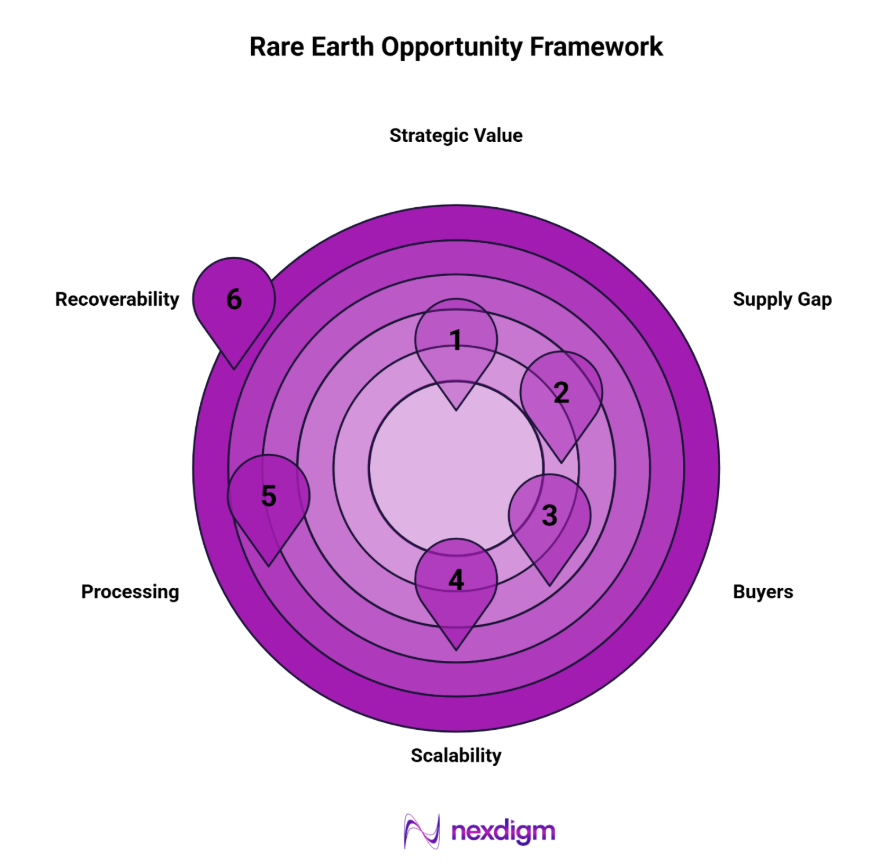
- What is economically recoverable?
Assess grade, element mix, recovery rates and product composition to determine commercially recoverable magnet rare earths. - Can it be processed competitively?
Evaluate metallurgy, separation technology, processing costs, recovery rates, reagents and waste requirements. - Can the project scale?
Assess power, water, transport, equipment, skilled labour, permitting and infrastructure against planned production. - Who will buy the output?
Map customers and offtakers across oxides, metals, alloys and magnets, including specifications and procurement requirements. - What supply gap does it address?
Compare the project with existing and planned capacity to identify genuine diversification or downstream bottlenecks. - Does strategic value strengthen the economics?
Test prices, capex, processing costs, offtake structures and supply-security premiums under different scenarios.
The outcome is a commercial map showing whether the strongest opportunity lies in mining, separation, downstream integration or a partnership across the value chain.
Nexdigm Case: Identifying the Higher-Value Position
Nexdigm screened 12 rare earth projects across four jurisdictions, representing more than 1.1 Mt of contained rare earth oxides. Four met resource and processing thresholds. For one project, integrating downstream separation increased projected project value by 21%, while a five-year offtake agreement improved the base-case IRR from 13.8% to 17.4%.
To take the next step, simply visit our Request a Consultation page and share your requirements with us.
Harsh Mittal
+91-8422857704