
Rising raw material imports can indicate expanding industrial production, limited domestic supply, or changing procurement strategies. For manufacturers and distributors, these movements can reveal where demand is building and which materials may become more difficult or expensive to source. However, an increase in imports does not automatically indicate a supply shortage or a commercially attractive market.
Businesses need to compare physical volumes, supplier origins, price movements, and domestic production before making sourcing or investment decisions.
Separate Import Growth From Price Effects
Import expenditure can increase even when the quantity of material entering a country remains unchanged. International price increases, exchange-rate movements, and changes in the mix of imported grades can all affect reported trade values.
Import analysis should compare quantities and values wherever reliable data is available. UN Comtrade provides product-level trade statistics that help researchers examine these measures across reporting periods and trading partners.
Seasonality and inventory cycles also matter. A temporary increase may reflect businesses rebuilding stocks after a disruption rather than a sustained rise in final demand. Comparing several periods with domestic production and downstream industrial activity helps establish whether the trend is structural or temporary.
Map Supplier Origins And Concentration
The countries supplying a material can reveal important differences in sourcing risk. A market may increase its total imports while becoming more dependent on a smaller number of suppliers. This can leave buyers exposed to production interruptions, export restrictions, transport disruptions, or changes in trade policy.
For raw material import volume tracking, researchers should examine supplier market shares alongside the availability of alternative origins. The distinction between shipment origin and country of production may also matter when materials pass through trading or processing hubs.
Domestic supply needs equal attention. Rising imports can reflect growing consumption, but they may also indicate reduced local output, insufficient processing capacity, or a mismatch between domestic production and the grades required by manufacturers.
Evaluate Costs Beyond The Purchase Price
International benchmark prices provide context for raw material markets, but they do not represent the full cost paid by an importer. Freight, insurance, duties, exchange rates, handling, and contractual terms can change the relative attractiveness of suppliers.
Businesses should also assess how price movements affect their operations. A material representing a small share of total spending may still be critical if production cannot continue without it. Conversely, a high-value material may carry manageable supply risk if several qualified suppliers are available.
Build A Raw Material Import Assessment Framework
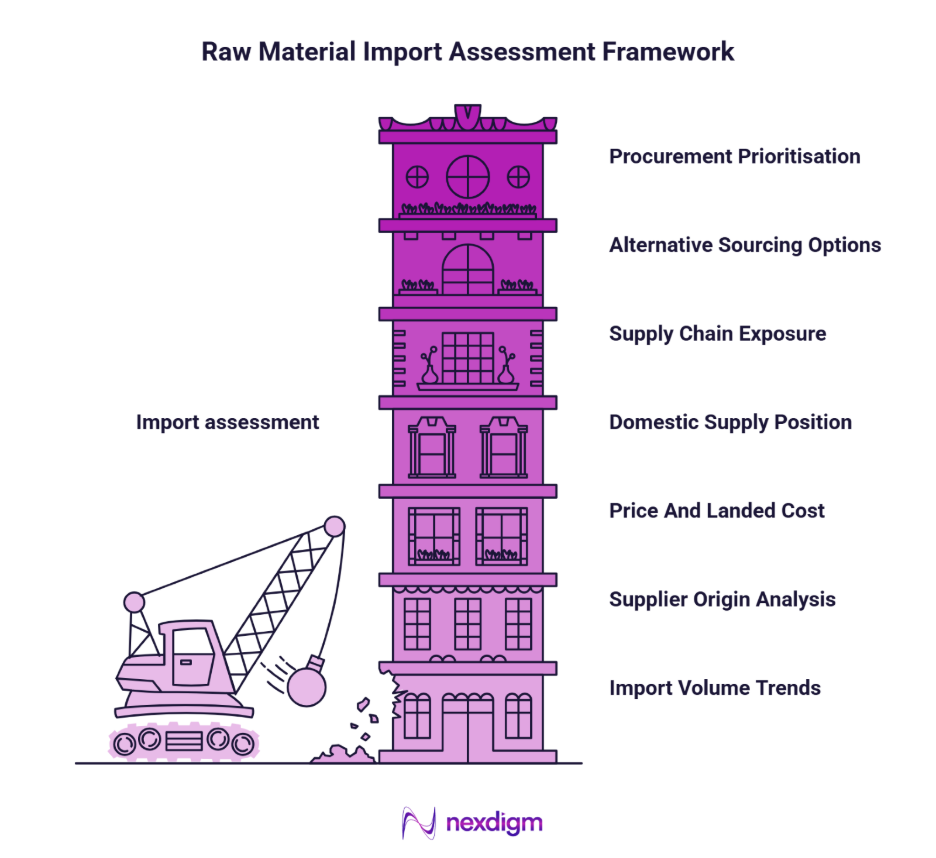
- Import Volume Trends: Compare physical quantities across several periods, account for seasonality, and investigate unusual movements to distinguish sustained demand growth from temporary stock accumulation.
- Supplier Origin Analysis: Map leading supplier countries and changes in market share to identify concentrated sourcing relationships and assess the availability of alternative origins.
- Price And Landed Cost: Combine benchmark prices with freight, duties, insurance, and exchange-rate movements to compare the actual acquisition costs of materials from different suppliers.
- Domestic Supply Position: Compare imports with local production, available capacity, and downstream consumption to determine whether import growth reflects structural demand, insufficient domestic output, or temporary disruption.
- Supply Chain Exposure: Evaluate supplier concentration, transport routes, export restrictions, political exposure, and delivery reliability to identify materials vulnerable to interruption or sudden cost increases.
- Alternative Sourcing Options: Assess substitute materials, potential suppliers, technical qualification requirements, and switching costs to determine whether diversification is commercially and operationally feasible.
- Procurement Prioritisation: Rank materials by demand growth, cost exposure, operational criticality, and alternative availability to focus research and sourcing resources on the most consequential risks.
Use Import Intelligence To Strengthen Procurement
Import data becomes more useful when combined with supplier research, domestic production figures, and end-market demand. This approach helps procurement teams anticipate shortages, compare sourcing options, and identify vulnerabilities before they affect production. It also helps market researchers distinguish genuine supply gaps from temporary changes in prices or inventory levels.
Nexdigm’s Case Study
A manufacturer imports 12,000 tonnes of an industrial raw material annually, with 70% sourced from two countries. Following a 15% increase in benchmark prices, its estimated annual procurement bill rises from ₹24 crore to ₹27.6 crore, assuming unchanged volumes and full pass-through of the price increase. The company evaluates three alternative suppliers and identifies a sourcing mix that could reduce concentration while maintaining its quality requirements and delivery schedules.
To take the next step, simply visit our Request a Consultation page and share your requirements with us.
Harsh Mittal
+91-8422857704