

Raw material demand is often described through commodity volumes and price movements. That is useful for understanding the market, but insufficient for understanding where future demand will actually come from. The more commercially relevant question is what industries are consuming the material, which applications are expanding, and whether those applications can support sustained incremental demand.
The Same Material Can Have Several Demand Stories
A commodity rarely has a single demand driver.
Copper, for example, serves construction, manufacturing, transport, power infrastructure and emerging energy technologies. Aluminum has major exposure to transport, packaging and construction while also benefiting from electrification and renewable-energy infrastructure.
The demand outlook can therefore change even when total industrial activity is relatively stable.
The World Bank’s April 2026 Commodity Markets Outlook expects aluminum demand to grow steadily as solar installations, wind turbines, power transmission infrastructure and energy storage expand, while transport and packaging together account for about one-third of global aluminum consumption. At the same time, weak construction activity is expected to constrain part of the market.
A raw-material assessment therefore needs to separate end uses rather than treating aggregate consumption as a single growth curve.
Energy Transition Is Reshaping Material Demand
Some of the strongest changes are occurring where material demand is connected to electrification.
The IEA’s 2026 Global Critical Minerals Outlook reports that global battery demand grew by more than 35% in 2025, surpassing 1.5 TWh. Demand for key energy minerals has been growing at close to 10% annually in recent years, compared with roughly 1% annual growth for base metals. The energy sector accounted for around 75% of demand growth in key energy minerals in 2025.
This creates very different trajectories within the raw-material universe.
Lithium demand has grown particularly rapidly, while copper faces a different structural equation because of its role in electricity networks, industrial equipment and electrification.
The IEA expects critical-mineral demand to almost double by 2040 under its Stated Policies Scenario, with lithium demand more than tripling and copper adding approximately 7 million tonnes of demand by 2040.
For producers and investors, the important task is identifying which end-use markets are responsible for that growth and how durable those applications are.
Supply Conditions Can Change the Commercial Opportunity
Demand growth does not automatically translate into an attractive raw-material opportunity.
A market can experience rising consumption while becoming less commercially attractive because of new capacity, substitution, recycling, price pressure or supply concentration.
Copper illustrates the issue. The IEA’s 2026 outlook estimates that the projected copper supply deficit in 2035 has narrowed from around 30% in the previous outlook to 25% as new projects advance, but a gap remains.
At the same time, geopolitical concentration can influence market accessibility. The IEA reports that, excluding rare earths, the average share of the top refining country rose to 72% in 2025 from 70% in 2023.
A demand assessment therefore needs to consider both consumption and the ability of suppliers to serve that consumption.
End-Use Mapping Makes the Forecast Actionable
A useful raw-material forecast can move from the commodity level down to the application level:
Raw material → end-use industry → application → production volume → material intensity → regional demand → future capacity.
This allows analysts to identify whether demand is being driven by infrastructure, automotive production, packaging, electronics, construction, energy systems or another application.
It also makes substitution visible.
If an application becomes more material-efficient, demand may grow more slowly than production volumes. If a new technology increases material intensity, the opposite can occur.
Nexdigm can support raw materials demand assessment consulting through end-use mapping, demand forecasting, supply analysis, capacity assessment, trade-flow analysis and scenario modelling.
Nexdigm’s Raw Material Demand Assessment Lens
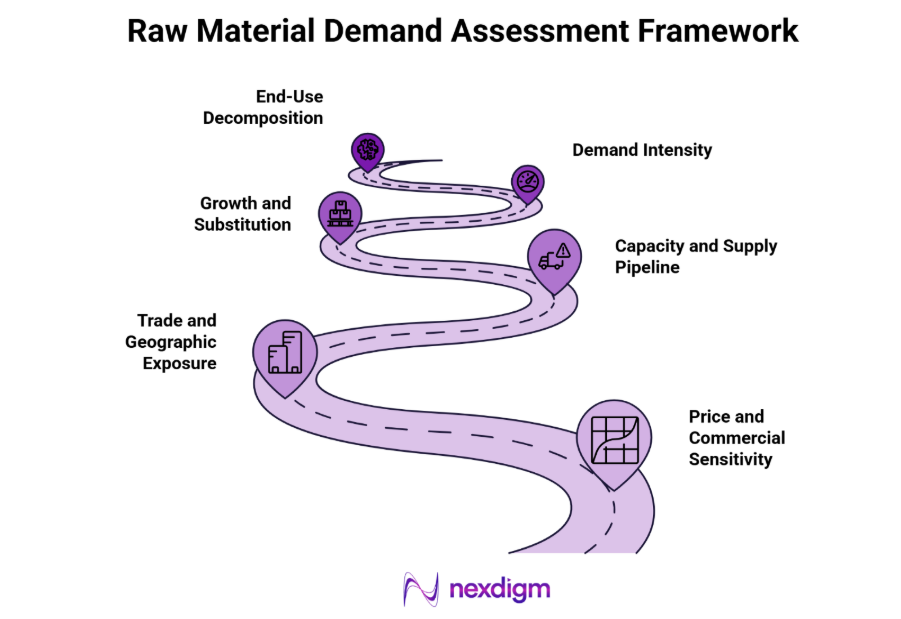
- End-Use Decomposition
Map consumption across industries and applications to identify the sources of current and future demand. - Demand Intensity
Assess material consumption per unit of production, technology or application. - Growth and Substitution
Evaluate production growth alongside material efficiency, alternative materials and technology shifts. - Capacity and Supply Pipeline
Track mines, processing capacity, expansions, closures and new projects against projected consumption. - Trade and Geographic Exposure
Analyse import dependence, export flows, supplier concentration and regional consumption. - Price and Commercial Sensitivity
Test how changes in prices, energy costs, regulation and supply constraints affect demand and investment attractiveness.
This approach separates temporary commodity movements from structural end-use demand.
Raw Material Demand Signals Worth Tracking
Nexdigm supported a raw-material producer evaluating new growth opportunities across energy and industrial applications. The assessment mapped 1.5 TWh of 2025 battery demand, end-use consumption, regional growth and supply constraints, helping the client prioritize high-growth applications for capacity expansion.
Nexdigm’s analysis enabled the client to distinguish structural demand growth from broader commodity growth and prioritize applications with stronger long-term volume potential.
To take the next step, simply visit our Request a Consultation page and share your requirements with us.
Harsh Mittal
+91-8422857704