

Rising demand alone does not justify new raw material capacity or market entry. Strong growth figures, including battery demand expanding over 35% past 1.5 TWh in 2025 and mineral consumption rising roughly 10% annually, signal clear opportunity.
However, commercial viability depends on whether the market can absorb added volume without oversupply, whether producers can operate competitively on the cost curve, and whether buyers will absorb output at sustainable prices. Because energy technologies drove roughly 75% of mineral growth in 2025, each material requires a distinct capacity strategy rather than a generic expansion plan.
Demand Growth Has to Survive the Supply Response
The first question for a new producer is not simply how fast consumption is growing. It is how much additional supply is already coming into the market.
The IEA’s 2026 outlook projects lithium demand to more than triple by 2040 under its Stated Policies Scenario, while demand for nickel, graphite and rare earths is projected to grow by 50% to 90%.
Yet supply pipelines can change the commercial picture considerably. A material may have strong long-term demand while facing a period of oversupply caused by aggressive capacity additions, inventory accumulation, or new low-cost production.
The timing between investment and demand realization therefore becomes critical. A plant commissioned several years after an investment decision must compete against capacity that may not exist when the project was first approved.
The Cost Curve Determines Who Captures the Growth
Two producers can serve the same market and experience very different economics.
Feedstock costs, electricity, water, labour, processing yields, logistics, royalties, taxes, and financing all influence the delivered cost of material.
This is particularly important in commodities where products are relatively standardized. When prices fall, high-cost producers feel the pressure first.
Current metal markets demonstrate the volatility involved. The World Bank’s April 2026 Commodity Markets Outlook projects its metals and minerals price index to rise 17% in 2026, supported by strong demand and supply tightness. It also expects the index to decline 7% in 2027 as supply pressures ease.
The World Bank also expects iron ore prices to fall toward a seven-year low as weak Chinese property activity, subdued construction in advanced economies, and ample supply weigh on the market.
A feasibility study therefore needs to test whether the proposed asset remains viable under weaker pricing rather than relying on the strongest point in the commodity cycle.
End-Use Demand Matters More Than Aggregate Consumption
A raw material can have multiple end uses, and those applications may grow at very different rates.
Copper demand, for example, is supported by electricity networks, renewable generation, data centres, construction, transportation, and industrial equipment. Lithium is much more closely connected to battery demand.
The IEA’s 2026 outlook highlights the importance of energy technologies, with EVs, battery storage, renewable generation and electricity networks continuing to drive mineral demand.
For a new producer, this means demand should be modelled by application, geography, specification, and material grade.
A producer targeting a specialised grade may face a smaller addressable market but encounter stronger customer relationships and qualification barriers. A commodity-grade producer may have a much larger market but compete primarily on cost.
Offtake Can Change the Risk Profile
Capacity expansion becomes easier to underwrite when a meaningful share of output can be linked to identifiable customers.
Long-term offtake agreements can improve revenue visibility, support project financing, and reduce exposure to spot-market volatility. Customer qualification can also create barriers to entry in specialised materials where changing suppliers requires testing, certification, or process modifications.
This makes customer mapping a central part of raw materials market feasibility consulting.
The analysis should identify major buyers, purchasing volumes, geographic concentration, quality specifications, contract duration, switching costs, and the percentage of proposed production that could realistically be contracted.
Recycling and Substitution Can Alter the Demand Curve
Long-term demand forecasts also need to account for material efficiency, recycling, and substitution.
The IEA notes that recycling can reduce the need for new primary supply, while technological changes can alter the intensity with which minerals are used.
A project with strong demand growth but high substitution risk may require a different capacity or product strategy from one serving applications where material requirements are difficult to replace.
Nexdigm’s Raw Material Market Entry Feasibility Framework
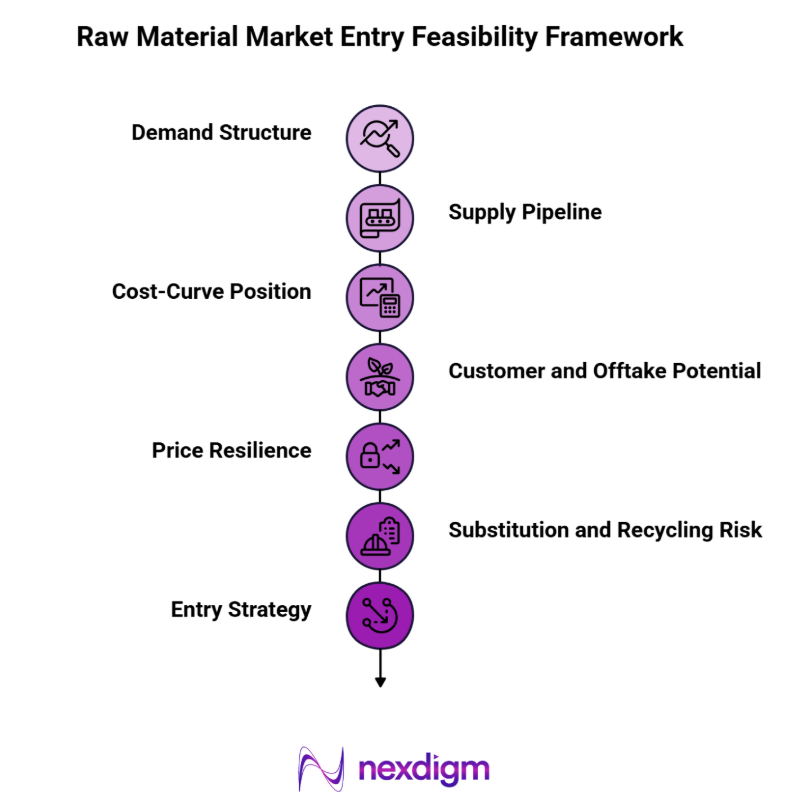
- Demand Structure
Map consumption by end-use industry, application, geography, grade, and expected growth period. - Supply Pipeline
Assess operating capacity, utilization, announced projects, commissioning schedules, inventories, imports, exports, and potential capacity additions. - Cost-Curve Position
Benchmark feedstock, energy, labour, processing, logistics, royalties, and other costs against competing producers. - Customer and Offtake Potential
Identify major buyers, qualification requirements, purchasing volumes, contract structures, and achievable contracted production. - Price Resilience
Stress-test margins against commodity-price declines, input-cost increases, lower utilization, and project delays. - Substitution and Recycling Risk
Evaluate material efficiency, recycling penetration, alternative inputs, technology changes, and downstream substitution. - Entry Strategy
Determine whether the opportunity supports greenfield capacity, acquisition, joint venture, processing, tolling, or phased market entry.
Case Study: Raw Materials Market Feasibility Consulting
Global battery demand exceeded 1.5 TWh in 2025, up over 35%, while energy technologies drove 75% of key energy-mineral demand growth. A new producer could therefore prioritize battery-linked grades, but capacity timing and customer offtake remain critical.
To take the next step, simply visit our Request a Consultation page and share your requirements with us.
Harsh Mittal
+91-8422857704