

A refinery produces a portfolio of fuels and feedstocks, each exposed to different market forces. Gasoline demand depends on vehicle use, fuel efficiency and electrification. Diesel follows freight, industrial activity and agriculture. Jet fuel responds to passenger traffic and airline capacity. LPG serves household, commercial and industrial applications, while naphtha demand depends heavily on petrochemical production.
Forecasting total oil demand without separating these products can lead to incorrect investment decisions. A country may consume more petroleum overall while demand for a particular refinery output stagnates. A market with moderate aggregate growth may still offer an attractive opportunity in jet fuel, LPG or a specific petrochemical feedstock.
The International Energy Agency’s Global Energy Review 2026 reported that global oil demand increased by approximately 0.65 million barrels per day (mb/d) in 2025, equivalent to 0.7% growth. The relatively subdued increase reflected weaker petrochemical feedstock growth and continued pressure on conventional road-fuel demand from electrification and alternative fuels.
The composition of growth matters more than the headline figure. A forecast that assumes every product will expand at the same rate risks overstating some markets and overlooking others.
Turn Economic Activity Into Product Volumes
A useful forecast starts with the activity generating consumption and converts it into demand for individual products. Each product needs its own drivers, assumptions and forecast horizon.
- Gasoline: Vehicle-kilometres, vehicle ownership, fuel economy, electric vehicle adoption and biofuel blending.
- Diesel: Freight movement, industrial output, agricultural activity, commercial transport and fuel substitution.
- Jet fuel: Passenger traffic, air cargo, flight frequency, aircraft efficiency and international connectivity.
- LPG: Household connections, clean-cooking adoption, commercial consumption, industrial demand and petrochemical use.
- Naphtha and other feedstocks: Petrochemical capacity, plant utilisation, polymer production, feedstock economics and product mix.
The model must distinguish physical activity from the fuel required to support it. More passenger travel does not automatically produce proportional fuel growth if aircraft become more efficient. Rising road freight can increase diesel consumption, but efficiency gains, alternative fuels and changes in transport modes may moderate the effect.
Regional assumptions matter as well. The IEA reported that India’s oil demand in 2024 was 11.6% above its 2019 level, while gasoline consumption had risen by 41.7% over the same period. Such differences illustrate why historical growth rates should not simply be extrapolated across products or markets.
Petrochemicals and Aviation Are Changing the Product Mix
The relationship between oil consumption and economic growth is becoming less uniform across end uses. In transport, electrification, efficiency gains and alternative fuels are changing the relationship between activity and petroleum consumption. Petrochemical feedstocks face different influences, including new processing capacity, trade flows, polymer demand and competition between production regions.
The IEA’s Oil 2025 outlook projected that polymers and synthetic fibres would require 18.4 mb/d of oil by 2030, representing more than one-sixth of global oil demand. It also projected that petrochemicals would become the leading source of global oil-demand growth from 2026 onwards. These are medium-term projections, not confirmed outcomes, but they highlight the growing importance of feedstock demand in refinery planning.
A refinery forecast should test several distinct possibilities:
- Transport-led growth: Freight, aviation or vehicle activity supports higher demand for selected fuels.
- Feedstock-led growth: Petrochemical expansion increases demand for naphtha, LPG or other inputs.
- Substitution-led slowdown: Electric vehicles, biofuels and efficiency improvements weaken conventional road-fuel demand.
- Product-mix divergence: Some products expand while others stagnate, changing the balance between domestic output, imports and exports.
The implications extend beyond sales volumes. A refinery configured around one product mix may struggle if local demand shifts towards products it cannot produce efficiently or in sufficient quantities.
The Refinery Has to Fit the Forecast
Demand projections become useful when reconciled with refinery yields, domestic production, imports, exports and inventory movements. The objective is to establish which products will be undersupplied, which may face excess capacity and whether the refinery can respond through operating changes, configuration upgrades, imports or additional investment.
A forecast should test the assumptions most likely to change the outcome. Slower aviation growth, faster electric vehicle adoption, a new petrochemical complex or revised fuel specifications can materially alter the product balance. Scenario analysis helps establish whether an investment remains attractive under those conditions.
For refinery product demand forecasting consulting, Nexdigm can combine sector-level activity forecasts with product balances, refinery configuration and trade analysis to support decisions on capacity utilisation, product yields, import contracts and capital allocation.
Refinery Product Demand Forecasting Framework
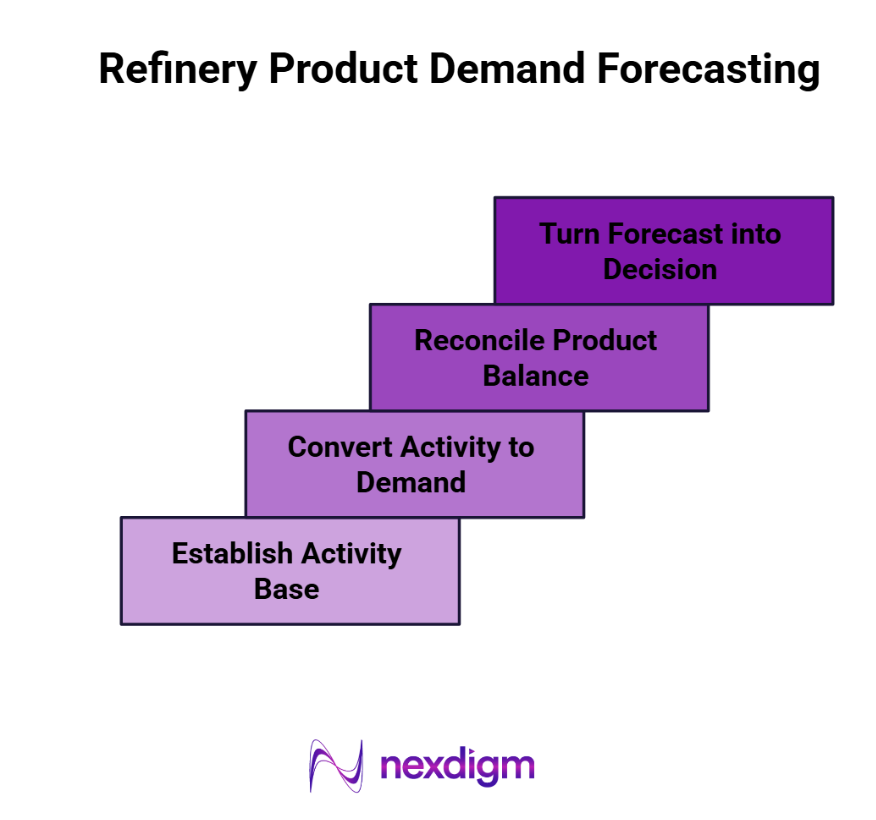
- Establish the Activity Base
Forecast the physical drivers behind gasoline, diesel, jet fuel, LPG and petrochemical feedstock consumption, using product-specific assumptions rather than a single macroeconomic growth rate. - Convert Activity Into Product Demand
Translate vehicle use, freight, passenger traffic, industrial production and household consumption into fuel volumes, accounting for efficiency, substitution and changes in consumption intensity. - Reconcile the Product Balance
Compare forecast demand with domestic refinery output, imports, exports, inventories and competing supply to identify persistent deficits and potential surpluses. - Turn the Forecast Into a Refinery Decision
Test alternative product yields, utilisation levels, configuration changes and supply contracts against base, downside and upside scenarios. Prioritise investments that remain commercially viable across plausible demand outcomes.
Nexdigm Case Study
Nexdigm assessed a proposed refinery optimisation programme with 180,000 barrels per day of crude-processing capacity, developing a five-year demand forecast across four products. The base case projected jet fuel demand growth of 4.8% annually, LPG growth of 3.6%, gasoline growth of 1.9% and diesel growth of 0.8%. Scenario modelling identified a potential 12% shortfall against planned jet-fuel output by year four, alongside a diesel surplus risk. The analysis supported revised yield assumptions and evaluation of an LPG import contract under slower aviation-growth and faster electric-vehicle adoption scenarios.
To take the next step, simply visit our Request a Consultation page and share your requirements with us.
Harsh Mittal
+91-8422857704