

Refrigerated trucks are an essential component of temperature-controlled supply chains, enabling businesses to transport food, pharmaceuticals, dairy products, meat and other perishable goods across domestic and international markets. Their performance directly affects product quality, delivery reliability and operational costs.
Selecting a refrigerated truck supplier requires an assessment of vehicle specifications, refrigeration technology, payload capacity, maintenance support and lifecycle expenses. Procurement teams must also consider whether the supplier can support fleet expansion and provide reliable after-sales services across operating locations.
Why Refrigerated Truck Supplier Selection Matters
A refrigerated vehicle must maintain the required internal environment despite changes in external temperature, cargo volume, door openings and transportation conditions.
The vehicle body, insulation, refrigeration unit and temperature monitoring equipment work together to maintain the required conditions. A weakness in any of these components can compromise cold chain integrity.
In India, FSSAI requirements establish expectations for hygienic food transportation and temperature control. The UNECE ATP Agreement also provides internationally recognised technical requirements concerning insulation, refrigeration capacity and temperature-controlled transport equipment.
These requirements make equipment performance and supplier documentation important considerations during procurement.
A refrigerated truck supplier should be assessed across five areas:
- Vehicle range: Availability of light, medium and heavy refrigerated commercial vehicles.
- Refrigeration performance: Cooling capacity, temperature range and multi-temperature capabilities.
- Payload capacity: Usable cargo volume, gross vehicle weight and load configuration.
- Maintenance support: Workshop coverage, spare parts and refrigeration equipment servicing.
- Commercial value: Acquisition price, fuel consumption, maintenance expenses and warranty terms.
Comparing Vehicle Specifications and Refrigeration Technology
Refrigerated trucks are available in different configurations depending on cargo requirements and operating conditions.
Light refrigerated vehicles are commonly used for urban deliveries and last-mile distribution. Medium-duty vehicles support regional distribution, while heavy-duty refrigerated trucks are more suitable for larger shipment volumes and longer transportation routes.
Procurement teams should compare suppliers based on:
- Temperature range: Ability to maintain chilled, frozen or multiple temperature zones.
- Insulation quality: Thermal performance of vehicle bodies, doors and sealing systems.
- Refrigeration equipment: Cooling capacity, operating efficiency and equipment reliability.
- Payload and volume: Usable cargo space after accounting for refrigeration equipment.
- Monitoring systems: Availability of temperature sensors, digital records and remote alerts.
- Vehicle configuration: Compatibility with loading docks, delivery routes and cargo handling requirements.
Suppliers should also provide documentation covering refrigeration equipment specifications, installation quality, maintenance schedules and applicable certifications.
Evaluating Maintenance Support and Total Cost of Ownership
After-sales support is particularly important for refrigerated fleets because a refrigeration unit failure can result in both vehicle downtime and cargo losses.
Procurement teams should examine the supplier’s service network, technician availability, spare parts inventory and emergency repair arrangements.
Important indicators include:
- Preventive maintenance intervals.
- Average repair turnaround time.
- Refrigeration unit breakdown frequency.
- Spare parts availability.
- Warranty coverage.
- Emergency service response time.
Total cost of ownership should include the vehicle purchase price, refrigeration unit expenses, fuel consumption, scheduled maintenance, replacement parts, insurance and downtime-related losses.
Businesses should also evaluate whether suppliers offer fleet financing, leasing, extended warranties and maintenance contracts.
Refrigerated Truck Supplier Evaluation Framework
A structured refrigerated truck supplier analysis should compare vehicle manufacturers and specialised body builders against consistent technical and commercial requirements.
The evaluation should include:
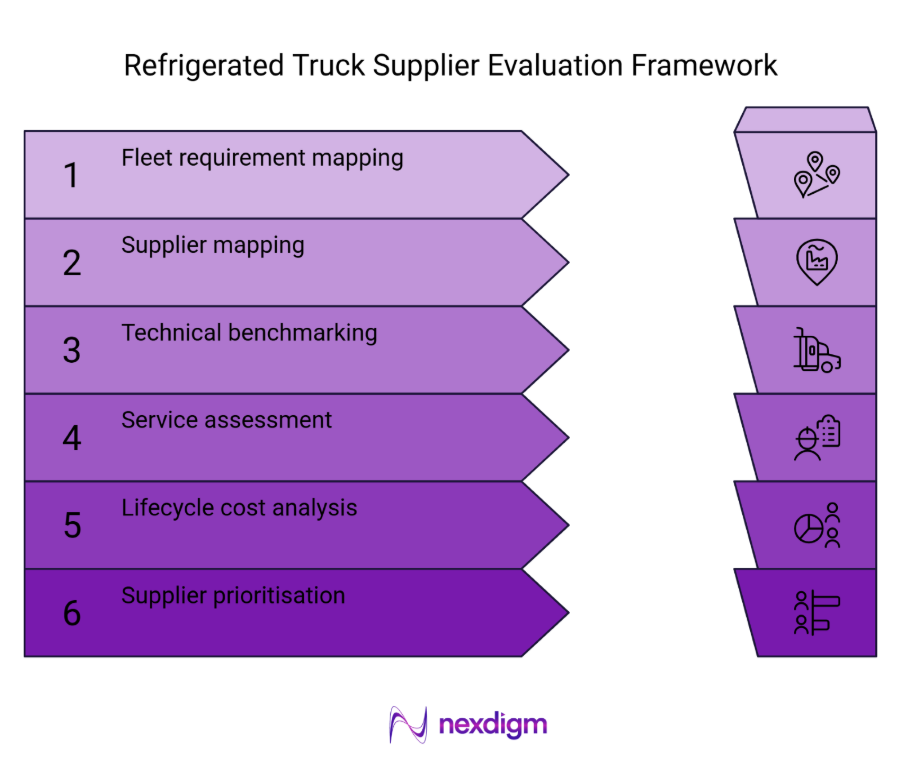
- Fleet requirement mapping: Identify vehicle categories, payload requirements, temperature ranges and operating routes.
- Supplier mapping: Identify manufacturers, authorised dealers and refrigerated body builders.
- Technical benchmarking: Compare insulation, refrigeration capacity, vehicle specifications and monitoring systems.
- Service assessment: Evaluate workshop coverage, spare parts availability and maintenance response.
- Lifecycle cost analysis: Compare acquisition, fuel, servicing, warranty and downtime expenses.
- Supplier prioritisation: Rank suppliers based on technical suitability, delivery capacity and long-term service support.
Nexdigm can support organisations through refrigerated vehicle market research, manufacturer benchmarking, supplier due diligence and commercial analysis. These services help procurement teams understand differences in vehicle capabilities and assess supplier suitability for specific cold chain fleet requirements.
Nexdigm’s Case Study
Nexdigm compared 9 refrigerated truck suppliers across 3 vehicle categories, assessing cooling capacity, payload, maintenance networks and acquisition costs. The research shortlisted 3 suppliers, identified a 12% variation in lifecycle costs and established technical and after-sales benchmarks for fleet procurement.
To take the next step, simply visit our Request a Consultation page and share your requirements with us.
Harsh Mittal
+91-8422857704