

The shift towards regenerative agriculture is creating new procurement considerations for agribusinesses, particularly around bio-inputs, soil amendments, and resource-efficient farming solutions. India’s National Mission on Natural Farming recorded 20.93 lakh farmers across 10.32 lakh hectares during FY 2025–26, reflecting the expanding adoption of natural farming practices.
The government has also established 7,601 Bio-Input Resource Centres to support local production and access to natural farming inputs. These developments indicate growing opportunities for suppliers offering biological and soil-enhancing products. However, identifying suitable vendors requires more than tracking product availability.
Businesses need to assess product relevance, supplier capabilities, regional distribution, and commercial feasibility. Regenerative farming input sourcing research helps organizations evaluate this evolving supplier landscape and identify options aligned with their agricultural and procurement priorities.
Why Regenerative Input Selection Requires a Market-led Assessment
Regenerative farming inputs vary in composition, application, performance, and suitability across crops and soil conditions. Biofertilizers, microbial formulations, compost-based products, and soil amendments may serve different agricultural requirements. Businesses must therefore examine product specifications, quality documentation, availability, and supplier capabilities before considering procurement. A structured assessment helps distinguish commercially viable options from products with limited evidence or inconsistent supply.
Factors That Shape Regenerative Input Sourcing
Selecting suitable inputs requires businesses to evaluate more than sustainability claims. Three considerations can guide the initial supplier assessment:
- Product and Application Suitability: Examine product composition, intended crop applications, soil compatibility, technical specifications, and available performance information before considering supplier options.
- Availability and Distribution Reach: Assess production capacity, regional presence, seasonal availability, logistics networks, and the supplier’s ability to maintain consistent input deliveries.
- Commercial and Strategic Fit: Compare pricing, scalability, quality systems, documentation, and alignment with the organization’s longer-term regenerative agriculture procurement priorities.
Together, these considerations help procurement teams identify relevant input categories and establish clearer criteria for evaluating potential suppliers.
Nexdigm’s Research Lens on the Regenerative Agriculture Input Market
Our research expertise combines agricultural market intelligence with supplier research to help businesses understand the changing landscape of regenerative farming inputs. Our research examines manufacturers, specialized bio-input providers, soil amendment producers, and distribution networks across relevant markets. By studying product portfolios, supplier positioning, market presence, and commercial dynamics, we help organizations develop a broader view of available sourcing alternatives and identify suppliers that merit closer evaluation.
How Nexdigm Structures Regenerative Farming Input Sourcing Research
Our regenerative farming input sourcing research follows a structured process that connects market discovery with supplier-level evaluation:
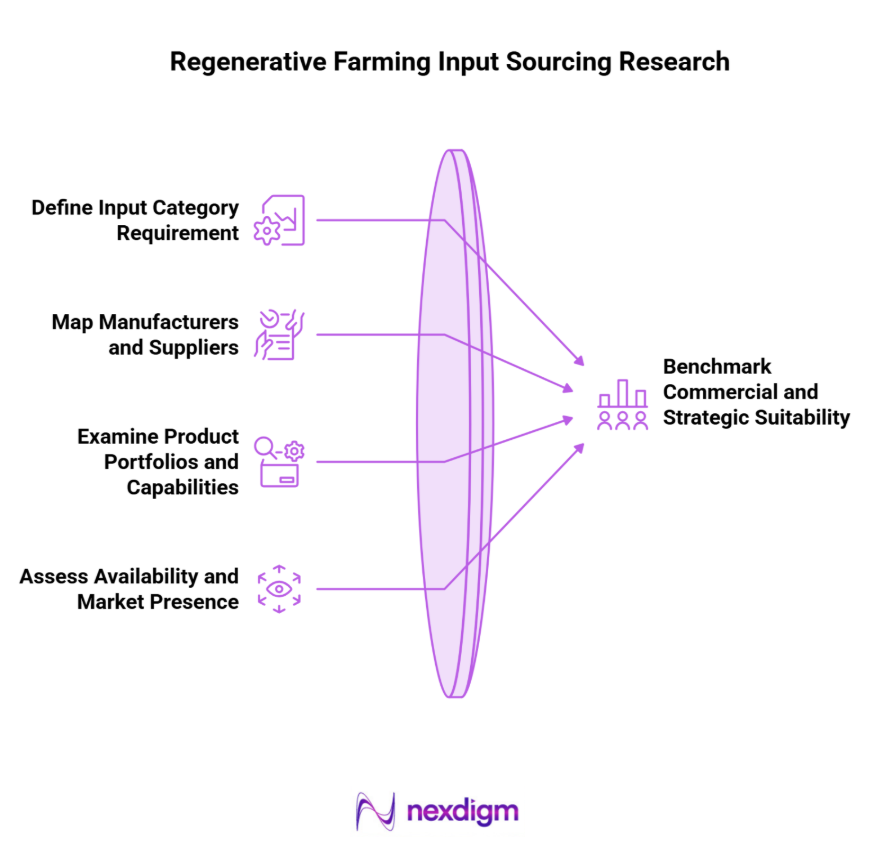
- Defining Input Categories and Procurement Requirements: Identify relevant bio-inputs, microbial products, organic fertilizers, compost-based solutions, and soil amendments based on crop applications and business requirements.
- Mapping Manufacturers and Suppliers: Research domestic and international manufacturers, distributors, specialized vendors, and emerging market participants across selected product categories and sourcing regions.
- Examining Product Portfolios and Capabilities: Review product specifications, composition, application areas, certifications where available, production capabilities, and supporting technical information.
- Assessing Availability and Market Presence: Evaluate supplier locations, distribution coverage, production capacity, supply consistency, and access to target agricultural markets.
- Benchmarking Commercial and Strategic Suitability: Compare supplier offerings across pricing, product relevance, operational capabilities, and scalability to develop a shortlist for further assessment.
This approach helps businesses move from broad market discovery to a more focused understanding of potential suppliers and sourcing opportunities.
Where Nexdigm’s Farming Input Sourcing Research Creates Business Impact
Our research expertise helps businesses translate supplier intelligence into practical procurement advantages. By connecting market-level findings with business requirements, our experts support decision-making across the following key areas:
- Expanding Sourcing Opportunities: Identify emerging suppliers, specialized bio-input manufacturers, and alternative sourcing markets to broaden procurement choices and reduce dependence on limited vendor networks.
- Improving Procurement Visibility: Develop a clearer understanding of product availability, supplier capabilities, distribution constraints, and commercial differences to support better-informed sourcing decisions.
- Strengthening Long-term Strategic Fit: Evaluate potential suppliers against scalability, product suitability, operational requirements, and regenerative agriculture priorities to support sustainable procurement planning.
Through these research-led insights, we help agribusinesses identify relevant market opportunities, prioritize potential suppliers, and align input sourcing decisions with evolving business and agricultural requirements.
Supporting Evolving Agricultural and Business Requirements Through Research
As regenerative agriculture continues to evolve, businesses need sourcing strategies that can adapt to changing input requirements, supplier capabilities, and market conditions. Nexdigm’s research helps organizations track emerging market developments, assess new supplier opportunities, and evaluate sourcing alternatives against evolving business priorities. This enables procurement teams to make informed decisions while maintaining a balance between operational needs, commercial feasibility, and long-term agricultural objectives.
Nexdigm’s Case
An agricultural inputs company engaged Nexdigm to assess regenerative input suppliers across four sourcing regions. The research evaluated 34 suppliers and identified that 27% had limited production scalability, while 21% lacked adequate quality assurance documentation. Based on the findings, the company shortlisted 11 suppliers for further technical and commercial assessment.
To take the next step, simply visit our Request a Consultation page and share your requirements with us.
Harsh Mittal
+91-8422857704