

Regenerative farming is gaining attention as farmers, agribusinesses, food companies, and investors explore production models that can improve soil health, strengthen resilience, and maintain long-term productivity. Adoption increasingly includes reduced tillage, crop rotation, cover crops, residue retention, organic amendments, and more efficient nutrient management.
Recent evidence indicates measurable potential. A 2026 FAO review of 120 empirical studies found soil-quality improvements of 7–13% across several regenerative practices, while selected practices produced 10–18% crop-yield improvements in tropical studies.
These developments are creating opportunities for organizations evaluating farmer adoption, practice economics, input efficiency, soil-health solutions, carbon initiatives, and scalable regenerative agriculture models.
Understanding the Drivers of Regenerative Farming Adoption
The adoption of regenerative farming varies across regions and farming systems, influenced by factors such as economic returns, ease of implementation, technical support, and productivity outcomes.
While practices like crop rotation, reduced tillage, and optimized nutrient management can improve soil health and resilience, their long-term scalability depends on farmer acceptance and commercial viability. Understanding these factors is essential for identifying high-potential regenerative agriculture opportunities.
From Farmer Adoption Drivers to Market Demand
Growing interest in regenerative farming is being shaped by a combination of environmental benefits and economic considerations. While improved soil health, reduced input dependency, and greater farm resilience continue to drive awareness, adoption ultimately depends on farmers’ confidence in the practical and financial outcomes of these practices.
As a result, understanding market demand requires a closer assessment of the factors influencing adoption, scalability, and long-term value creation across regenerative agriculture systems.
Nexdigm’s Take on Regenerative Farming Demand Assessment
As interest in regenerative agriculture grows, stakeholders need a clear understanding of the factors influencing adoption and scalability. Through a Regenerative Farming Market Demand Study, Nexdigm evaluates the demand for practices, helping organizations identify commercially viable and sustainable growth opportunities:
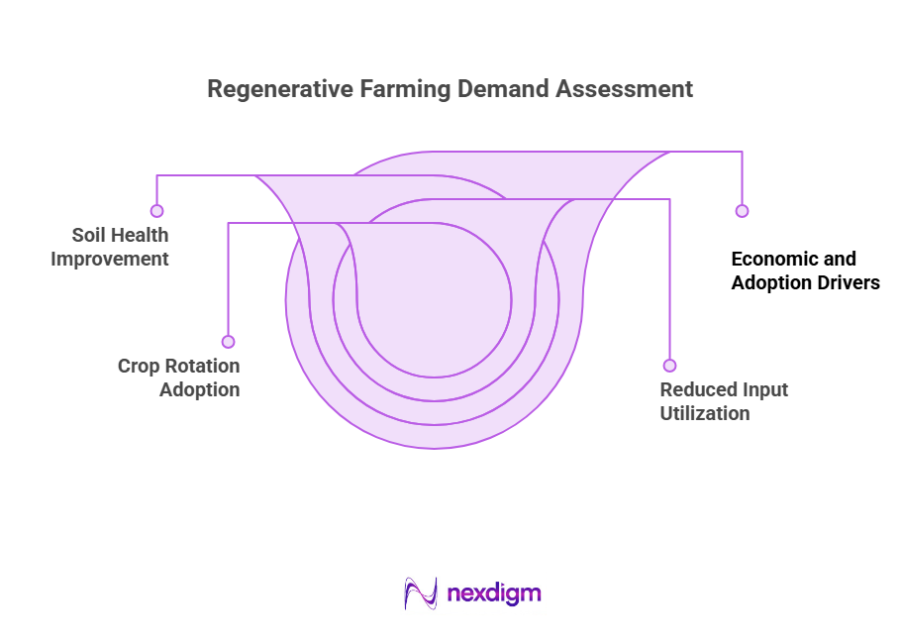
- Soil Health Improvement: Assess demand for practices that enhance soil structure, fertility, and water retention, enabling farmers to improve long-term productivity while reducing vulnerability to environmental stress.
- Crop Rotation Adoption: Evaluate farmer willingness to adopt diversified cropping systems that improve nutrient cycling, reduce pest pressure, and strengthen farm resilience through more sustainable production methods.
- Reduced Input Utilization: Analyze the adoption potential of practices that optimize fertilizer, pesticide, and resource use, helping farmers lower costs while improving operational efficiency and sustainability outcomes.
- Economic and Adoption Drivers: Examine the financial benefits, implementation requirements, and behavioral factors that influence farmer decision-making and long-term adoption of regenerative farming practices.
This study nables stakeholders to identify practices with the strongest demand, adoption potential, and economic viability.
Nexdigm’s Assessment of Regenerative Farming Adoption Potential
While interest in regenerative agriculture continues to grow, adoption varies significantly across practices and farming systems. Nexdigm assesses regenerative farming solutions based on:
- Soil Health Management: Practices such as cover cropping, residue retention, and organic amendments are gaining traction due to their ability to improve soil fertility, water retention, and long-term farm resilience.
- Crop Rotation and Diversification: Crop rotation supporting nutrient cycling, reduces pest pressure, and improves soil quality, making it a key component of sustainable and resilient farming systems.
- Reduced-Input Farming Systems: Optimized fertilizer and pesticide use can lower production costs while maintaining productivity, increasing their attractiveness to cost-conscious farmers.
- Farmer Adoption Readiness: Adoption that depends on factors such as implementation complexity, access to technical support, awareness levels, and the time required to realize economic benefits.
The assessment highlights regenerative farming practices that balance soil-health improvements with economic viability and farmer acceptance. Understanding these adoption dynamics enables stakeholders to prioritize solutions with the greatest potential for sustainable growth and long-term commercial impact.
Applications of Regenerative Farming Across Agricultural Value Chains
As regenerative agriculture gains traction, its applications extend beyond on-farm sustainability initiatives. Organizations across the agricultural ecosystem are leveraging regenerative practices for:
- Soil Health Enhancement: Regenerative practices support soil restoration through improved fertility, water retention, and organic matter management, contributing to long-term agricultural productivity.
- Sustainable Crop Production: Crop rotation, cover cropping, and reduced tillage help create more resilient farming systems that support stable yields and efficient resource utilization.
- Input Optimization: Reduced-input approaches enable farmers to improve nutrient-use efficiency and lower dependency on synthetic fertilizers and crop protection products.
- Climate and Carbon Initiatives: Regenerative farming is increasingly being integrated into carbon programs and sustainability strategies aimed at improving environmental outcomes and reducing agricultural emissions.
The applications of regenerative farming extend across production systems, sustainability programs, and agricultural value chains. As adoption accelerates, these practices are creating opportunities to improve farm performance, support environmental goals, and build more resilient agricultural ecosystems.
Nexdigm’s Case
An agribusiness company engaged Nexdigm to assess regenerative farming adoption across soil health, crop rotation, reduced inputs, and farmer economics. The study evaluated 55+ adoption indicators, identified 12 scalable practice clusters, and improved opportunity prioritization by 27%, supporting stronger farmer engagement, resource efficiency, sustainable production, and investment planning.
To take the next step, simply visit our Request a Consultation page and share your requirements with us.
Harsh Mittal
+91-8422857704