

India’s agricultural market is often discussed as a single opportunity, but the commercial conditions underlying that opportunity vary substantially by geography. Crop mix, irrigation, farm structure, production patterns, processing capacity and market connectivity can all change from one region to another.
India produced 357.73 million tonnes of foodgrains and 362.08 million tonnes of horticultural crops in 2024–25. These national figures demonstrate the scale of the market but reveal little about the conditions a new entrant will face in a particular state or district.
For companies planning agricultural expansion, geography is therefore not simply a location decision. It can influence the business model, investment requirements and route to market.
The Same Product Can Face Different Market Conditions
Agricultural production is shaped by local climate, water availability, cropping patterns and farm structures. Irrigation coverage increased nationally from 49.3% of gross cropped area in FY2015–16 to 55% in FY2020–21, but the national average masks substantial differences between individual regions.
Those differences can affect the commercial relevance of agricultural products and services.
An input company may find strong demand in one region because of crop concentration, while another may require a different product mix. A processor may prefer a market with concentrated production, whereas an agricultural technology provider may prioritise a fragmented market where a specific production problem creates stronger demand.
A national market-size figure cannot capture these distinctions.
Farm Structure Changes the Route to Market
The structure of agricultural production is another reason regional strategies need to differ. India’s average operational holding was 1.08 hectares in the 2015–16 Agriculture Census.
For companies sourcing agricultural products, fragmented holdings can increase aggregation requirements. For technology providers, they can affect affordability and equipment access. For distributors, they can change the economics of reaching individual customers.
The presence of farmer-producer organisations, cooperatives, aggregators and established input networks can therefore be commercially significant.
Two regions with comparable production volumes may require very different go-to-market models.
Infrastructure Determines What the Market Can Support
Production is only one stage of the agricultural value chain. Storage, processing, transport and market connectivity determine how efficiently output can move to its eventual buyer.
This becomes increasingly important as Indian agricultural businesses move toward higher-value and export-oriented products. Agricultural exports reached US$52.55 billion in FY2025–26, compared with US$51.12 billion in FY2024–25.
For an exporter or processor, the presence of suitable logistics and processing infrastructure can therefore influence the attractiveness of a region as much as the production base itself.
The assessment should consider whether infrastructure already exists, whether it is accessible to the entrant and what investment would be required to address remaining gaps.
Regional Conditions Should Shape the Entry Model
Geographic differences should ultimately influence how a company enters a market.
A mature market with established distributors may support a partnership-led model. A fragmented but high-potential region may require local aggregation capabilities. A market with strong production but limited processing infrastructure may present an opportunity for integrated investment.
This is why regional agriculture market entry consulting needs to go beyond comparing state-level market sizes. The objective is to understand what type of commercial presence each region can support and what capabilities an entrant would need to establish.
Nexdigm’s Regional Opportunity Framework
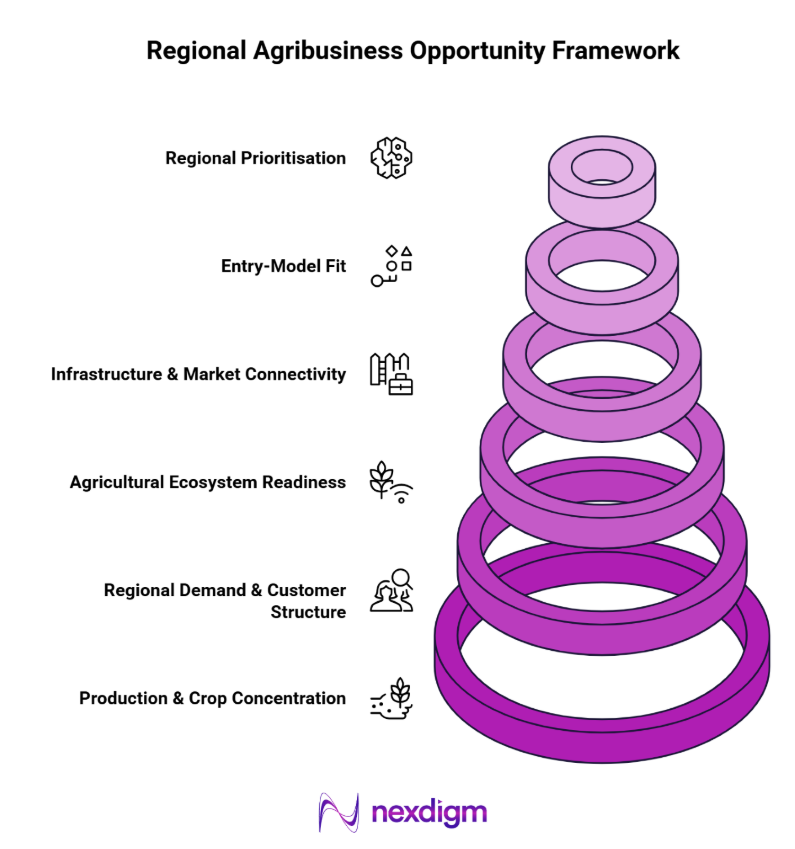
- Production and Crop Concentration
Map agricultural output by crop and geography, including seasonality and production concentration. This establishes where relevant supply pools are located and how dependable they may be. - Regional Demand and Customer Structure
Assess buyers, farmer segments, consumption patterns and institutional demand. This identifies whether the opportunity is driven by producers, processors, consumers, exporters or a combination of these groups. - Agricultural Ecosystem Readiness
Evaluate FPOs, aggregators, processors, input suppliers, distributors and other ecosystem participants. A strong local network can reduce the infrastructure and partnerships a new entrant needs to build. - Infrastructure and Market Connectivity
Assess roads, storage, processing, logistics and access to domestic or export markets. This determines how efficiently products can move through the target region and where additional investment may be required. - Entry-Model Fit
Translate regional conditions into an appropriate entry model, such as direct operations, partnerships, distribution, contract arrangements or phased investment. - Regional Prioritisation
Compare markets across demand, supply, competition, accessibility and commercial economics to identify the regions that warrant deeper evaluation and investment.
Nexdigm’s Case: Reordering Regional Expansion
An agribusiness evaluated eight Indian states using production, demand, infrastructure, competition and logistics indicators. The assessment changed the planned expansion sequence, with the revised priority market showing an estimated 22% lower logistics cost than the company’s original target. Regional agriculture cannot therefore be assessed effectively through a single national market figure. The commercial opportunity depends on how local production, demand, infrastructure and market participants interact.
Nexdigm can help companies evaluate these differences through geographic market assessment, opportunity screening, competitive analysis and market-entry strategy development.
To take the next step, simply visit our Request a Consultation page and share your requirements with us.
Harsh Mittal
+91-8422857704