

A national enrollment number can tell you how large an education system is. It cannot tell you where the next viable campus should be built.
India’s student population is distributed across regions experiencing very different demographic, migration, income, and institutional changes. A district gaining young families can generate a very different education opportunity from one where the school-age population is stabilising but household spending is increasing.
Regional forecasting needs to capture both.
India’s Enrollment Map Is Not Uniform
UDISE+ 2024–25 records 24.69 crore students across 14.71 lakh schools. That scale creates an enormous education market, but aggregate enrollment can conceal significant differences between states, districts, cities, and age cohorts.
Population growth is only one part of the equation.
Migration into employment centres, new residential development, household income growth, shifts between government and private schools, and changes in institutional capacity can all reshape local enrollment demand.
Demographics Tell Only Half the Story
A growing child population creates potential demand. It does not necessarily create demand for a particular type of institution.
Consider two markets.
One may have rapidly expanding school-age cohorts but limited household purchasing power. Another may have slower population growth but rising incomes, increasing private-school penetration, and substantial demand for specialised education.
For operators, the second market can sometimes represent a very different expansion proposition.
The same principle applies across age groups. A region experiencing slower primary enrollment growth may still present opportunities in senior secondary education, professional programmes, vocational training, or specialised learning services.
Migration Changes the Forecast
Education demand often follows people rather than administrative boundaries.
NCR, Bengaluru, Hyderabad, and Pune, for example, have attracted large populations of working-age households and expanded residential development. New family settlements can create concentrated demand for schools and early-childhood education even when broader state-level demographics appear less dynamic.
The reverse can happen in rural areas where sustained out-migration reduces local school populations.
Forecasting therefore needs to identify where households are moving, not simply where they currently live.
The Public-to-Private Shift
Enrollment growth can also occur without population growth.
When households move children from government schools to private English-medium institutions, private enrollment can increase even if the underlying child population remains stable.
That makes institutional transition another forecasting variable alongside demographics.
For education operators, the useful question becomes: how much future enrollment comes from new students, how much from migration, and how much from changes in institutional preference?
Nexdigm’s Regional Enrollment Forecasting Model
The regional enrollment forecasts approach evaluates future demand through six layers:
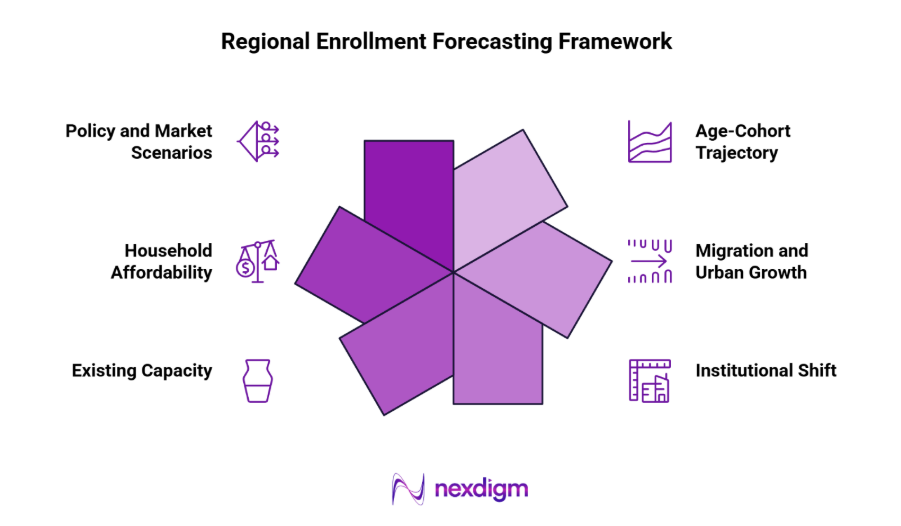
- Age-Cohort Trajectory
Project school-age and tertiary populations by district, age group, and admission cohort using historical demographic patterns and forward-looking population estimates. - Migration and Urban Growth
Map employment centres, residential development, infrastructure expansion, and household migration to identify emerging education corridors. - Institutional Shift
Track movement between government, private, aided, vocational, and higher education institutions to identify changing enrollment preferences. - Existing Capacity
Assess current seats, occupancy, campus additions, programme availability, and potential saturation across target markets. - Household Affordability
Overlay income distribution, education expenditure, and fee tolerance to determine how much projected demand is commercially addressable. - Policy and Market Scenarios
Model how board expansion, education policy, land development, institutional approvals, and other market changes could alter future enrollment.
Case Study: Finding the Next Expansion Market
A British international K-12 operator evaluated 5 key Indian metropolitan clusters covering 65 competitor schools charging ₹6 lakh to ₹14 lakh annually. The findings revealed a 35% supply deficit in a fast-growing growth corridor, supporting a ₹180 crore phased deployment for a single flagship campus of 2,000 seats over an immediate multi-city commitment.
Enrollment forecasting becomes more useful when it moves beyond population projections. For education groups, developers, and investors, the objective is to identify where demographic momentum, household demand, institutional gaps, and accessibility are likely to intersect over the investment horizon.
To take the next step, simply visit our Request a Consultation page and share your requirements with us.
Harsh Mittal
+91-8422857704