

Regional fulfilment hubs are becoming a critical component of modern market entry strategy, enabling businesses to strengthen delivery capabilities across multi-market operations. By positioning inventory closer to customers, companies can reduce transit times, improve order accuracy, and respond faster to regional demand patterns.
Regional fulfillment hub entry strategy supports smoother expansion into new geographies by balancing cost efficiency, service reliability, and operational scalability. These hubs also help businesses manage cross-border logistics, local compliance, and last-mile delivery more effectively. As companies enter competitive markets, regional fulfilment hubs provide the infrastructure needed to enhance customer experience and sustain growth.
The global e-commerce logistics market was valued at USD 524.2 billion in 2025 and is projected to reach USD 624.33 billion in 2026, while Asia Pacific accounted for 42.63% of the market. Cross-border e-commerce logistics is also expected to grow by USD 98.4 billion between 2024 and 2029, reinforcing the need for regional hubs to improve delivery speed, cost control, and market entry strategy execution across multiple markets.
Using Regional Fulfillment Hubs to Accelerate Market Expansion
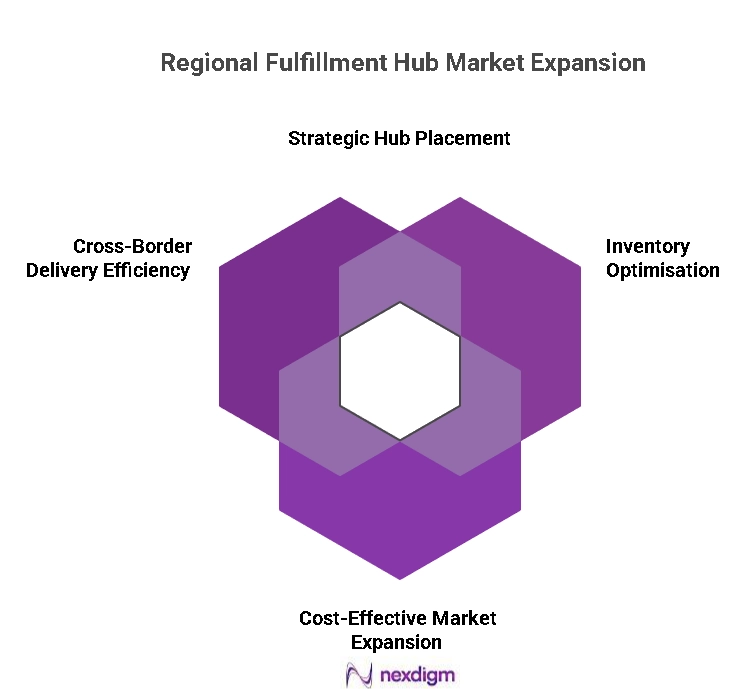
Using regional fulfillment hubs enables businesses to accelerate market expansion by improving delivery speed, reducing logistics costs, supporting cross-border operations, and strengthening market entry strategy across multiple customer regions:
-
Strategic Hub Placement
Locating fulfillment hubs near demand centres improves delivery speed, lowers transport costs, and supports faster market entry across regions.
-
Cross-Border Delivery Efficiency
Regional hubs reduce customs delays, improve inventory movement, and help businesses manage fulfilment across multiple countries more efficiently.
-
Inventory Optimisation
Distributed inventory enables faster demand response, reduces stockouts, and improves product availability in new and existing markets.
-
Cost-Effective Market Expansion
Hub-based fulfilment lowers long-distance shipping costs and allows businesses to scale operations without heavy local infrastructure investment.
Nexdigm Finance, Accounting, and Compliance Support for Regional Hub Operations
Nexdigm can support regional hub operations by managing finance, accounting, tax compliance, reporting, and regulatory requirements across markets. This helps businesses maintain accurate records, meet local obligations, control operational risks, and ensure smooth financial governance while scaling fulfilment networks across multiple regions.
Nexdigm Location Planning and Feasibility Assessment for Hub-Based Market Entry
Nexdigm can assess market demand, logistics access, infrastructure, operating costs, and regulatory factors to identify suitable hub locations that support efficient market entry and scalable regional fulfilment operations.
-
Market Demand Assessment
Evaluates regional demand patterns, customer density, and growth potential to identify locations supporting effective hub-based market entry.
-
Logistics Connectivity Review
Assesses transport routes, port access, delivery networks, and last-mile reach to ensure efficient regional fulfilment operations.
-
Regulatory and Compliance Mapping
Examines local permits, tax requirements, customs rules, and compliance obligations affecting hub setup and operations.
-
Feasibility and Risk Evaluation
Analyses operational risks, scalability, investment needs, and market readiness to support informed hub location decisions.
Nexdigm’s case:
Nexdigm helped a consumer goods company assess hub-based market entry across three regional markets by evaluating demand density, logistics access, warehousing costs, and compliance requirements. Through its location planning and feasibility assessment, Nexdigm identified an optimal fulfilment hub model that could reduce delivery timelines by 25–30%, lower logistics costs by 15–18%, and improve regional order coverage by nearly 40%.
To take the next step, simply visit our Request a Consultation page and share your requirements with us.
Harsh Mittal
+91-8422857704