

Healthcare delivery is increasing beyond traditional facilities as patients, providers, and payers adopt digital models that improve access, convenience, and continuity of care. Remote healthcare is no longer limited to virtual consultations. it now includes remote patient monitoring, chronic disease management, digital diagnostics, and connected care solutions.
The global telehealth market continues to expand, with estimates placing its value at around USD 77 billion in 2025, driven by increasing digital adoption, smartphone penetration, and demand for convenient healthcare access. In India, digital healthcare adoption is also accelerating, supported by initiatives such as the Ayushman Bharat Digital Mission, which has expanded digital health infrastructure across the country.
A structured Remote healthcare service demand analysis helps healthcare businesses understand where adoption is growing, which patient segments are driving demand, and how remote care models can create sustainable clinical and commercial value.
The Shift Towards Remote Healthcare
Remote healthcare is changing how patients interact with healthcare providers. While teleconsultation created the foundation for digital care adoption, demand is now expanding toward continuous monitoring, preventive care, and technology-enabled chronic disease management. Nexdigm helps healthcare organizations evaluate this shift by analyzing various drivers contributing to this shift.
Understanding Growth Opportunities in Remote Healthcare
Teleconsultation and Virtual Care Adoption
Nexdigm evaluates teleconsultation demand across patient segments, specialties, and locations to understand where virtual care models can create the strongest impact. The assessment considers patient acceptance of virtual consultations and specialty-wise demand potential to help businesses identify where teleconsultation can complement traditional healthcare delivery.
Remote Monitoring and Chronic Care Potential
Growing chronic disease burden is increasing demand for continuous monitoring solutions. Nexdigm assesses opportunities across areas such as diabetes management, cardiovascular care, elderly care, post-discharge monitoring, and preventive healthcare through detailed analytical processes.
Technology and Commercial Model Assessment
Remote healthcare success depends on more than technology adoption. Nexdigm evaluates digital platforms, connected devices, healthcare partnerships, and revenue models to understand scalability and commercial feasibility.
With a thorough understanding of growth opportunities in remote healthcare, Nexdigm helps healthcare organizations analyze these opportunities and develop scalable strategies for sustainable growth through its strategic process.
Nexdigm’s Remote Healthcare Service Demand Analysis
Nexdigm conducts a structured Remote healthcare service demand analysis by combining healthcare market intelligence, customer insights, technology assessment, and commercial evaluation.
- Healthcare Demand Mapping: Nexdigm analyses patient demographics, disease prevalence, healthcare access, and digital adoption trends to identify where remote healthcare solutions can address meaningful needs.
- Care Model Evaluation: Different remote care models, including teleconsultation, remote patient monitoring, digital therapeutics, and hybrid healthcare delivery, are assessed to determine suitability across patient and provider segments.
- Technology Assessment: Nexdigm evaluates digital health platforms, healthcare providers, technology companies, device manufacturers, and ecosystem partners to understand market positioning and collaboration opportunities.
- Opportunity and Business Model Analysis: Potential opportunities are assessed based on customer demand, pricing models, scalability, operational requirements, and long-term commercial potential.
Business Impact created by Nexdigm
Nexdigm’s healthcare service demand analysis focuses on the key areas, creating a long-lasting business impact and helping them understand demand drivers and market trends, through the following ways:
- Targeted segments: Identifying patient groups and healthcare areas with stronger adoption potential.
- Service development: Determining which remote care offerings align with market needs.
- Enhanced Technology partnerships: Evaluating platforms, devices, and ecosystem players.
- Developed Commercial models: Assessing subscription, service-based, and enterprise healthcare opportunities.
- Market expansion: Identifying locations and segments where digital healthcare can scale.
Nexdigm in Providing a Sustainable Future
Remote healthcare presents significant opportunities, but success depends on selecting the right patient segments, services, technologies, and operating models. Businesses that understand changing healthcare behaviour and market requirements will be better positioned to develop scalable solutions.
Through a comprehensive Remote healthcare service demand analysis, Nexdigm helps healthcare organizations identify growth opportunities and build future-ready care models aligned with evolving patient expectations. This helps businesses evaluate opportunities across the remote healthcare value chain by combining:
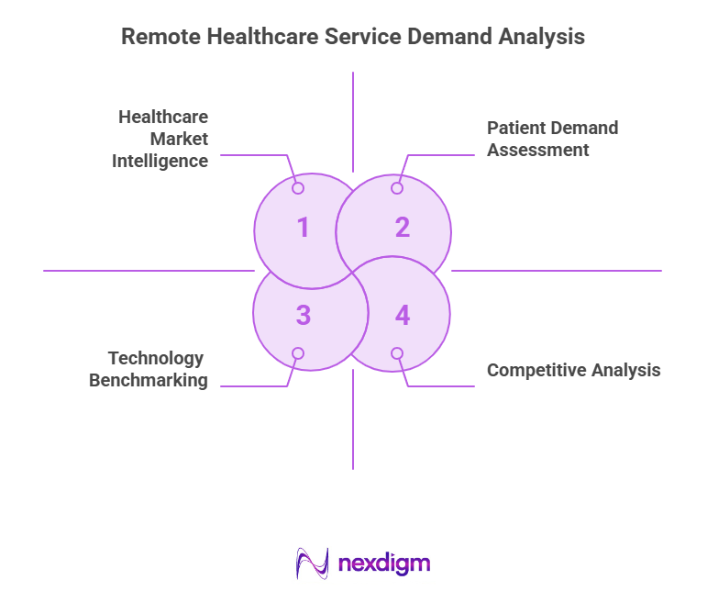
- Healthcare market intelligence: Analyzing digital health trends, telemedicine adoption, regulatory developments, and market dynamics to identify growth opportunities.
- Patient demand assessment: Evaluating patient preferences, care accessibility needs, adoption drivers, and service utilization patterns across segments.
- Technology benchmarking: Assessing digital health platforms, remote monitoring solutions, and technology capabilities to identify best-fit innovations.
- Competitive analysis: Comparing competitor offerings, service models, market positioning, and digital capabilities to uncover differentiation opportunities.
This provides businesses with a practical view of investment and innovation opportunities that can create sustainable value.
Nexdigm’s Case
Nexdigm supported a healthcare provider in evaluating remote care opportunities across teleconsultation, monitoring, and chronic care segments. The assessment helped identify priority patient groups, service gaps, and scalable digital care models. The client improved opportunity identification speed by 40%, enhanced market visibility, and developed a roadmap targeting 30% expansion in digital healthcare coverage.
To take the next step, simply visit our Request a Consultation page and share your requirements with us.
Harsh Mittal
+91-8422857704