

The replacement-parts market is being supported by an older and more heavily used vehicle population. In the US, the average light-vehicle age reached 12.8 years in 2025, up from 12.6 years in 2024, while vehicles aged 4–11 years still represented more than 119 million vehicles. Globally, the aftermarket covers approximately 1.61 billion vehicles in operation, creating a large and recurring demand base for maintenance and replacement components.
Supplier competition is also evolving. Roland Berger found that 57% of consumers now prefer independent aftermarket parts over OE brands, a 14-percentage-point increase from 2024. More than 60% of workshops in mature markets now source significant volumes online, increasing the importance of supplier availability, delivery reliability, and commercial competitiveness alongside product quality.
For aftermarket businesses, replacement parts supplier benchmarking can therefore provide a structured way to understand which suppliers are strongest, where sourcing gaps remain, and which alternatives may better match changing market requirements.
Supplier Strength Is Becoming More Multi-Dimensional
Replacement-parts suppliers are increasingly competing across several dimensions at once. Product breadth, quality consistency, manufacturing capacity, delivery performance, geographic coverage, and commercial terms can all influence sourcing outcomes. A supplier with a broad catalog may not offer the strongest regional availability, while a specialized supplier may provide better technical performance or pricing for selected categories.
This makes a consistent comparison important. Benchmarking can help organizations move beyond individual supplier relationships and develop a clearer view of where capabilities are strong, where weaknesses exist, and which suppliers could strengthen the overall sourcing portfolio.
From Supplier Comparison to Sourcing Opportunity
A useful benchmark should not stop at ranking suppliers. It should help organizations understand what the comparison means for their sourcing strategy.
- Capability Gaps: Identify product categories, applications, quality capabilities, or capacity requirements that existing suppliers may not fully address.
- Competitive Alternatives: Compare established and emerging suppliers across cost, quality, availability, geographic reach, and product coverage to identify stronger options.
- Portfolio Opportunities: Determine where supplier diversification, regional sourcing, or new vendor relationships could improve availability and sourcing resilience.
Together, these perspectives turn benchmarking into a practical exercise for identifying where supplier performance can be strengthened and where new sourcing opportunities may exist.
How Nexdigm’s Experts Assess the Gaps Behind Supplier Performance
Supplier performance can look strong when assessed individually, yet weaknesses may become visible when suppliers are compared across the same categories and markets. Nexdigm can help identify these less obvious differences by placing supplier capabilities, commercial positioning, and market coverage into a common analytical view.
- Hidden Weaknesses: Identify suppliers that appear competitive but have limitations in capacity, product coverage, regional reach, or quality consistency.
- Relative Strengths: Highlight suppliers whose capabilities or commercial positioning stand out against comparable replacement-parts providers.
- Untapped Options: Identify alternative suppliers that may offer stronger coverage, competitive economics, or capabilities missing from the existing sourcing base.
This strategic view helps turn replacement parts supplier benchmarking into a way of discovering both supplier risks and previously overlooked sourcing opportunities.
Nexdigm’s Replacement Parts Supplier Assessment Framework
Nexdigm can structure the assessment around a set of connected evaluation steps to create a consistent view of supplier competitiveness:
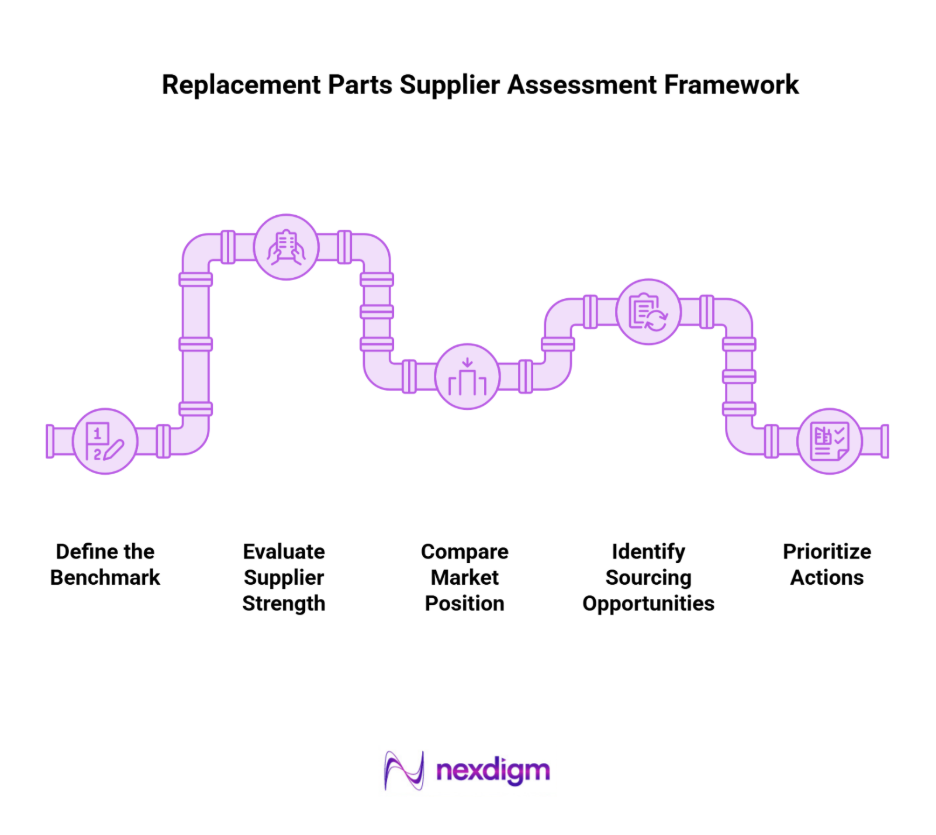
- Define the Benchmark: Establish relevant product categories, specifications, regions, volumes, and supplier groups for a like-for-like comparison.
- Evaluate Supplier Strength: Assess product coverage, manufacturing capability, quality, capacity, geographic reach, and commercial positioning.
- Compare Market Position: Benchmark suppliers against relevant peers to identify relative strengths, pricing differences, and capability gaps.
- Identify Sourcing Opportunities: Evaluate alternative suppliers, regional options, diversification possibilities, and areas for supplier development.
- Prioritize Actions: Rank opportunities based on commercial potential, supplier suitability, implementation feasibility, and sourcing importance.
This framework helps transform supplier data into a structured decision base for replacement parts supplier benchmarking and sourcing strategy.
What Nexdigm’s Supplier Benchmarking Reveals for Aftermarket Strategy
Benchmarking can reveal patterns that are difficult to identify through individual supplier reviews. Nexdigm can help translate these patterns into a broader view of aftermarket sourcing performance:
- Competitive Position: Understand where the existing supplier base performs strongly or falls behind comparable market alternatives.
- Portfolio Exposure: Identify categories, regions, or suppliers where limited coverage could create sourcing or availability risks.
- Growth Potential: Highlight suppliers and markets that could support broader product coverage, new applications, or regional expansion.
- Strategic Priorities: Determine which supplier relationships, categories, or sourcing gaps warrant deeper evaluation and management attention.
This gives procurement and aftermarket teams a clearer understanding of what supplier performance means for the wider sourcing strategy, not just how individual vendors compare.
Nexdigm’s Case
An aftermarket distributor benchmarked 30 replacement-parts suppliers across six categories and four regions. Nexdigm’s analysis identified 26% additional qualified supplier options, revealed 21% gaps in product or regional coverage, and improved supplier-screening efficiency by 30%. The findings helped the distributor strengthen supplier diversification, prioritize high-potential vendors, and focus sourcing efforts on categories with the greatest competitive opportunity.
To take the next step, simply visit our Request a Consultation page and share your requirements with us.
Harsh Mittal
+91-8422857704