

When a vehicle leaves the showroom, its demand story does not end. Every vehicle on the road eventually creates another opportunity for tires, servicing, repairs, and other aftermarket needs. It is important for automotive businesses to understand these evolving aftermarket opportunities by connecting market trends with vehicle usage, customer behaviour, and commercial potential.
Replacement tires are particularly interesting because demand is not driven only by new-vehicle sales. It depends on how many vehicles are on the road, how much they are driven, the conditions they operate in, and when their tires reach the end of their useful life.
For businesses evaluating the opportunity, a robust Replacement tire market analysis therefore needs to move beyond vehicle sales and examine the underlying vehicle parc and usage economics.
What Shapes Replacement Tire Demand?
Understanding the replacement tire opportunity requires looking beyond overall vehicle sales. Demand is influenced by a combination of fleet size, vehicle usage, operating conditions, and replacement behaviour. Examining these interconnected factors helps businesses understand where demand is building and which segments offer the strongest potential.
The Four Forces Behind Replacement Tire Demand
Replacement tire demand is shaped by the size of the vehicle base, how frequently vehicles are driven, the conditions they face, and when tires need replacement. Together, these four forces determine the timing, volume, and location of aftermarket demand:
Vehicle Parc
The size and age of the vehicle population provide the fundamental demand base. A larger parc creates a greater pool of vehicles requiring periodic tire replacement. An expanding parc, particularly across passenger vehicles, two-wheelers, commercial vehicles and tractors, creates a steadily increasing replacement opportunity. For market participants, the more relevant question is therefore not simply how many vehicles are sold today? but how many vehicles will enter replacement cycles over the next three to five years?
Mileage
Vehicle utilization directly affects tire wear. High-mileage commercial fleets, delivery vehicles, taxis and heavily used two-wheelers can move through replacement cycles considerably faster than lightly used private vehicles.
This makes mileage segmentation particularly important. A vehicle-parc model that treats every vehicle equally can overstate demand in low-utilization segments while understating opportunities in intensive-use applications.
Freight activity is especially relevant for commercial tires. Current industry estimates indicate that replacement demand is expected to grow 6–7% in 2026, supported by the large vehicle base and strong freight movement.
Road Conditions
Road quality, terrain, congestion, temperature and operating conditions can accelerate tire wear. Urban stop-start driving creates a different wear profile from long-distance highway operations, while rural and construction-oriented applications can expose tires to more demanding surfaces.
Consequently, replacement demand varies geographically and by vehicle application. Understanding these differences helps identify markets where replacement frequency not merely vehicle ownership is creating the strongest opportunity.
Replacement Cycles
Vehicle parc becomes commercially meaningful when translated into replacement timing. Factors such as vehicle age, annual mileage, tire specifications, operating environment and maintenance behaviour determine when an owner replaces a tire. The resulting replacement cycle can then be used to estimate annual replacement volumes and identify future demand waves.
This is particularly important as India’s vehicle fleet ages. A growing used-vehicle population can extend vehicle usage and create additional aftermarket demand for maintenance components, including tires.
Nexdigm’s Support in Turning Tire Demand into an Opportunity
For an automotive player evaluating the replacement tire opportunity, Nexdigm can structure the assessment around four connected steps:
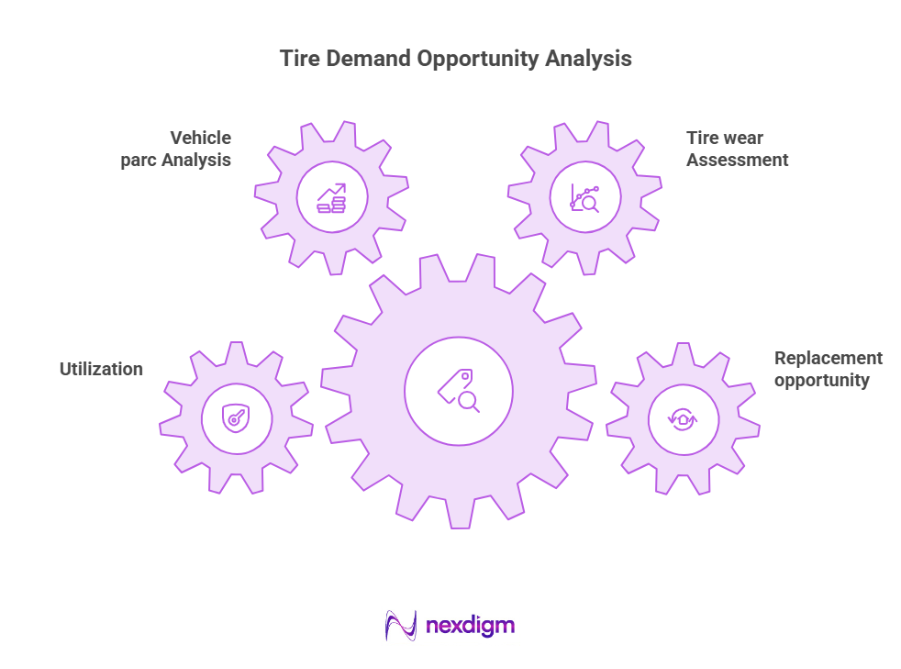
- Vehicle parc Analysis: Establish the addressable fleet by vehicle category, geography and age
- Utilization: Evaluate mileage and usage intensity
- Tire wear Assessment: Assesses the impact of road conditions and operating environments on tire life
- Replacement opportunity: Convert replacement cycles into market volumes, value pools and channel opportunities
This approach enables a more granular view of where demand is likely to emerge rather than relying solely on historical tire sales. Importantly, Nexdigm’s Replacement Tire Market Analysis can connect these demand drivers to target and understand which products to prioritize, and how to strengthen aftermarket channels.
Areas Where Nexdigm Can Add Value
Nexdigm combines market data with customer and vehicle insights to identify the most attractive replacement-tire opportunities and translate them into practical growth strategies.
- Parc segmentation: Identify demand across passenger vehicles, two-wheelers, LCVs, trucks, buses, and tractors.
- Usage intensity: Assess mileage, fleet utilisation, and commercial operating patterns influencing tire wear.
- Replacement timing: Estimate replacement cycles based on vehicle age and usage.
- Competitive positioning: Compare brands on pricing, availability, service, and differentiation.
- Future demand: Assess EV adoption, changing vehicle mix, and fleet formalisation impacts.
With this objective, Nexdigm assist businesses to identify not only where the market is growing, but why it is growing and which customer segments are most attractive.
Nexdigm’s Tire Market Assessment
Nexdigm assisted an automotive player in assessing replacement tire demand as India’s replacement segment is expected to grow 6–7% in FY26. The study linked parc, mileage, road conditions, and replacement cycles and helped business grow rapidly.
To take the next step, simply visit our Request a Consultation page and share your requirements with us.
Harsh Mittal
+91-8422857704