

Restaurant choice is increasingly made before the customer reaches the restaurant.
A consumer may compare menus, prices, ratings, delivery times, photographs and reviews before deciding where to order. For dine-in occasions, location, ambience, cuisine, service and social context can matter just as much.
This makes restaurant demand more complicated than simply counting footfall. Restaurants compete for specific occasions, and the factors that win one occasion may be irrelevant to another.
The Decision Has Become More Transparent
Food delivery platforms have made restaurants easier to compare.
Swiggy’s 2026 Restaurant Awards attracted more than 1.3 crore votes from 6.43 lakh unique users across 160-plus cities and 110 categories. More than 15,000 brands received awards.
The scale of participation illustrates how consumers increasingly interact with restaurants through digital platforms, categories and local recommendations.
This also changes competitive dynamics.
A restaurant is no longer competing only with the establishments visible from its street. It may be competing with dozens of alternatives displayed on a customer’s phone.
Taste, Price and Convenience Create the Core Choice Set
Swiggy’s analysis of India’s food-delivery market has identified convenience, taste and price as increasingly important factors in restaurant selection, while food delivery has expanded consumers’ ability to discover and compare restaurants.
These factors interact differently by occasion.
- Everyday meal: Price, familiarity and delivery reliability can dominate.
- Social meal: Ambience, cuisine, menu breadth and group suitability become more important.
- Impulse order: Speed, promotions and visual appeal can influence the decision.
- Premium occasion: Experience, service, product quality and brand perception can justify a higher spend.
- Health-led order: Nutritional information, ingredients and dietary options may carry greater weight.
A customer-demand assessment therefore needs to identify the occasion before asking why the customer chooses a restaurant.
Price Is More Than the Menu Rate
Consumers increasingly evaluate the total value of an order.
That can include food price, delivery fees, minimum-order requirements, discounts, portion size and perceived quality.
Swiggy launched its ₹99 Store across more than 175 cities in 2025, offering meals priced at ₹99 with free delivery through its Eco Saver mode. The initiative targeted price-conscious, high-frequency users.
This provides evidence of a broader affordability dynamic.
Restaurants can respond through different pricing structures, including entry-level meals, bundles, add-ons, premium items and occasion-specific offers.
The critical question is which mechanism creates incremental demand rather than simply discounting customers who would have purchased anyway.
Convenience Has Become Part of the Product
Convenience now includes several dimensions:
- Distance and accessibility
- Delivery time
- Order accuracy
- Digital ordering
- Payment options
- Reservation ease
- Takeaway speed
- Operating hours
NIQ’s 2026 on-premise research found that nearly seven in ten Indian consumers visit restaurants, cafés and bars at least once a quarter, with frequency varying by occasion and venue. The research also highlights the importance of understanding which occasions drive spending across different venue types.
A restaurant may therefore have strong demand without having the strongest overall brand awareness if it owns a specific occasion particularly well.
Local Relevance Can Beat Broad Positioning
Restaurant demand is highly local.
Cuisine preferences, household demographics, office populations, student concentrations, neighbourhood income, competition and mobility patterns can all change within a few kilometres.
Swiggy’s 2026 awards data demonstrates this local variation, with participation spanning 160-plus cities and regional categories alongside national categories.
For operators, this means demand assessment should move from national restaurant trends to catchment-level behaviour.
A concept that works in a business district may struggle in a residential neighbourhood. A premium café may perform near affluent mixed-use developments but face insufficient weekday demand elsewhere.
What Customers Actually Reward
A restaurant customer-demand study should test five layers:
- Attraction: What gets the customer to notice the restaurant?
- Selection: Why is it chosen over alternatives?
- Transaction: What price and offer make the purchase acceptable?
- Experience: Does food, service and convenience meet expectations?
- Repeat: What creates another visit or order?
This distinction is important because the factor that generates trial is not necessarily the factor that creates loyalty.
Nexdigm’s Restaurant Demand Assessment Framework
Nexdigm’s restaurant customer demand assessment research helps companies understand customer choice, consumption occasions, pricing, catchment behaviour, competitive positioning and repeat-purchase drivers.
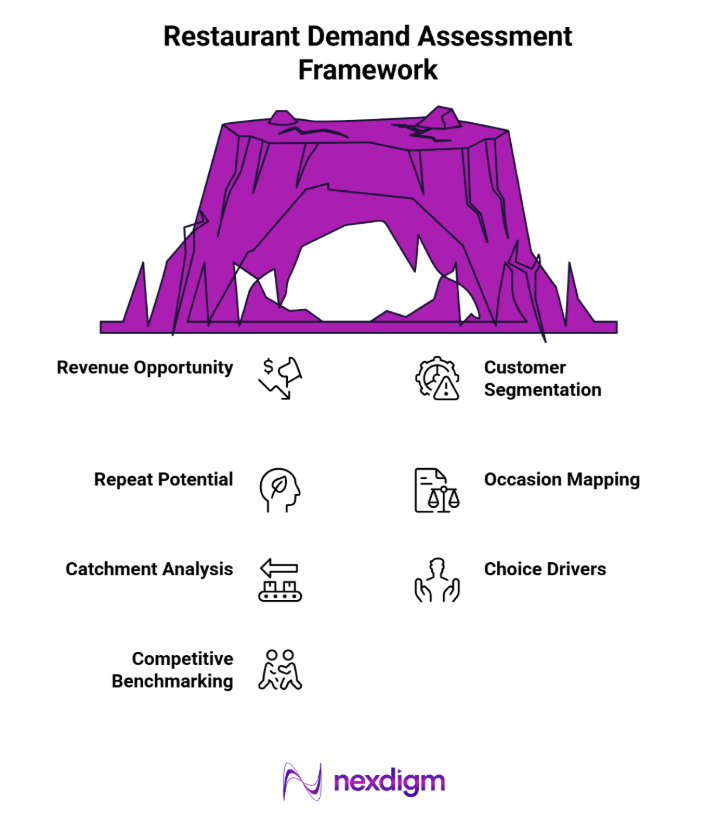
- Occasion Mapping: Identify meal, social, impulse, premium and delivery-led occasions.
- Customer Segmentation: Profile consumers by demographics, spending capacity, lifestyle and frequency.
- Choice Drivers: Quantify the importance of taste, price, convenience, ambience, service, reviews and menu attributes.
- Competitive Benchmarking: Compare restaurants by cuisine, pricing, ratings, offers, location and delivery performance.
- Catchment Analysis: Map residential, commercial, institutional and mobility-driven demand.
- Repeat Potential: Identify the attributes most strongly associated with frequency and customer retention.
- Revenue Opportunity: Translate customer preferences into ticket size, visit frequency and addressable demand.
This moves restaurant research from general customer satisfaction toward a clearer understanding of what actually creates demand.
Nexdigm Case: Identifying Drivers of Restaurant Customer Demand
Nexdigm surveyed 2,600 restaurant customers across 5 cities and benchmarked 48 competing outlets. Taste, value and location emerged as leading selection factors, while a 14% improvement in perceived value was associated with a projected 9% increase in repeat visits.
To take the next step, simply visit our Request a Consultation page and share your requirements with us.
Harsh Mittal
+91-8422857704