
A restaurant concept can look attractive on paper and still fail within its first year because the catchment is wrong, average spend is insufficient, competition is too dense or the format does not match local demand.
Restaurant feasibility therefore begins before the menu is finalized. The location, customer base, spending behaviour, operating model and competitive environment need to support one another.
Start With the Catchment, Not the Concept
India’s foodservices market is projected to grow from approximately US90billioninFY26toUS150 billion by FY31. Online foodservice is expected to increase its share from 11% to 18% over the same period, while organised foodservice already represents approximately 45% to 50% of the market.
The national growth story is a useful context, but a restaurant operates within a much smaller geographic radius.
A restaurant concept must align with the operational rhythm of its local catchment area.
Prioritizing Spend Potential Over Pure Footfall
Substantial foot traffic alone does not assure a restaurant’s financial viability.
The pivotal factor is whether target guests demonstrate the willingness and financial capacity to support the planned average outlay per visit.
NIQ’s 2026 on-premise insights show that nearly 70% of Indian consumers patronize dining establishments, cafés, or bars at least quarterly, yet visit frequency and spending dynamics vary widely based on venue type and dining occasion.
Analyzing guest spending relative to distinct dining occasions offers clear clarity:
- Neighborhood Cafés: Depend on high-frequency, modest-ticket purchases.
- Casual Dining: Sustains profitability through less frequent visits with higher per-person spend.
- Fine Dining: Serves a select demographic with significantly greater purchasing power.
Aligning Venue Format With the Financial Model
Spend Potential Matters More Than Footfall Alone
High foot traffic does not automatically guarantee financial success for a venue.
The key consideration is whether prospective patrons possess both the inclination and purchasing power to meet the intended average spend per head.
According to 2026 on-premise data from NIQ, approximately 70% of consumers in India dine at restaurants, cafés, or bars minimum once per quarter, though spending habits and visit cadence differ significantly depending on the venue format and dining motivation.
Evaluating consumer expenditure through the lens of specific dining occasions is therefore highly effective.
For instance, local cafés rely primarily on frequent, low-to-medium value transactions. Casual dining establishments thrive on less frequent, higher-ticket meals. Conversely, fine-dining concepts rely on a more exclusive clientele with a markedly elevated capacity to spend.
Format Fit Determines the Revenue Model
Choosing the right restaurant format dictates your financial model, as each concept carries distinct economic drivers:
- Quick-Service Restaurant (QSR)
Focuses on speed and volume, operating on reduced service times and rapid customer turnover. - Café
Relies on high-margin beverage sales and frequent repeat visits, balanced against extended seating times. - Casual Dining
Commands higher average guest spend and offers extensive menus, balanced by more complex kitchen operations. - Cloud Kitchen
Eliminates front-of-house overhead, relying heavily on third-party delivery margins and online channel presence. - Premium Fine Dining
Generates top-tier ticket sizes from a selective clientele that expects superior service and atmosphere.
The right format depends on catchment characteristics rather than industry fashion. Humanity has survived enough restaurant concepts opening because someone thought exposed brick was a business model.
Competition Needs to Be Mapped Around Occasions
Restaurant competition is not limited to businesses selling the same cuisine.
A new casual restaurant may compete with cafés, QSRs, delivery-first brands, food courts and even grocery products designed for convenient home consumption.
Competition should therefore be mapped across:
- Cuisine and menu proposition
- Average ticket
- Meal occasion
- Delivery radius
- Dine-in experience
- Brand positioning
- Promotional intensity
- Customer ratings and reviews
- Peak-hour capacity
This reveals whether the proposed concept has genuine differentiation or simply enters an already crowded consumption occasion.
Digital Ordering Is Changing Location Economics
Online foodservice’s projected share of 18% by FY31 demonstrates how digital ordering is becoming structurally important to restaurant economics.
At the same time, speed is becoming part of the consumer proposition. Swiggy’s Bolt service reached more than 500 cities and 45,000 restaurant brands by May 2025, accounting for more than one in ten Swiggy food-delivery orders.
For a new restaurant, delivery potential should therefore be evaluated alongside physical footfall.
Nexdigm’s Restaurant Feasibility Framework
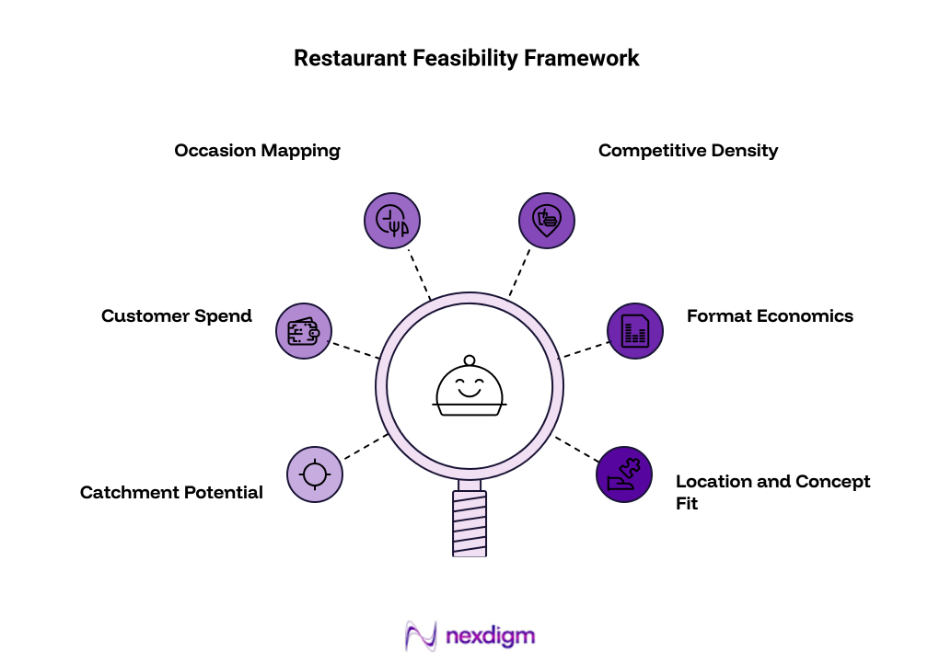
- Catchment Potential: Assess residential, commercial and institutional populations within relevant drive-time and walk-time zones.
- Customer Spend: Estimate household income, dining frequency, average ticket potential and price sensitivity.
- Occasion Mapping: Identify breakfast, lunch, dinner, weekend, social and delivery-led consumption opportunities.
- Competitive Density: Benchmark restaurants by cuisine, price, format, ratings, capacity, promotions and customer segments.
- Format Economics: Model seating, throughput, delivery mix, rent, labour, food costs and expected revenue by format.
- Location and Concept Fit: Test whether the proposed concept, pricing and operating model match the catchment and competitive environment.
Nexdigm’s restaurant market feasibility assessment helps companies evaluate catchment demand, customer spending, competition, location economics, format fit and revenue potential before investment.
This provides a commercial basis for deciding whether the concept, location and operating model can work together.
Nexdigm Case: Assessing Restaurant Catchment and Format Viability
A restaurant operator evaluated 5 catchments, 42 competitors and 2,400 consumers before launching a new format. Nexdigm identified a viable catchment with 18% higher spending potential, 12% pricing headroom, and an estimated 3.2-year payback.
To take the next step, simply visit our Request a Consultation page and share your requirements with us.
Harsh Mittal
+91-8422857704