

Restaurant expansion is increasingly a question of format economics.
A concept that performs well in a premium urban neighbourhood may not work in a smaller city. A delivery-first model may require very different real estate and staffing economics from a dine-in restaurant. Even within the same city, customer missions can vary sharply between office districts, residential catchments, malls, transit locations, and mixed-use neighbourhoods.
India’s consumer foodservice market generated US$57.5 billion in value sales in 2024, according to Agriculture and Agri-Food Canada citing Euromonitor. Tier 2 and Tier 3 cities are emerging as important growth markets, while independent operators continue to account for the majority of the market.
The Concept Has to Fit the Occasion
The first step in assessing a restaurant concept is understanding what customers are buying.
A breakfast-led café, family restaurant, QSR, premium casual concept, cloud kitchen, and dessert outlet compete for different occasions even when they operate within the same broad foodservice market.
Research should examine:
- Consumer mission and frequency
- Average spending
- Peak ordering periods
- Group size and dining occasion
- Dine-in versus takeaway versus delivery
- Cuisine and menu preferences
- Price sensitivity
Travel distance and convenience
This establishes whether the proposed concept has enough recurring demand to support an outlet.
Catchment Economics Come Next
Restaurant performance is highly location sensitive.
A catchment assessment can examine population density, household income, office and residential concentration, competitor density, traffic patterns, retail infrastructure, delivery coverage, and expected consumer spending.
The objective is to determine whether the location can generate enough transactions at the required average ticket to support rent, labor, food costs, delivery commissions, and other operating expenses.
A strong concept in a weak catchment can still become a bad investment. Humans remain impressively capable of discovering this after signing the lease.
Format Determines Scalability
The format should be tested against the economics of expansion.
Compact stores can reduce capital requirements. Delivery-led kitchens can broaden geographic coverage without full dine-in infrastructure. Food-court formats can access concentrated traffic, while standalone outlets can provide greater visibility and operating control.
This makes format selection a strategic decision rather than simply a real-estate choice.
Building the Restaurant Opportunity Case
Nexdigm’s restaurant opportunity assessment consulting can connect market demand with the operating conditions required to scale a restaurant concept.
The assessment can move through five practical questions:
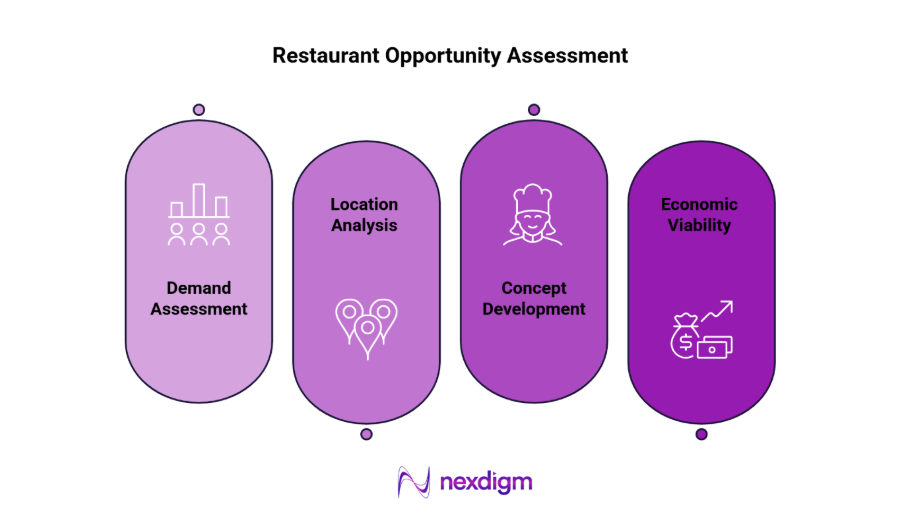
- Is the demand large enough?
Assess catchment population, consumer spending, dining frequency, daypart demand, and willingness to pay to establish the addressable customer base. - Where is the demand concentrated?
Map residential, commercial, educational, and transit-led catchments alongside footfall, accessibility, competitor density, and local spending patterns. - What should the concept offer?
Evaluate cuisine preferences, menu gaps, portion expectations, price points, service formats, and dine-in, takeaway, and delivery preferences. - Can economics work?
Benchmark average ticket size, outlet costs, rent, labor, food costs, delivery commissions, expected transactions, and operating margins to test outlet-level viability. - Can the model be replicated?
Compare locations and formats to determine whether the concept can be expanded without materially weakening unit economics or consumer appeal.
This framework gives restaurant operators a basis for making decisions across market selection, catchment prioritization, format design, menu positioning, pricing, site selection, and expansion sequencing.
A QSR Engagement That Identified Operational Gaps
Nexdigm assessed a regional QSR chain across 3 service formats: dine-in, takeaway, and delivery, using mystery evaluations to examine order accuracy, service speed, packaging, SOP adherence, and customer experience. The findings informed targeted training and process improvements across the chain.
To take the next step, simply visit our Request a Consultation page and share your requirements with us.
Harsh Mittal
+91-8422857704