

Restaurant procurement covers much more than ingredients. Food, beverages, takeaway packaging, cleaning materials, kitchen equipment, maintenance, and outsourced services all contribute to the cost of operating a restaurant. When purchasing records are fragmented across locations or suppliers, management may see total expenditure without understanding the factors driving it.
A useful analysis links purchasing costs to menu economics, outlet activity, supplier performance, and operating requirements.
Understand the Restaurant Cost Base
Restaurant procurement differs from packaged-goods sourcing because demand is closely linked to daily covers, menu mix, portion sizes, wastage, and service patterns. A change in sales mix can alter ingredient consumption even if total customer numbers remain stable.
India’s food-processing sector has expanded, with gross value-added reaching ₹2.24 lakh crore in 2023-24, according to government estimates. This wider processing ecosystem supports restaurant sourcing through ingredient processors, packaged food suppliers, dairy producers, and food distributors. However, restaurant operators still need to evaluate local availability, delivery frequency, and the economics of their specific menu.
Measure Cost at Menu Level
Total food spend does not show whether ingredients are being used efficiently. Restaurants should compare actual ingredient consumption with standard recipes, portion sizes, and expected yields. Differences may arise from supplier prices, preparation loss, over-portioning, spoilage, or unrecorded stock movements.
For restaurant procurement spend analysis consulting, purchasing records should be connected to menu sales, inventory movements, waste logs, and supplier invoices. This allows operators to distinguish a genuine price increase from a change in menu mix or kitchen execution.
Packaging requires separate attention, particularly for takeaway and delivery orders. Containers, cups, lids, bags, cutlery, and seals may have different usage patterns from dine-in supplies. Their cost should be analysed per order or transaction where possible, rather than treated as one undifferentiated monthly expense.
Examine Supplier and Operating Costs
Restaurants may source through wholesalers, specialist distributors, direct manufacturers, local producers, and cash-and-carry channels. Each model has different trade-offs in pricing, minimum order quantities, product freshness, delivery frequency, and administrative effort.
Equipment and maintenance create a different cost pattern. A low purchase price may be offset by higher energy consumption, maintenance requirements, spare-parts costs, or shorter service life. Procurement analysis should therefore consider lifecycle cost for major equipment instead of comparing initial quotations alone.
Restaurant Procurement Spend Analysis Framework
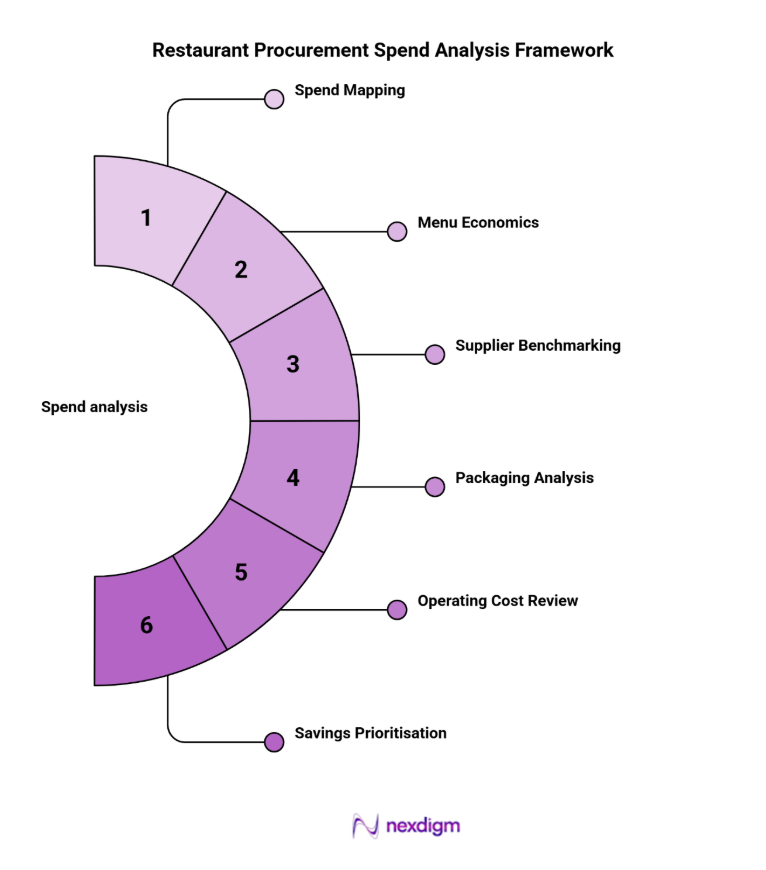
- Spend Mapping: Consolidate food, beverages, packaging, equipment, cleaning supplies, maintenance, and outsourced services by supplier, outlet, category, and period.
- Menu Economics: Compare ingredient costs with standard recipes, portion sizes, yields, menu sales, and waste records to identify cost differences at product level.
- Supplier Benchmarking: Compare equivalent specifications, delivered prices, minimum orders, payment terms, quality, and delivery reliability across relevant suppliers.
- Packaging Analysis: Measure packaging cost per order or serving and review material specifications, usage, damage, storage, and delivery charges.
- Operating Cost Review: Assess equipment purchase price, energy requirements, maintenance, spare parts, warranty, and expected service life to estimate total ownership cost.
- Savings Prioritisation: Rank opportunities by spend achievable savings, operational effort, food safety, menu consistency, and supply continuity before changing vendors or specifications.
Turn the Analysis Into Outlet-Level Decisions
Restaurant procurement improvements should be practical and measurable. Operators may standardise recipes, consolidate compatible orders, renegotiate delivery terms, review packaging formats, or qualify backup suppliers for critical ingredients.
Results should be tracked by outlet and category, adjusting for sales volume and menu mix. This helps determine whether a cost reduction reflects better procurement or simply lower business activity.
Nexdigm’s Case Study
A restaurant group operating 28 outlets analysed ₹19 crore in annual food, beverage, and packaging purchases. The review identified inconsistent supplier pricing, excess packaging use, and avoidable ingredient wastage. Revised purchasing terms and outlet-level controls reduced addressable procurement costs by 4.3% over six months while maintaining menu specifications and service requirements.
To take the next step, simply visit our Request a Consultation page and share your requirements with us.
Harsh Mittal
+91-8422857704