

Restaurant operations depend on a supplier network that must deliver the right products, in the right condition, at the right time. A restaurant may work with vendors supplying fresh produce, dairy, meat, seafood, frozen ingredients, cooking oils, beverages and packaging. Each category has different storage, handling and quality requirements.
For a single outlet, supplier problems may appear as isolated incidents. Across a chain of 50 or 100 restaurants, inconsistent deliveries and quality failures can affect menu availability, food costs, customer experience and operating standards across multiple locations.
Supplier compliance therefore needs to be evaluated as an operating risk, not merely an onboarding formality.
Why Restaurant Supplier Oversight Is Becoming More Important
India’s food service market includes organised chains as well as a large base of independent restaurants and local food businesses. The wider food-processing sector reached a gross value added of ₹2.24 lakh crore in FY2023–24, while processed food exports accounted for 20.4% of agricultural exports in FY2024–25.
As restaurant groups expand across cities, they often add suppliers to support local sourcing and reduce delivery distances. This can improve availability, but it also introduces variation in product specifications, documentation and handling practices.
A vendor approved for one location may not have the infrastructure or delivery capacity required to serve several outlets. Restaurant groups therefore need a consistent method for evaluating suppliers across markets.
The Supplier Gaps That Affect Restaurant Operations
Quality and Product Consistency
Ingredient quality can vary by season, supplier location and handling conditions. Fresh produce may differ in size, grade and shelf life. Dairy products require appropriate storage and temperature control, while meat and seafood suppliers need reliable hygiene, processing and cold-chain practices.
A useful assessment examines product specifications, incoming inspection procedures, rejection rates and the consistency of supplies across deliveries.
Licensing and Food Safety Compliance
Restaurants should verify that vendors hold the licences and registrations required for their activities. Documentation should be checked against the products supplied, the operating location and the applicable regulatory requirements.
FSSAI analysed 170,535 food samples during FY2024–25, of which 34,388 were found non-conforming. The enforcement data highlights the need for stronger oversight of food quality across the supply chain. It does not indicate that the same proportion of restaurant suppliers are non-compliant.
Storage and Handling Practices
Supplier compliance does not end at the factory or warehouse. Products may be exposed to temperature fluctuations, poor segregation, unsuitable packaging or delays during transport.
Restaurant groups should examine the vendor’s storage infrastructure, vehicle conditions, product handling procedures and ability to maintain required conditions throughout delivery.
Delivery Reliability and Operational Capacity
Late deliveries can disrupt kitchen planning, create menu substitutions and increase dependence on emergency purchases. Vendor evaluation should therefore include delivery frequency, lead-time consistency, order fulfilment, geographic coverage and capacity during peak demand.
A supplier serving five outlets may not have sufficient vehicles, warehouse capacity or inventory to serve 40 outlets without changing its operating model.
The Commercial Cost of Supplier Gaps
Supplier failures can affect restaurant economics in several ways:
- Ingredient rejection increases wastage and replacement costs.
- Inconsistent specifications affect portion control and menu quality.
- Delivery delays can lead to stockouts and emergency procurement.
- Weak traceability can complicate investigations and product withdrawals.
- Limited supplier capacity can constrain new outlet openings.
The financial impact depends on the ingredient’s importance, its replacement options and the number of outlets affected. A shortage of a standard dry ingredient may be manageable, while the loss of a specialised sauce or protein supplier can disrupt several menu items.
A Framework for Evaluating Restaurant Suppliers
A restaurant supplier compliance benchmarking consulting assessment can compare vendors across five operational dimensions.
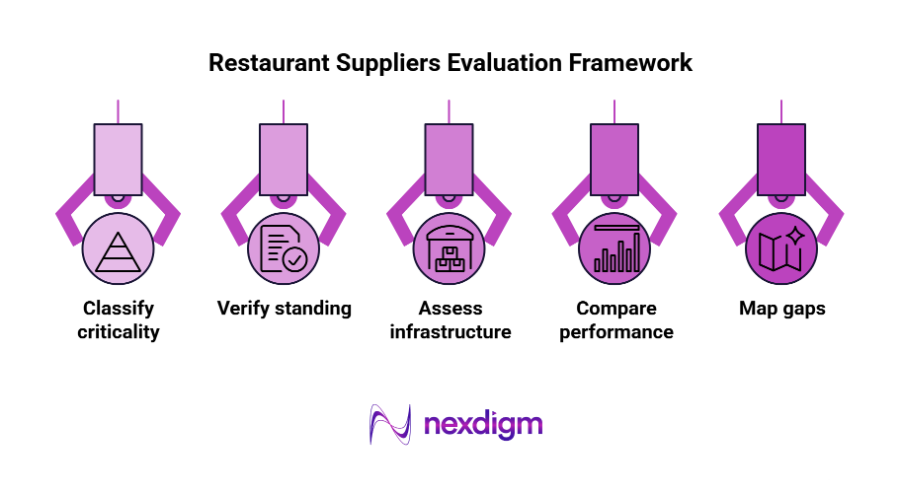
- Classify supplier criticality: Separate essential ingredients and high-risk categories from products with readily available alternatives.
- Verify regulatory standing: Examine FSSAI documentation, applicable product standards, testing records and facility-specific approvals.
- Assess handling and infrastructure: Evaluate storage conditions, transport arrangements, hygiene controls and product traceability.
- Compare service performance: Review delivery accuracy, fulfilment rates, lead times, rejection patterns and capacity across restaurant locations.
- Map gaps by market and category: Identify where supplier quality, compliance or infrastructure varies and where alternative vendors may be required.
Nexdigm’s market intelligence capabilities can support restaurant businesses by mapping supplier ecosystems, comparing regional market conditions and assessing the availability and operating capacity of vendors across locations. This helps businesses make better-informed decisions about expansion markets, supplier diversification and operational risk.
Nexdigm’s Case Study
A restaurant chain with 64 outlets across 4 cities reviewed 52 suppliers covering fresh produce, dairy, meat, packaging and dry ingredients. The assessment identified 13 vendors with material service or compliance gaps. After supplier rationalisation and alternate-source qualification, outlet-level fulfilment improved from 84% to 96%, while ingredient rejection rates declined by 22%.
To take the next step, simply visit our Request a Consultation page and share your requirements with us.
Harsh Mittal
+91-8422857704