

Restaurant procurement operates under different conditions from centralised retail sourcing. Fresh produce, meat, dairy, dry goods, beverages, cleaning supplies, and kitchen consumables have different storage requirements, delivery frequencies, and quality risks. A supplier that offers competitive prices may still be unsuitable if deliveries arrive outside receiving hours or products fail to meet kitchen specifications.
Supplier research should identify vendors that fit the restaurant’s menu, operating model, location, and service requirements.
Map Local Supplier Markets
Restaurant sourcing may involve producers, wholesalers, specialist distributors, cash-and-carry businesses, and broadline foodservice suppliers. Their strengths differ by product category. A specialist produce supplier may offer freshness and flexibility, while a broadline distributor may simplify ordering across multiple categories.
Market mapping should capture product range, service area, delivery frequency, minimum orders, cold-chain capability, and experience serving restaurants of similar size. Multi-outlet businesses should also establish whether vendors can maintain consistent service across all locations.
Compare Delivered Cost and Quality
Restaurant purchase prices need to be evaluated against usable yield, product specifications, delivery charges, order minimums, and wastage. Differences in cut size, grade, ripeness, pack format, or preparation requirements can make two quotations commercially incomparable.
For restaurant supplier identification and vendor research, suppliers should be assessed against the restaurant’s actual specifications and receiving procedures. Food safety documentation, temperature control, batch identification, substitution policies, and procedures for rejected goods are particularly important for perishable categories.
Test Service Reliability
Restaurant demand can fluctuate with day of week, local events, weather, and seasonal menu changes. Suppliers must be able to handle these variations without excessive substitutions, late deliveries, or inconsistent quality.
Restaurants should examine order accuracy, on-time delivery, fill rates, complaint resolution, and emergency replenishment options. They should also assess the practical availability of alternatives when a supplier cannot fulfil an order, particularly for ingredients essential to core menu items.
Restaurant Supplier Evaluation Framework
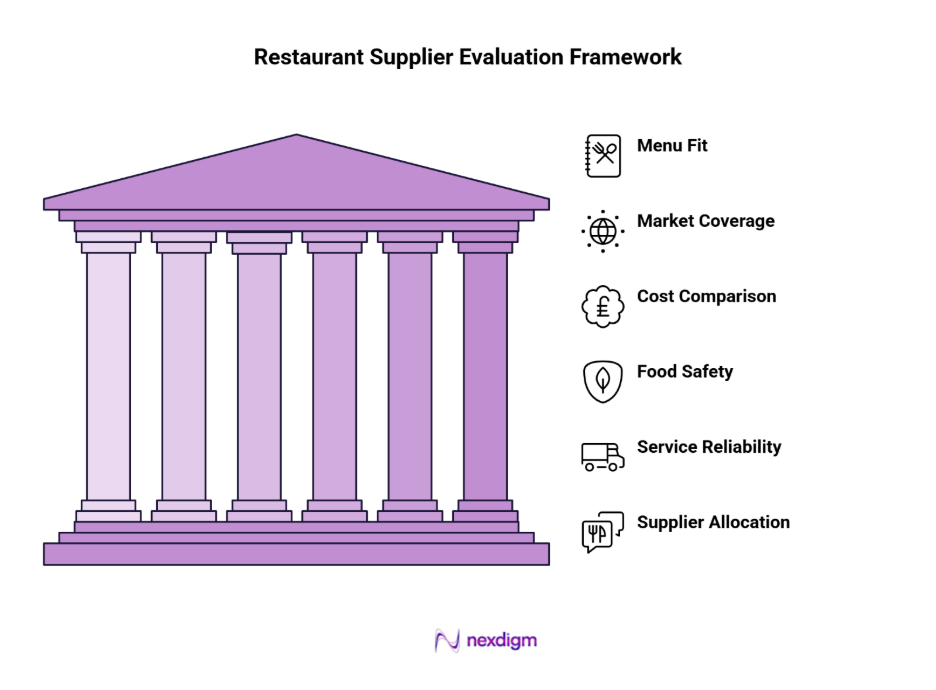
- Menu Fit: Define ingredient grades, pack sizes, freshness, preparation specifications, dietary requirements, and quality expectations for each purchasing category.
- Market Coverage: Map suppliers by product range, location, delivery schedules, minimum order quantities, and ability to serve individual restaurants or multi-outlet operations.
- Cost Comparison: Compare delivered prices, usable yield, freight, order minimums, wastage, substitutions, and payment terms to establish the true cost of supply.
- Food Safety: Verify applicable licences, hygiene controls, temperature management, traceability records, and product-specific handling requirements before approving suppliers.
- Service Reliability: Assess order completeness, delivery punctuality, quality consistency, issue resolution, and backup arrangements for urgent or incomplete orders.
- Supplier Allocation: Assign suppliers by category and operational criticality, maintaining alternatives for essential ingredients where replacement delays could disrupt menu availability.
Build a Reliable Supplier Base
Restaurants should combine supplier qualification with ongoing performance reviews. Samples, trial orders, receiving inspections, and clear rejection procedures help establish whether a supplier can meet the required standard consistently.
The sourcing model should reflect the business. A single-site restaurant may prioritise flexibility and frequent local delivery, while a multi-outlet chain may need standardised specifications, consolidated pricing, and broader distribution coverage.
Nexdigm’s Case Study
A restaurant group operating 12 outlets reviewed suppliers across produce, dairy, and dry goods. Comparing delivered prices, minimum orders, and fulfilment records identified opportunities to consolidate selected purchases. The revised sourcing plan targeted a 5% reduction in addressable purchasing costs, with freshness, delivery reliability, and outlet-level availability monitored.
To take the next step, simply visit our Request a Consultation page and share your requirements with us.
Harsh Mittal
+91-8422857704