

Retail banking growth is increasingly shaped by customer behavior, digital adoption, deposit competition, lending demand, and payment activity. McKinsey reports that global banking balances across deposits, loans, and assets under management reached $406 trillion in 2025, while global banking net income rose to $1.3 trillion.
Customer access is also becoming increasingly digital. The World Bank’s Global Findex 2025 found that 79% of adults globally owned a financial account in 2024, while 86% owned a mobile phone.
For banks, fintech companies, and investors, the opportunity is not simply to measure market growth. It is to understand where growth is coming from, which customer segments are driving it, and whether it can be sustained.
A Retail banking market assessment helps organizations evaluate deposits, lending, payments, customer engagement, digital adoption, competition, and market economics. Nexdigm brings these factors together to identify the markets, products, customer segments, and channels with stronger growth potential.
Understanding the Growth Drivers of Retail Banking Sector
Nexdigm starts by breaking retail banking growth into its underlying components rather than treating the market as one revenue pool. Its assessment examines:
- Deposit growth: Measure increases in customer savings and account balances, indicating stronger customer trust, retention, and funding capacity.
- Consumer lending: Track growth in personal loans, mortgages, and credit products, reflecting customer borrowing demand and revenue opportunities.
- Payment activity: Assess transaction volumes and frequency, showing customer engagement, spending behavior, and the bank’s role in daily finances.
- Digital engagement: Evaluate usage of mobile and online banking channels, indicating customer adoption, convenience preferences, and cross-selling potential.
Nexdigm compares these indicators across markets and customer segments to determine whether growth comes from new customers, deeper relationships, higher transaction activity, or changing product demand. This gives decision-makers a clearer picture of where future retail banking growth may originate.
Finding New Opportunities
Deposits remain central to retail banking economics. Nexdigm examines how savings behavior, pricing, interest rates, and competition influence where customer funds move. Its analysis covers:
- Deposit Growth: Nexdigm tracks changes in balances and customer acquisition across markets.
- Customer Preferences: Nexdigm identifies demand for savings accounts, current accounts, term deposits, and higher-yield products.
- Rate Sensitivity: Nexdigm examines how customers respond to changing interest-rate conditions.
- Deposit Switching: Nexdigm identifies movement between products and competing institutions.
Nexdigm combines these insights with customer and market data to identify where deposit growth is strongest and where banks may face competitive pressure.
Understanding the Digital Adoption with Nexdigm
Digital access is no longer simply a supporting banking channel. Nexdigm evaluates whether customers are actively using digital services and whether that engagement creates commercial value.
McKinsey reports that mobile has become the most widely used banking channel, while banks leading in mobile adoption have experienced significantly faster deposit-account growth.
Nexdigm measures:
- Mobile usage: Measure how frequently customers use banking apps, indicating digital adoption, convenience preferences, and opportunities for personalized services.
- Online banking activity: Track customer interactions through web banking platforms, reflecting engagement levels and effectiveness of digital service delivery.
- Digital transactions: Evaluate volume and value of online payments, transfers, and purchases, revealing customer reliance on digital channels.
This allows financial institutions to distinguish between customers who are digitally registered and those who are genuinely active digital users.
How Nexdigm Prioritizes Investment in Retail Banking
For investors, retail banking growth needs to be evaluated alongside profitability, customer economics, and market structure. Nexdigm assesses:
- Market growth: Evaluates expansion in retail banking demand, helping identify attractive markets with strong customer acquisition and revenue potential.
- Payment activity: Measures transaction volumes and spending patterns, revealing customer engagement levels and opportunities for fee-based revenue growth.
- Digital maturity: Examines adoption of digital banking capabilities, indicating operational efficiency, customer experience strength, and long-term competitiveness.
Nexdigm combines these market-level indicators with customer and competitive analysis through its Retail Banking framework to determine where growth may be structurally attractive.
Nexdigm’s Retail Banking Framework
Nexdigm assesses retail banking markets through its Retail banking market assessment that help organizations identify growth opportunities, evaluate customer behavior, and support strategic decision-making. This involves:
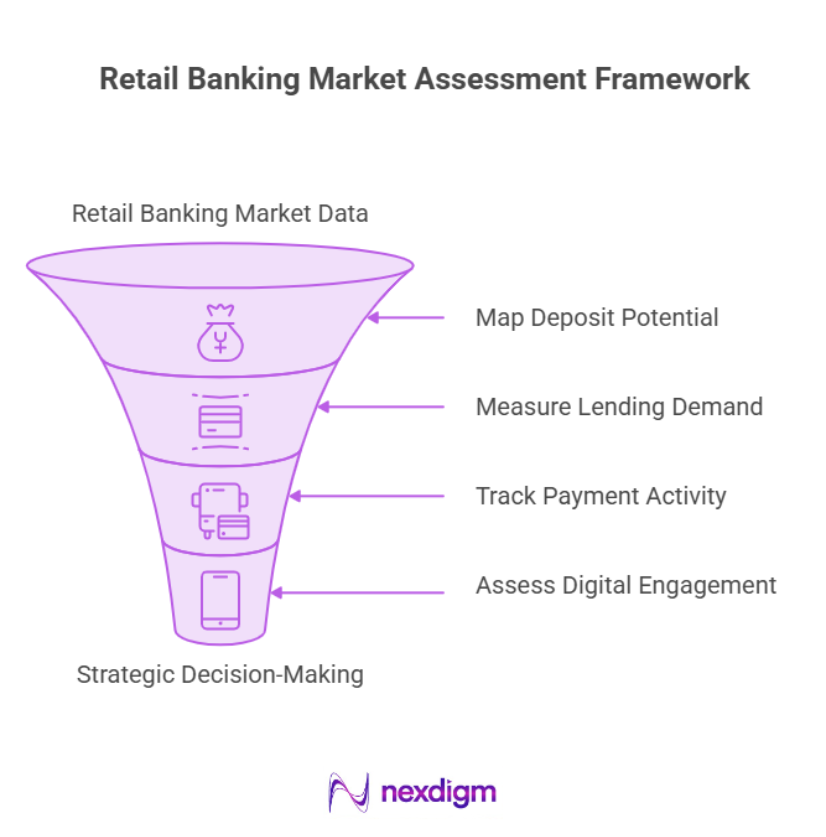
- Map Deposit Potential: Analyze deposit growth, savings behavior, pricing sensitivity, and competitive movements to identify markets with stronger funding opportunities.
- Measure Lending Demand: NStudy borrower segments, credit activity, income, economic conditions, and competitor lending to identify areas with attractive consumer-credit potential.
- Track Payment Activity: Nexdigm evaluates transaction volumes, payment methods, merchant activity, and digital adoption to identify markets where payment engagement is increasing.
- Assess Digital Engagement: Nexdigm measures mobile usage, digital transactions, feature adoption, and channel migration to determine whether digital investment is translating into deeper customer relationships.
Together, these major areas provide a clear view of where retail banking growth is emerging, what is driving it, and where the greatest opportunities exist.
Nexdigm’s Case
A retail bank used Nexdigm’s Retail banking market assessment to identify high-growth customer segments, deposit opportunities, lending demand, and digital engagement gaps. Within 12 months, targeted customer acquisition increased 28%, deposit growth improved 23%, digital engagement rose 31%, and cross-product adoption increased 19%.
To take the next step, simply visit our Request a Consultation page and share your requirements with us.
Harsh Mittal
+91-8422857704