

As customer acquisition costs continue to increase, financial institutions are rethinking their retail banking pricing strategy analysis to improve profitability while maintaining customer loyalty. A data-driven pricing analysis enables banks to optimize product pricing, service fees, and promotional offers based on customer behavior, competitive benchmarking, and market trends.
By aligning pricing strategies with evolving consumer expectations, retail banks can enhance customer lifetime value, strengthen acquisition and retention efforts, and create sustainable revenue growth in an increasingly competitive and digitally driven banking environment.
Global banking balances reached approximately $406 trillion in 2025, while industry revenues increased to $6.4 trillion and profits rose 7% year over year to $1.3 trillion. These trends reinforce the value of advanced retail banking pricing strategy analysis and data-driven pricing optimization.
Retail Banking Pricing Analysis for Profitable Customer Growth
Retail banking pricing analysis helps banks’ balance acquisition costs, customer value, and profitability by refining product rates, service fees, and offers through data-driven, segment-focused pricing decisions across competitive retail markets. Major focus areas of the same are:
- Improve Offer Profitability: Banks can assess whether promotional rates and incentives generate sufficient long-term value, helping eliminate unprofitable offers and prioritize acquisition campaigns with stronger financial returns.
- Align Pricing with Customer Segments: Segment-specific pricing matches fees, rewards, and product terms with customer needs, enabling banks to improve relevance, increase conversion, and strengthen overall portfolio profitability sustainably.
- Reduce Revenue Leakage: Detailed pricing analysis uncovers unnecessary waivers, inconsistent discounts, and underpriced services, allowing banks to protect margins and recover revenue without compromising customer experience or competitiveness.
- Support Product Bundling: Customer and product data helps banks create attractive account bundles, increase product adoption, deepen relationships, and generate additional revenue from existing customers across multiple services.
Nexdigm’s Retail Banking Pricing Strategy Analysis for Sustainable Growth
Nexdigm delivers retail banking pricing intelligence through advanced pricing analysis, competitive benchmarking, customer segmentation, and market research to help financial institutions optimize pricing strategies and improve profitability. With Nexdigm’s data-driven approach, this enables banks to reduce customer acquisition costs, enhance customer lifetime value, strengthen pricing decisions, increase revenue opportunities, and achieve sustainable growth while remaining competitive in an evolving retail banking landscape.
Nexdigm’s Roadmap for Profitable Retail Banking Pricing Analysis
Nexdigm’s structured roadmap helps retail banks evaluate pricing performance, control acquisition costs, improve customer value, and build profitable pricing strategies through evidence-based analysis, implementation, governance, and continuous optimization across portfolios. Key roadmap steps for the same are:
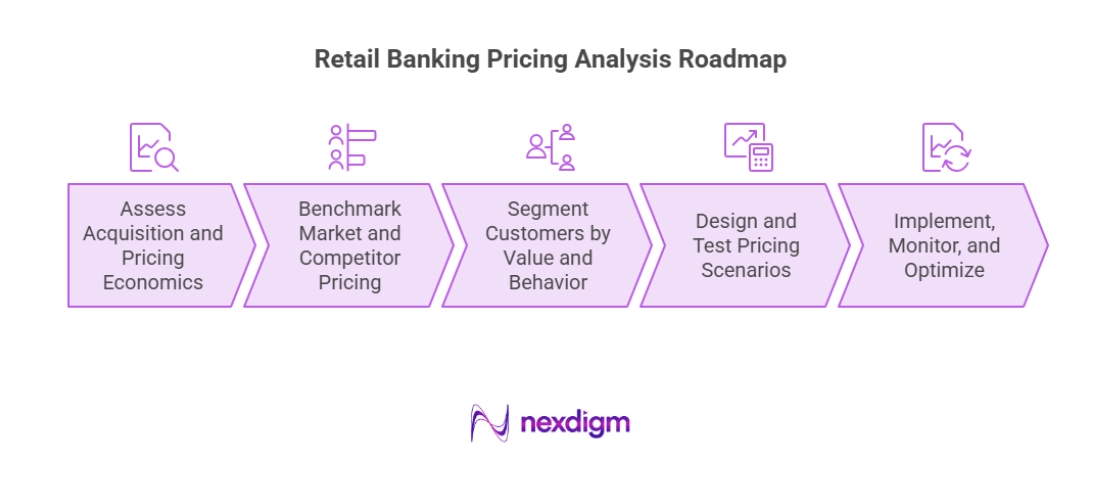
- Assess Acquisition and Pricing Economics: Nexdigm evaluates acquisition costs, product rates, service fees, customer profitability, and channel performance to identify margin pressures and establish clear retail banking pricing priorities.
- Benchmark Market and Competitor Pricing: Retail banking products, promotional offers, fees, and rewards are benchmarked against competitors to uncover pricing gaps, assess market positioning, and identify sustainable differentiation opportunities.
- Segment Customers by Value and Behavior: Customers are grouped using profitability, product usage, price sensitivity, and lifetime value to create targeted pricing strategies that improve acquisition quality, retention, and cross-selling potential.
- Design and Test Pricing Scenarios: Nexdigm models alternative rates, fees, bundles, and incentives to estimate conversion, revenue, margin, and churn outcomes before recommending commercially balanced retail banking pricing actions.
- Implement, Monitor, and Optimize: Pricing changes are introduced through controlled implementation, supported by performance dashboards, governance reviews, and continuous optimization to sustain profitability as acquisition costs and market conditions evolve.
Nexdigm’s Case
Nexdigm supported a financial services client with market opportunity analysis, customer segmentation, digital acquisition planning, and retail banking pricing intelligence. The engagement delivered a 25% increase in digital customer acquisition and 30% expansion into underserved customer segments, strengthening targeting efficiency, customer growth, long-term market positioning, and sustainable profitability.
To take the next step, simply visit our Request a Consultation page and share your requirements with us.
Harsh Mittal
+91-8422857704