

Retail categories are being shaped by changing consumer demand, sourcing costs, tariffs, and increasingly complex supply networks. The U.S. National Retail Federation forecasts 2026 retail sales at US$5.6 trillion, up 4.4% from 2025, while the latest NRF Retail Monitor reported September 2026 core retail sales of US$453.1 billion, up 3.73% year-on-year. E-commerce is also expanding, with U.S. online retail sales reaching US$340.2 billion in Q2 2026, up 12.2% year-on-year.
These movements make import data increasingly valuable for retailers, manufacturers, distributors, and investors. Looking at product-level imports can reveal where demand is developing, which countries and suppliers are gaining relevance, how pricing differs, and whether category growth is creating attractive commercial opportunities. This is where retail category import analytics can turn trade records into a more structured view of category strategy.
Import Activity Can Reveal More Than Category Size
Category-level import data provides a view of what products are entering a market, where they originate, and how sourcing patterns change over time. Rising imports can indicate stronger demand, but they can also reflect inventory rebuilding, pricing changes, or shifts in domestic production. Examining volume, value, suppliers, and origins together creates a more useful interpretation.
Supplier and Pricing Signals Add Commercial Context
Analyzing supplier participation and pricing alongside demand can reveal competitive dynamics, sourcing dependencies, and market concentration. Changes in supplier market share highlight evolving sourcing patterns, while comparisons of import values across origins and products provide insights into pricing competitiveness. Nexdigm can support this through trade intelligence, supplier benchmarking, and pricing analysis, enabling more informed sourcing and commercial decisions.
Nexdigm’s View of Retail Category Imports
Import data becomes more useful when businesses can understand the story behind the numbers. Nexdigm combines retail category import analytics ,trade intelligence and supplier intelligence to provide this broader view into:
- Track Category Movement: Nexdigm examines product-level imports to identify growing categories, changing demand, and emerging market patterns.
- Understand Suppliers: The analysis maps suppliers and sourcing origins to identify concentration, new participants, and alternative supply options.
- Compare Pricing: Nexdigm assesses indicative import values across suppliers and origins to highlight pricing differences and sourcing opportunities.
This approach helps businesses turn import information into clearer insights for category planning, sourcing, pricing, and market decisions.
Nexdigm’s Retail Category Intelligence Service Offerings
Import numbers alone do not explain whether a category represents a sustainable opportunity. Nexdigm brings together trade findings, category trends, consumer demand, competitor activity, pricing, and supply conditions to add commercial context.
Our strategic approach can identify attractive category opportunities, reveal supplier concentration and supply gaps, compare pricing across sources, and support decisions around assortment, sourcing, category expansion, and portfolio priorities.
This enables businesses to move from simply tracking imports to understanding what those movements mean for their broader category strategy.
Nexdigm’s Retail Category Import Assessment
Nexdigm can assess retail categories through a combination of import trends, product-level trade data, supplier intelligence, pricing analysis, market research, and competitive assessment. The objective is to determine where category demand is developing through:
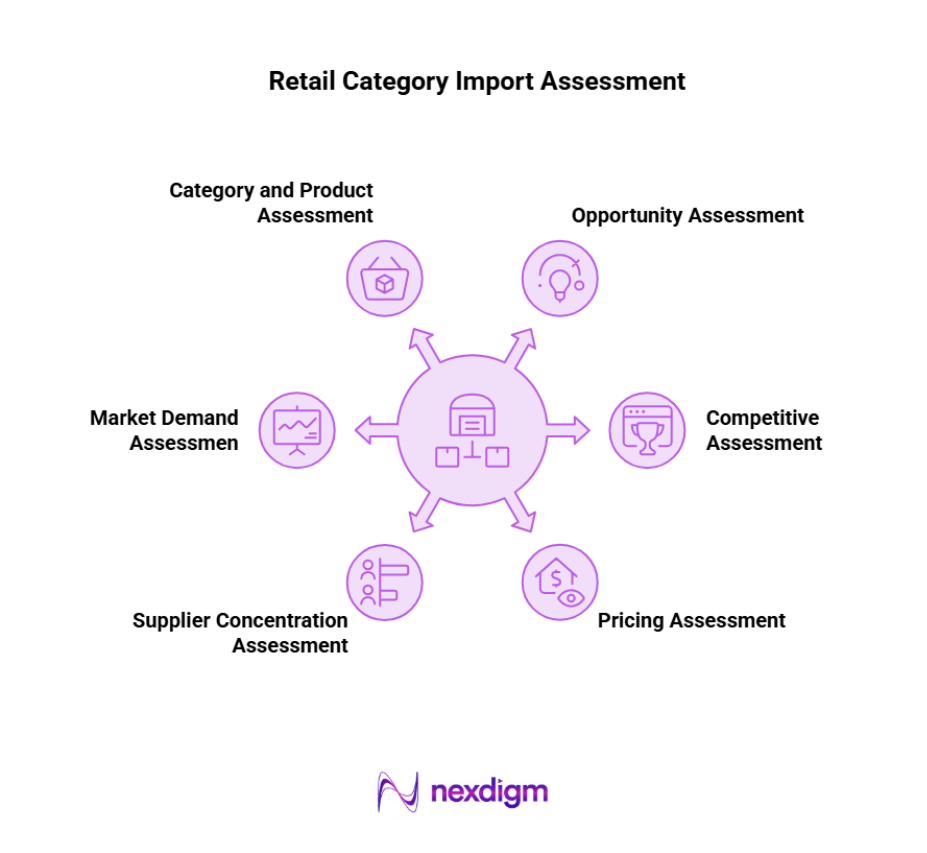
- Category and Product Assessment: Analyzing imports across products and subcategories to identify growth areas, declining segments, and products gaining market traction.
- Market Demand Assessment: Evaluating import growth, volumes, shipment activity, and buyer participation to understand the strength and direction of category demand.
- Supplier Concentration Assessment: Mapping suppliers and sourcing origins to identify dominant participants, emerging suppliers, geographic dependencies, and potential supply gaps.
- Pricing Assessment: Comparing indicative import values across suppliers, origins, products, and periods to identify pricing differences and potential sourcing advantages.
- Competitive Assessment: Examining supplier participation, market shares, product flows, and company activity to understand competitive intensity and changes in market positioning.
- Opportunity Assessment: Combining category growth, demand, supplier activity, pricing, competition, and accessibility to identify the most attractive opportunities for business action.
The assessment provides a structured view of category demand, supply, pricing, and competition, helping businesses determine which opportunities deserve further investment and which areas may require closer monitoring.
Benefits of Nexdigm’s Retail Category Import Assessment
Nexdigm’s structured assessment can help businesses in the following ways:
- Identify Growing Categories: Detect product segments showing stronger import and demand momentum.
- Find Market Opportunities: Identify categories and markets with attractive growth potential.
- Understand Supplier Risks: Highlight dependence on specific suppliers or sourcing origins.
- Discover Alternative Sources: Identify emerging suppliers and alternative procurement markets.
- Benchmark Pricing: Compare indicative import prices across suppliers and origins.
- Understand Competition: Track changes in supplier participation and competitive positioning.
Overall, the assessment helps businesses turn retail import data into practical category intelligence, supporting better decisions across sourcing, pricing, portfolio planning, procurement, and growth.
Nexdigm’s Case
Nexdigm used monthly trade-flow analysis to identify market shifts ahead of annual data. The approach helped a manufacturer achieve 18% export-volume growth, 24% higher distributor orders, and 15% fewer inventory gaps, demonstrating how timely trade intelligence can strengthen demand forecasting, sourcing decisions, and international category planning.
To take the next step, simply visit our Request a Consultation page and share your requirements with us.
Harsh Mittal
+91-8422857704