

A retailer can grow sales and still lose ground in a category if competitors are growing faster. Equally, a brand may gain share in a declining category without delivering meaningful revenue growth. Understanding category performance requires more than comparing sales totals: retailers need to examine share, product mix, pricing and changes in customer demand together.
Measure Share Against the Right Market
Market share is meaningful only when the market is defined consistently. A retailer’s share of total grocery sales is different from its share of premium packaged foods, and a brand’s share of value may differ from its share of units sold.
Start by defining the category, geography, channel and measurement period. Then select the appropriate denominator, such as total category revenue or total units sold within the same scope.
Separate value share from volume share. If a brand’s revenue grows while unit share falls, price increases or a shift toward higher-priced products may be responsible. If unit share rises but revenue remains flat, the brand may be winning through discounting or selling a lower-priced mix.
Retail sales data also requires care when interpreting growth. The US Census Bureau’s monthly retail sales estimates are adjusted for seasonal and trading-day effects but are not adjusted for price changes. Nominal sales growth should therefore not be treated as equivalent to real demand growth.
Find The Drivers Behind Category Movement
Effective retail category share intelligence connects sales and market-share changes with product availability, pricing, promotions, assortment and customer spending. The purpose is to establish not only who is gaining share, but what is driving the movement.
Four patterns are particularly informative:
- Share gain with volume growth: May indicate stronger demand, better distribution or increased customer preference.
- Share gain with falling prices: Could reflect successful value positioning, but the margin impact needs to be tested.
- Revenue growth with declining unit share: May signal price inflation or a shift toward premium products rather than stronger competitive performance.
- Share loss alongside stockouts: May indicate an execution problem rather than a loss of customer preference.
Product mix matters because category growth is rarely uniform. A retailer may gain in entry-level products while losing in premium ranges or perform well online while weakening in physical stores. Analysis should separate subcategories, price bands, brands and channels wherever data allows.
Connect Performance with Consumer Demand
Category share should be interpreted against changes in the spending environment. The US Bureau of Labor Statistics reported that average household spending rose 1.8% in nominal terms in 2024, while consumer prices rose 2.9%, implying a decline in inflation-adjusted spending. The effect varied by category, demonstrating why nominal sales alone can obscure changes in purchasing power.
Retailers should compare category growth with relevant spending indicators and their own transaction data. Basket size, repeat purchases, conversion, promotion response and substitution between products can help explain whether share changes reflect durable preferences or temporary price and availability effects.
Retail Category Share Intelligence Framework
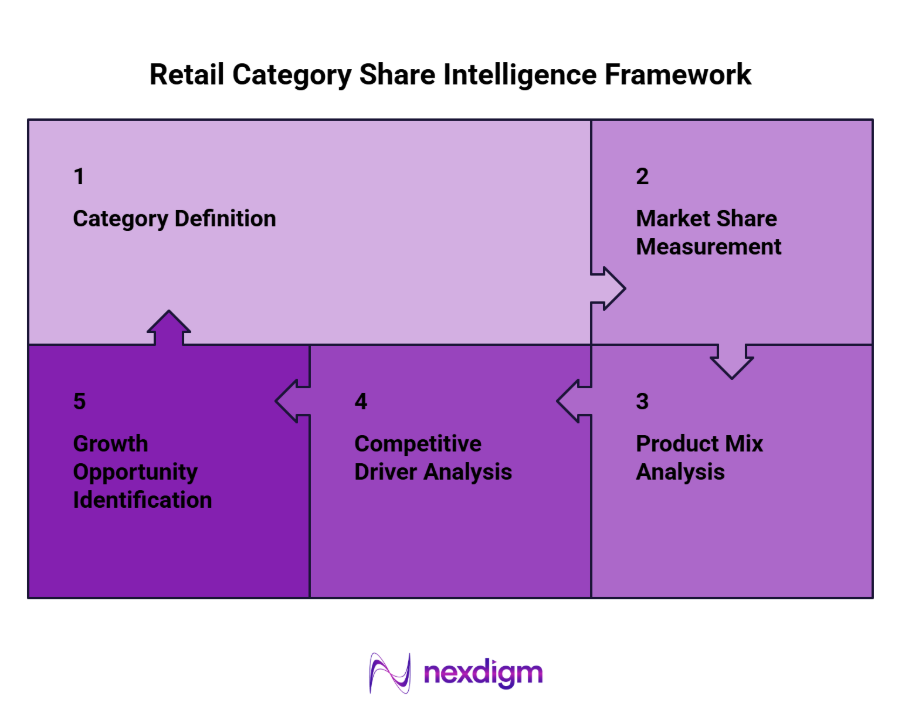
- Category Definition: Establish the relevant products, channels, geography and measurement period.
- Market Share Measurement: Compare value share, volume share and category growth.
- Product Mix Analysis: Identify performance differences across brands, subcategories and price tiers.
- Competitive Driver Analysis: Assess the effects of pricing, promotions, availability and distribution.
- Growth Opportunity Identification: Prioritise categories and products with credible opportunities to gain share.
Nexdigm’s Case Study: Diagnosing Share Loss
A personal-care retailer reviewed six subcategories across online and physical stores. Two subcategories gained revenue but lost unit share, while another lost share alongside recurring stockouts. The team separated pricing effects from availability issues and prioritised assortment and replenishment changes for the affected lines.
To take the next step, simply visit our Request a Consultation page and share your requirements with us.
Harsh Mittal
+91-8422857704