

Retailers are increasingly dealing with consumers whose behaviours cut across traditional demographic boundaries. A 2026 IBM-NRF study of 18,000 global consumers found that 41% use AI assistants to research products, 33% use them to look for reviews, and 31% use them to search for deals.
In India, an A&M–CII study found that 64% of shoppers complete purchases across two or more channels, while 83% rely on reviews before buying. These shifts make customer segmentation more dynamic: retailers need to distinguish consumers not only by age or income, but also by needs, purchase behaviour, channel preferences, value sensitivity, and shopping missions.
Effective retail customer segmentation analysis can therefore help businesses identify high-value customers and tailor products, pricing, experiences, and engagement strategies accordingly.
Why Traditional Customer Groups Are No Longer Enough
Customers with similar demographic profiles can have very different purchase frequencies, basket sizes, brand preferences, price sensitivity, and channel behaviour. Conversely, consumers from different demographic groups may respond similarly to convenience, value, premium products, or personalized offers. This makes behavioural and needs-based segmentation increasingly important for understanding the real drivers of retail value.
Customer Value Is Becoming More Contextual
Consumer priorities are also changing across categories and circumstances. BCG’s 2026 consumer research identifies value over price, longevity, solo living, trust, and AI-guided decision-making among the themes reshaping demand. Segmentation can help retailers determine which of these factors matter most to specific customer groups.
- High-Value Shoppers: Purchase frequency, basket value, profitability, loyalty, and lifetime potential can help identify customers requiring differentiated engagement.
- Need-Based Segments: Shopping missions, preferences, price sensitivity, convenience requirements, and product needs can reveal segments that demographics alone may overlook.
As customer perceptions of value become increasingly nuanced, segmentation helps businesses align offerings with evolving needs, preferences, and purchasing behaviors. By identifying high-value and need-based customer groups, retailers can create more targeted strategies
Nexdigm’s Approach to Conducting Customer Segmentation Analysis
Understanding customers requires more than knowing who they are. Nexdigm uses consumer research, market intelligence, purchase data, and category insights to understand how different customers behave and what they value. Our retail customer segmentation analysis helps businesses to:
- Understand Customer Needs: Identify what different customer groups value, including price, quality, convenience, products, and shopping experience.
- Identify Valuable Customers: Analyse spending, purchase frequency, loyalty, and basket size to identify high-value and high-potential customer groups.
- Support Better Decisions: Use segment insights to improve products, pricing, promotions, customer engagement, and channel strategies.
This approach helps businesses turn customer information into clearer segments and more focused retail strategies.
Why Businesses Partner with Nexdigm for Customer Segmentation
Nexdigm brings together consumer research, retail market intelligence, category analysis, competitive intelligence, pricing assessment, and channel intelligence.
This integrated perspective allows customer segments to be evaluated within their broader market context. Rather than relying only on transaction history or demographics, Nexdigm connects who customers are, what they need, how they shop, what they value, and how commercially attractive they are.
Nexdigm’s Customer Segmentation Assessment
Nexdigm’s assessment moves from broad customer information toward actionable segments with identifiable commercial characteristics. It combines behavioural, demographic, attitudinal, transactional, and market inputs to understand both customer value and customer needs through:
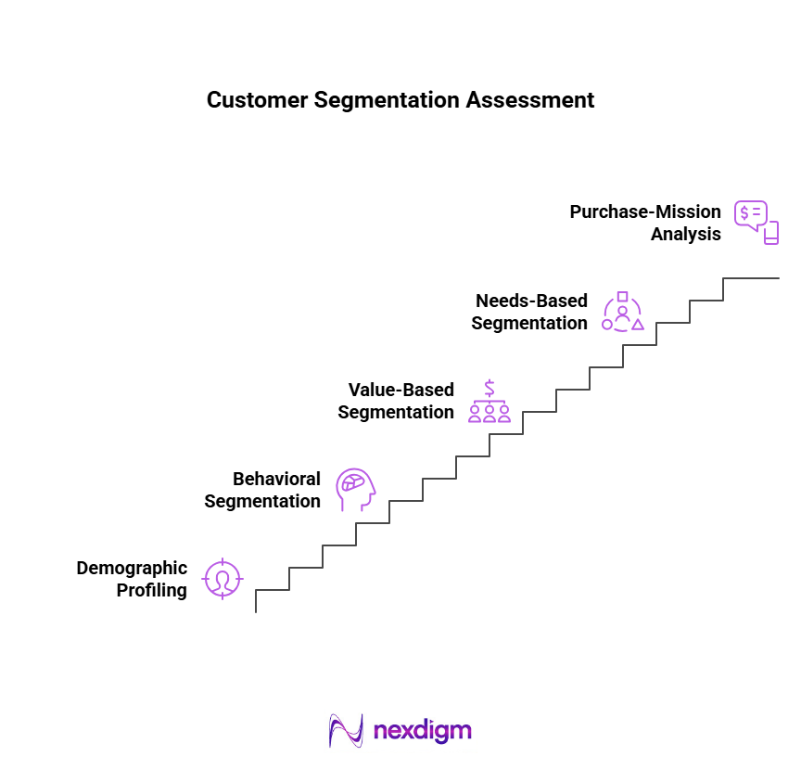
- Demographic Profiling: Nexdigm examines age, income, household structure, occupation, geography, and other relevant characteristics to establish the foundational profile of each customer group.
- Behavioural Segmentation: The analysis evaluates purchase frequency, basket size, category participation, brand switching, promotional response, and shopping frequency to identify meaningful behavioural differences.
- Value-Based Segmentation: Nexdigm can segment customers according to revenue contribution, profitability, lifetime value, purchase frequency, and growth potential to identify commercially important groups.
- Needs-Based Segmentation: The assessment identifies customers according to underlying needs such as convenience, affordability, quality, premiumization, variety, speed, trust, or product functionality.
- Purchase-Mission Analysis: Nexdigm examines whether customers shop for routine replenishment, planned purchases, impulse occasions, gifting, urgent needs, or other specific missions.
The assessment therefore moves beyond describing customer groups to determine which segments matter most and what businesses should do differently for each.
Nexdigm’s Case
Nexdigm conducted a consumer preference study covering 4,000+ respondents across 10 major Indian cities, examining purchase preferences, category perceptions, and shopping behaviour. The study generated segment-level insights that helped identify priority consumer groups and differentiated product preferences, supporting more targeted retail positioning and customer engagement.
To take the next step, simply visit our Request a Consultation page and share your requirements with us.
Harsh Mittal
+91-8422857704