

Retail facility management is a fragmented supplier market. Cleaning, security, technical maintenance, pest control, waste handling, and energy-related services may be provided by separate specialists or bundled under a single facilities contract. The right sourcing model depends on the retailer’s property footprint, service complexity, and ability to manage multiple vendors.
A market assessment should compare not only service rates but also workforce coverage, subcontracting, compliance controls, and the supplier’s capacity to deliver consistently across locations.
Understand the Service Market
Facility management vendors differ in scale and operating model. Regional providers may offer local responsiveness and competitive pricing, while national operators can coordinate services across a wider store network. Specialist providers may be better suited to technical maintenance or regulated activities that require specific qualifications.
Retailers should map the available supplier base by service category and geography. A company with broad cleaning coverage should not automatically be considered qualified for electrical maintenance, fire-system servicing, or other technically specialised work.
Compare Service Scope and Pricing
Facility management quotations often bundle labour, supervision, equipment, consumables, call-outs, and reporting. Different staffing assumptions or service frequencies can make apparently similar offers commercially incomparable.
The Royal Institution of Chartered Surveyors’ guidance on facility management procurement emphasises planning, procurement decisions, and post-award management as connected parts of the process. For retailers, that means the scope, performance measures, and review arrangements should be established before comparing offers, not negotiated after a supplier is selected.
For retail facility management supplier identification, the evaluation should also distinguish directly employed staff from subcontracted services and identify who remains accountable when performance fails.
Assess Coverage and Compliance
A supplier’s national presence does not necessarily mean it has its own workforce in every market. Retailers should verify local supervisors, staffing arrangements, backup personnel, emergency response, and the use of subcontractors.
Compliance checks should be tailored to the service and jurisdiction. Relevant areas may include worker qualifications, labour requirements, safety procedures, insurance, waste-handling obligations, and records of inspections or incidents. These requirements should be verified against applicable local rules rather than assumed to be uniform across regions.
Retail Facility Management Vendor Assessment Framework
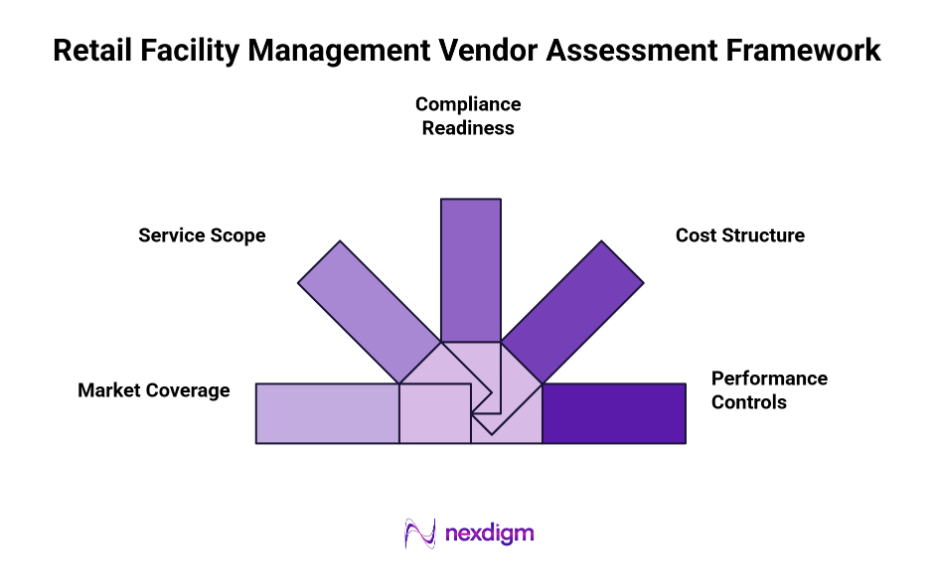
- Market Coverage: Map vendor presence by service line and location, distinguishing owned operations from subcontracted delivery and confirming local response capability.
- Service Scope: Standardise service frequencies, staffing levels, operating hours, equipment, consumables, technical requirements, and emergency obligations before requesting comparable quotations.
- Compliance Readiness: Verify relevant qualifications, insurance, safety processes, labour documentation, permits, and incident-reporting responsibilities for each service category.
- Cost Structure: Compare labour, supervision, equipment, consumables, travel, call-out charges, overtime, and contract escalation terms under consistent assumptions.
- Performance Controls: Define measurable service levels, inspection routines, escalation paths, corrective actions, and periodic reviews to maintain accountability after contract award.
Choose the Right Contract Model
A single integrated contract can simplify accountability but may reduce transparency into subcontractor costs. Separate specialist contracts can improve technical control but increase coordination requirements. Retailers should choose based on the complexity of their sites and the capacity of their internal facilities team.
Nexdigm’s Case Study
A retailer reviewing facilities contracts across 42 locations found that cleaning and maintenance proposals used inconsistent staffing and call-out assumptions. Normalising the scope revealed meaningful cost differences between vendors. Revised service specifications and contract terms produced an 7% reduction in addressable annual spend while retaining location-level service requirements.
To take the next step, simply visit our Request a Consultation page and share your requirements with us.
Harsh Mittal
+91-8422857704