

Retail decision-making is becoming increasingly data-intensive as consumers move between physical stores, marketplaces, social platforms, and digital channels. UNCTAD estimates that business e-commerce sales exceeded US$28 trillion in 2024 across 46 economies representing around three-quarters of global GDP. Its latest data also shows that e-commerce sales in developing economies have grown at more than twice the average annual rate of developed economies since 2016.
The retail transformation is not limited to online sales. The OECD reports that the share of EU internet users purchasing online increased from 59% in 2014 to 77% in 2024, while online sales rose from 10% of total retail turnover in 2017 to 19% in 2023. Retailers are also increasingly adopting advanced technologies: AI adoption among EU retailers increased from approximately 7% in 2020 to 12% in 2024.
These changes create a much broader information environment for retailers and consumer businesses. This is where retail intelligence becomes valuable, bringing together market, consumer, competitor, channel, trade, and operational information to turn fragmented signals into commercially useful insights.
Sales Data Does Not Explain Every Demand Shift
Sales can rise because of price increases, new customers, higher purchase frequency, promotional activity, distribution expansion, or changes in product mix. Similarly, stable category sales can conceal strong growth in specific segments, channels, or geographies. Businesses therefore need to examine customer behaviour, product performance, pricing, channels, and competitive activity together to understand the underlying drivers of retail demand.
Understanding the Customer Behavior and Market Gaps
Consumers increasingly move between physical and digital channels, compare products across platforms, and respond differently to pricing, convenience, assortment, and brand propositions. This creates opportunities for retailers to identify underserved needs and emerging segments.
- Customer Behaviour: Analyzing preferences, purchasing journeys, channel choices, and price sensitivity can reveal behavioural changes hidden within aggregate sales performance.
- Market Gaps: Comparing consumer needs with existing products, pricing, assortment, and channel availability can identify whitespace for innovation and expansion.
How Nexdigm Turns Retail Signals into Actionable Intelligence
The value of retail intelligence lies in connecting individual market signals rather than viewing them in isolation. Customer behaviour, category performance, competitor activity, pricing, channels, and sourcing patterns can point to different opportunities when examined together. Nexdigm offers Retail Intelligence expertise that helps determine which signals are significant, how they influence one another, and where they can support practical retail decisions.
Nexdigm’s Retail Intelligence Expertise
Nexdigm combines retail and consumer-sector expertise with market research, consumer insights, competitive intelligence, trade analysis, pricing assessment, and supply-chain intelligence.
Our Retail Intelligence can connect customer behaviour, category performance, competitor activity, product availability, pricing, sourcing, channels, and market conditions to create a broader view of retail opportunities.
Rather than treating sales data as the final answer, Nexdigm can integrate secondary research, primary research, company intelligence, trade information, channel assessments, and market-level analysis to explain what is changing and what those changes could mean commercially.
Nexdigm’s Retail Intelligence Assessment
Nexdigm’s assessment is designed to move from market observation to diagnosis and then commercial prioritization. It examines the demand, customer, competitive, product, channel, and economic factors influencing retail performance through:
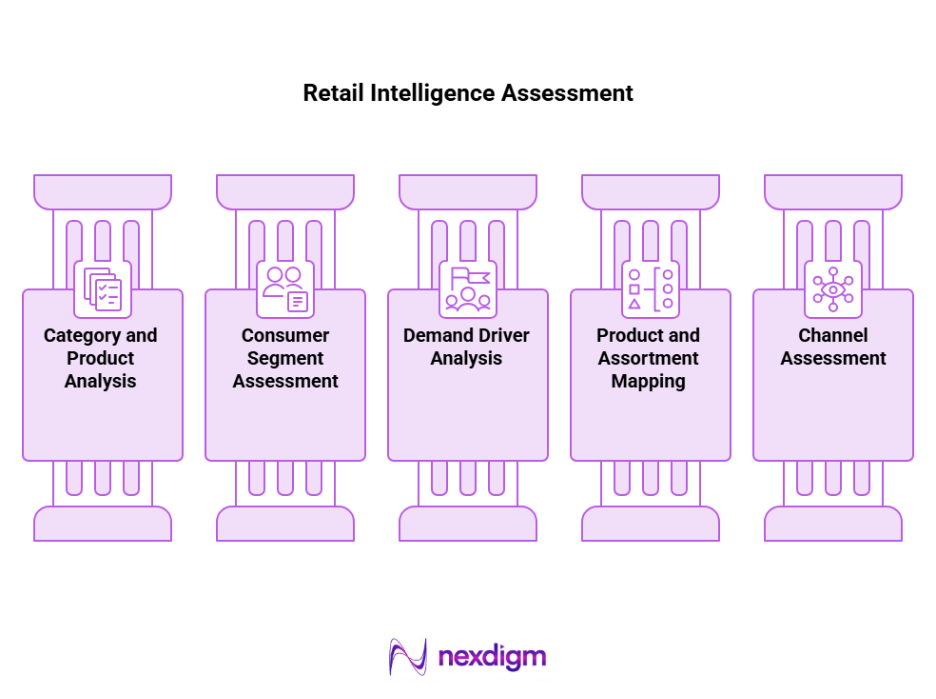
- Category and Product Analysis: Analyzing categories, subcategories, products, and SKUs to identify growth patterns, declining segments, and changes in product-level commercial importance.
- Consumer Segment Assessment: Nexdigm evaluates demographic, behavioural, geographic, and need-based segments to identify differences in preferences, purchasing behaviour, and unmet requirements.
- Demand Driver Analysis: Assessment of economic, demographic, lifestyle, technological, and category-specific factors influencing changes in consumer demand.
- Product and Assortment Mapping: Nexdigm compares product portfolios, formats, features, price points, and assortment structures to identify differentiation and whitespace opportunities.
- Channel Assessment: Evaluation of physical retail, e-commerce, marketplaces, distributors, specialty channels, and direct-to-consumer models to understand customer access.
Together, these dimensions help businesses understand what is changing, what is driving the change, and where the strongest opportunities or risks may lie.
Nexdigm’s Retail Intelligence Delivering Strategic Business Decisions
Retail intelligence creates value when market and consumer insights are translated into clear business actions. Nexdigm can connect customer behaviour, category performance, competitive activity, pricing, sourcing, and channel dynamics to support decisions across:
- Portfolio and Innovation Decisions: Nexdigm can identify underpenetrated product segments, changing consumer needs, price-point gaps, and emerging category trends to support portfolio expansion, rationalization, product development, and innovation priorities.
- Market and Channel Expansion: Evaluation of category attractiveness, customer segments, competitive intensity, channel development, pricing, and accessibility to help businesses prioritize geographic expansion and select appropriate retail or digital channels.
- Pricing and Competitive Positioning: Benchmarking competitor prices, promotions, product propositions, and market positioning to identify pricing gaps, improve value propositions, and determine where businesses can differentiate within crowded retail categories.
- Customer and Category Growth: Nexdigm can assess customer segments, purchase behaviour, category preferences, and unmet needs to identify growth opportunities, refine customer strategies, and develop targeted propositions for priority consumer groups.
By linking intelligence with specific commercial priorities, Nexdigm helps businesses move from understanding retail market changes to determining where to invest, how to compete, and which growth opportunities to pursue.
Nexdigm’s Case
Nexdigm supported a grocery retailer facing supplier price increases by benchmarking packaging and private-label costs and mapping alternative EU suppliers. The analysis identified 8–12% pricing gaps, enabling contract renegotiation and dual sourcing that stabilized procurement costs and protected category margins.
To take the next step, simply visit our Request a Consultation page and share your requirements with us.
Harsh Mittal
+91-8422857704