

Retail inventory risk is increasingly tied to uncertainty across both demand and supply. A 2026 IHL estimate puts global inventory distortion at US$1.7 trillion annually, comprising lost sales from stockouts and costs associated with overstocks. Separately, a 2025 survey of 200 U.S. small and mid-sized retailers found that 23% only discovered an item was out of stock when a customer attempted to purchase it, while 70% reported having 20–60% of business capital tied up in inventory.
These pressures make inventory decisions increasingly dependent on timely information about demand, suppliers, shipments, prices, origins, and market movements. Trade intelligence can provide one additional layer of visibility.
Inventory Risk Is Both a Demand and Supply Problem
Retailers can accumulate excess stock when forecasts overestimate demand, but they can also experience stockouts when replenishment fails to respond quickly to changing demand or supply disruptions. Recent research estimates that inventory record inaccuracies can affect 50–70% of SKUs in retailing, while correcting such inaccuracies has been associated with sales improvement potential of up to 11%.
Trade Flows Can Provide Earlier Supply Signals
Import and export movements can reveal changes in supplier participation, shipment frequency, sourcing origins, product availability, and indicative pricing. These signals can complement internal sales and inventory data.
- Demand Signals: Rising import activity, shipment frequency, and product movements can indicate changing market demand or replenishment requirements.
- Supply Signals: Supplier exits, declining shipments, origin concentration, and changing trade routes can indicate potential sourcing constraints or replenishment risks.
How Nexdigm Assesses Such Trade Flows
Nexdigm connects trade intelligence with retail, consumer, market, competitive, and supply-chain analysis to understand the external factors influencing trade flows and inventory decisions. Its retail inventory trade intelligence approach can provide visibility into the following areas:
- Product and Trade-Flow Signals: Analysis of product-level imports, exports, shipment frequency, trade values, and volumes to identify changing demand and supply patterns.
- Supplier and Sourcing Signals: Mapping of suppliers, origins, sourcing concentration, and trade relationships to identify dependencies, diversification opportunities, and potential replenishment risks.
- Pricing and Buyer Signals: Tracking indicative prices, buyer participation, and market activity to provide additional context for procurement, inventory valuation, and demand movements.
Why Retailers Need External Inventory Signals
Internal sales and inventory data show what is happening within a retailer’s network. They may not explain what is happening across the wider supplier and market ecosystem.
Trade intelligence can provide additional visibility into supplier behaviour, competitor sourcing, import demand, product availability, and country-level supply movements.
This becomes particularly relevant when retailers are dealing with long lead times, seasonal products, imported merchandise, concentrated sourcing, or categories exposed to international supply disruptions.
Nexdigm’s Retail Inventory Trade Intelligence Framework
Nexdigm can structure the analysis into five steps, connecting external trade signals with internal inventory and replenishment decisions. These steps are:
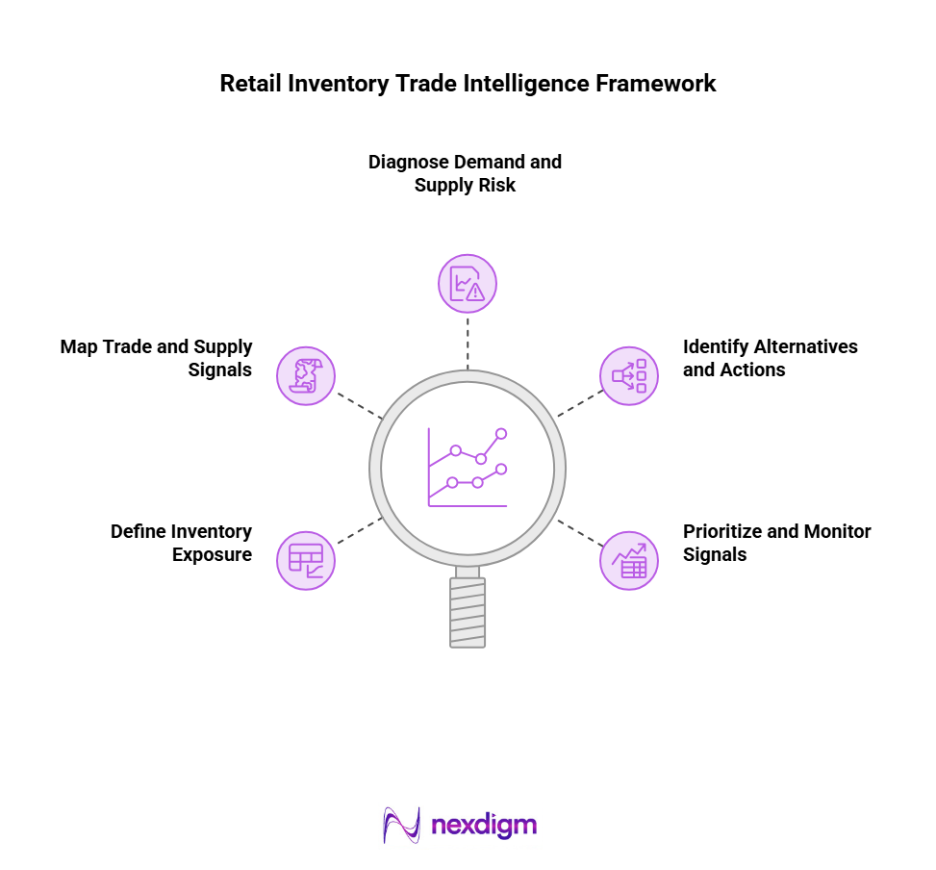
- Define Inventory Exposure: Identify priority categories, products, SKUs, suppliers, sourcing markets, and specific inventory concerns such as stockouts, overstocks, seasonal exposure, or long replenishment cycles.
- Map Trade and Supply Signals: Analyse imports, exports, shipment activity, supplier participation, sourcing origins, buyers, trade values, volumes, and pricing to establish the external market environment.
- Diagnose Demand and Supply Risk: Assess changes in product flows, supplier concentration, shipment frequency, buyer activity, and pricing to determine whether inventory exposure may be linked to demand shifts or supply constraints.
- Identify Alternatives and Actions: Evaluate alternative suppliers, sourcing origins, trade routes, procurement options, and inventory strategies to identify practical responses to emerging risks.
- Prioritize and Monitor: Rank products and sourcing relationships by risk and strategic importance, then monitor relevant trade signals to determine whether conditions are improving, deteriorating, or changing.
This five-step framework helps convert external trade movements into structured signals for inventory, procurement, and replenishment decisions.
Benefits of the Nexdigm’s Framework for Interpreting Inventory Risk
- Earlier Risk Identification: Trade and supplier signals can reveal emerging supply constraints before they become visible through internal inventory data alone.
- Better Demand Interpretation: Import activity, shipment frequency, and buyer movements can provide additional context for understanding whether demand is strengthening or weakening.
- Supplier Dependency Visibility: Mapping sourcing concentration helps retailers identify products that depend heavily on particular suppliers or geographic origins.
- Improved Replenishment Planning: External market signals can support decisions around reorder timing, safety stock, and replenishment priorities.
- Alternative-Sourcing Identification: Supplier and origin analysis can highlight potential alternatives when existing supply relationships become constrained.
Overall, Nexdigm’s framework helps retailers move from simply monitoring inventory levels to understanding the external market forces that may be driving inventory risk, enabling more informed replenishment, procurement, and sourcing decisions.
Nexdigm’s Case
Nexdigm supported a retail client evaluating supplier and procurement exposure across multiple product categories. By combining trade-flow analysis, supplier mapping, pricing benchmarks, and sourcing concentration, the assessment identified alternative supply markets and highlighted 8–12% pricing gaps across comparable sourcing options. The findings supported supplier diversification and procurement discussions, helping the client strengthen its approach to cost management and supply continuity.
To take the next step, simply visit our Request a Consultation page and share your requirements with us.
Harsh Mittal
+91-8422857704