

Retail participation is becoming a structural feature of capital markets as digital access, rising incomes, systematic investing, and broader financial awareness bring more individuals into equities and other investment products. In India, 235 lakhs new demat accounts were opened during FY26 through December 2025, taking the cumulative total beyond 21.6 crore. Unique registered investors crossed 12 crores in September 2025, with women accounting for nearly one-fourth of the investor base.
Regular household investment is creating a larger domestic pool of capital and supporting liquidity across equity and debt markets. Domestic institutional investors’ equity ownership also reached 18.3%, exceeding foreign portfolio investors at 16.7%.
The New Retail Investor Is Younger and More Geographically Diverse
Capital-market participation is spreading beyond traditional metropolitan investors. Individuals under 35 account for a significant share of new registrations, while secondary, tertiary, and rural markets are contributing an increasing proportion of new accounts.
Entry amounts are also becoming smaller. Investors can begin through micro-contributions and recurring monthly investments rather than substantial lump-sum allocations. Mobile applications have further reduced the friction involved in researching, purchasing, and monitoring investments.
Women now represent approximately 25% of unique investors, adding another expanding demographic segment to the retail investor base.
Participation Is Expanding Beyond Direct Equities
Equities remain an important entry point, but retail savings are increasingly distributed across different capital-market products.
Systematic Investment Plans are encouraging recurring investments in diversified equity and hybrid funds, shifting behaviour away from market timing. Index funds and ETFs provide lower-cost exposure to broad markets, while online bond platforms are making fixed-income products more accessible.
Retail investors are also participating in primary-market activity through IPOs and SME listings, using digital payment and application infrastructure to participate in corporate capital raising.
This diversification creates opportunities across products rather than concentrating retail demand within brokerage accounts alone.
Access Is Only One Part of the Participation Story
Digital onboarding has significantly reduced the friction associated with entering capital markets. Aadhaar-based e-KYC, digital documentation, instant payments, and centralized depository infrastructure allow accounts to be opened and funded much faster than traditional paper-based processes.
Income growth and formalization of household finances are expanding the pool of savings available for investment. Financial-literacy initiatives and easier access to market information are also encouraging longer-term investment behaviour. Monthly mutual fund SIP contributions have exceeded ₹28,000 crore, demonstrating the scale of recurring household participation.
For financial institutions, the opportunity lies in identifying populations that have the capacity to invest but remain underrepresented in capital markets.
Nexdigm’s Retail Investment Demand Assessment Framework
Nexdigm evaluates retail investor opportunity by connecting the capacity to invest with actual participation, product preferences, digital access, and long-term engagement.
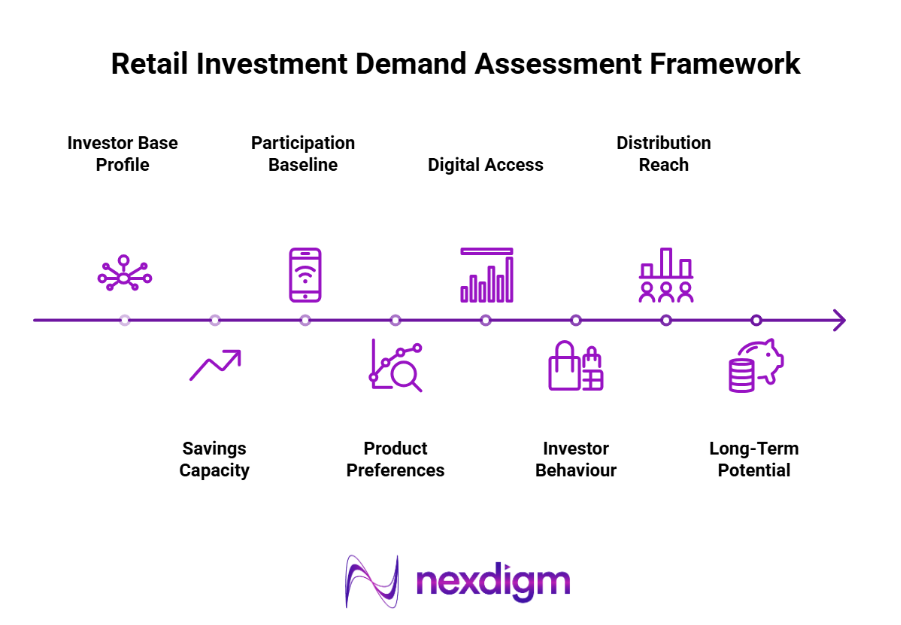
- Investor Base Profile: Segment populations by age, employment, urbanization, financial literacy, and other demographic characteristics.
- Savings Capacity: Assess disposable income, household debt, bank deposits, and the capacity to make recurring investments.
- Participation Baseline: Measure demat-account penetration, active investors, trading activity, and dormant accounts across target markets.
- Product Preferences: Analyse allocations across equities, mutual funds, bonds, gold, and higher-risk investment products.
- Digital Access: Evaluate smartphone ownership, connectivity, e-KYC availability, and digital-payment adoption.
- Investor Behaviour: Assess investment horizons, financial literacy, risk tolerance, market-cycle behaviour, and the influence of digital information channels.
- Distribution Reach: Map banks, independent financial advisors, digital platforms, local intermediaries, and other acquisition channels.
- Long-Term Potential: Project AUM growth, customer lifetime value, recurring investment behaviour, and retention across market cycles.
The assessment identifies where investable savings exist without corresponding capital-market participation, which investor cohorts are commercially attractive, and what products or distribution models can address them.
How Nexdigm Identifies the Next Retail Investor Pools
A national wealth-management organization and online brokerage assessed 30 Tier-2 and Tier-3 urban centres across income, age, and employment segments. The analysis identified approximately 11 million individuals with recurring savings capacity but capital-market participation below 4%.
Three priority cohorts emerged: professional service providers, female household financial managers, and specialized manufacturing-business owners. The firm subsequently introduced local-language digital interfaces, micro-SIP programs, and investor education initiatives, onboarding 840,000 new investors over two years, with more than 72% maintaining recurring systematic investments.
To take the next step, simply visit our Request a Consultation page and share your requirements with us.
Harsh Mittal
+91-8422857704
[email protected]