

Retail is moving from separate online and offline channels toward connected shopping journeys. Customers can discover products online, check store availability, order through an app, collect purchases in-store, or request home delivery.
The scale of this transition is significant. Deloitte reports that 80% of shopping still happens in physical stores, even as retailers expand digital and omnichannel capabilities. In India, online retail is projected to grow from $75 billion in 2024 to $260 billion by 2030, increasing its share of total retail from 7% to 14%.
For retailers, e-commerce businesses, distributors, 3PL providers, warehouse operators, investors, developers, and logistics technology companies, the challenge is no longer simply moving products from warehouses to stores.
It is about creating a connected network where stores, warehouses, inventory, fulfillment, transportation, and digital channels work together.
A Retail logistics market assessment helps identify where these networks are changing and what infrastructure is required to support future demand.
Retail Distribution Is Becoming More Connected
Traditional retail logistics followed a relatively linear model: manufacturers supplied distribution centers, distribution centers replenished stores, and customers purchased products in physical locations. Omnichannel retail creates multiple fulfillment paths.
An online order may be fulfilled from a central warehouse, regional distribution center, retail store, micro-fulfillment facility, or another nearby location. This creates flexibility but also increases operational complexity.
How Nexdigm Reads the Network Shift
Omnichannel growth does not mean every retailer needs more warehouses. The right response depends on product demand, store density, customer geography, inventory availability, order frequency, delivery expectations, and existing infrastructure.
Nexdigm connects these factors to understand how inventory should move across stores, warehouses, fulfillment centers, and customers.
This helps retailers distinguish between markets requiring additional physical capacity and those where better inventory coordination or fulfillment technology can unlock existing capacity.
What Is Reshaping the Distribution?
Several forces are changing retail logistics networks.
- Online growth: More digital orders increase demand for fulfillment, delivery, inventory visibility, and localized distribution.
- Store integration: Physical stores are increasingly used for pickup, returns, inventory fulfillment, and customer service.
- Customer expectations: Consumers expect convenient delivery, accurate availability, flexible collection, and simple returns across channels.
Omnichannel shopping creates reverse flows that require additional collection, processing, storage, and redistribution capacity.
How Nexdigm Finds the Right Distribution Model
The strongest opportunities emerge where customer density, digital demand, store networks, inventory availability, fulfillment costs, and delivery expectations overlap.
Nexdigm assesses these signals to identify where retailers can improve network coverage, increase asset utilization, reduce fulfillment friction, or develop additional logistics capacity.
The assessment helps determine the most suitable combination of stores, warehouses, fulfillment centers, transportation assets, and technology platforms required to support evolving customer needs.
To support this analysis, Nexdigm’s Retail Logistics Framework Model evaluates the key drivers shaping retail logistics demand and distribution performance, helping organizations identify high-potential opportunities and develop resilient, customer-centric logistics networks.
Nexdigm’s Retail Logistics Assessment
The Retail logistics market assessment focuses on five areas: demand, inventory, fulfillment, distribution infrastructure, and customer delivery. The framework connects changing consumer behavior with the physical and digital capabilities required to operate an effective omnichannel distribution network.
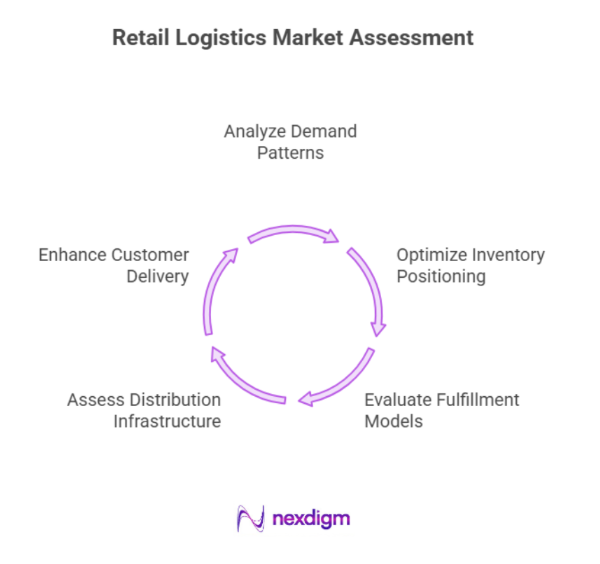
- Demand Patterns: Nexdigm examines online growth, store sales, order frequency, product categories, geographic demand, and seasonal peaks to determine where changing purchasing behavior is creating logistics pressure.
- Inventory Positioning: The assessment evaluates inventory visibility, stock accuracy, product velocity, store availability, and allocation strategies to determine where products should be positioned for efficient omnichannel fulfillment.
- Fulfillment Models: Nexdigm compares centralized warehouses, regional facilities, stores, and micro-fulfillment locations to identify the combination capable of balancing fulfillment costs, delivery speed, capacity, and customer convenience.
- Distribution Infrastructure: The framework considers warehouses, stores, urban facilities, transportation connections, delivery hubs, and available capacity to identify where existing infrastructure can support growth and where expansion may be required.
- Customer Delivery: Nexdigm assesses delivery speed, pickup options, flexibility, tracking, last-mile requirements, and returns to understand which service capabilities can improve customer experience without creating unsustainable logistics costs.
The assessment connects customer demand with inventory, fulfillment, infrastructure, and delivery, helping retailers determine whether growth requires new facilities, better asset utilization, stronger technology, or a combination.
Nexdigm’s Retail Logistics Market Assessment Insights
The Retail Logistics Assessment of Nexdigm helps businesses identify the key operational, infrastructure, and fulfillment factors influencing retail logistics performance. By evaluating demand patterns, distribution requirements, inventory strategies, and network capabilities, the assessment highlights the opportunities and challenges that shape logistics decision-making. These insights provide the foundation for developing targeted solutions and practical implementation strategies, as demonstrated in the following case study.
Nexdigm’s Case
A retailer used Nexdigm’s Retail logistics market assessment to improve inventory positioning and fulfillment planning. Within 12 months, order fulfillment efficiency increased 25%, inventory utilization improved 22%, delivery times declined and logistics costs fell, strengthening omnichannel performance and supporting scalable regional growth.
To take the next step, simply visit our Request a Consultation page and share your requirements with us.
Harsh Mittal
+91-8422857704