

Retail baskets are becoming more informative as consumers combine online and offline shopping, make more frequent top-up purchases, and respond differently to convenience, price, and promotions.
In India, quick-commerce basket sizes are rising as consumers increasingly use the channel for broader pantry shopping, while Beauty and Home Care average order values have increased 40% and 54% year-on-year, respectively.
Globally, 68% of brands in the 2026 Omnichannel Index use up- and cross-selling in the basket, while 60% support purchases that begin in one channel and finish in another. These shifts make retail market basket intelligence valuable for understanding what consumers buy together and what those combinations reveal about purchasing missions.
What Product Combinations Reveal About Shopping Missions
Products purchased together can reveal more than individual product demand. A basket containing snacks, beverages, and ready-to-eat products may indicate an immediate consumption occasion, while combinations involving household staples may reflect planned replenishment. Identifying these relationships helps retailers understand purchase missions, complementary needs, and opportunities to improve assortment and merchandising.
Basket Patterns Can Reveal Growth Opportunities
Market basket analysis identifies relationships between products that may not be obvious from individual SKU performance.
- Complementary Demand: Products frequently purchased together can reveal cross-selling, bundling, and merchandising opportunities within categories.
- Customer Missions: Recurring basket combinations can indicate specific shopping occasions, customer needs, and purchasing patterns that retailers can target more precisely.
By uncovering hidden relationships within purchasing behavior, basket pattern analysis helps businesses identify growth opportunities, strengthen category strategies, and improve customer engagement.
Nexdigm’s Retail Market Basket Intelligence Expertise
Nexdigm combines consumer research, retail market intelligence, category analysis, competitive intelligence, pricing assessment, and channel research to understand how consumers construct their baskets.
Our retail market basket intelligence approach can examine relationships between products, categories, brands, price points, promotions, customer segments, channels, and purchase occasions.
Rather than viewing individual SKUs independently, experts at Nexdigm analyze which products are purchased together, how frequently combinations occur, whether these relationships vary by customer or channel, and what they imply for assortment, merchandising, pricing, promotions, and customer growth.
How Nexdigm’s Market Basket Intelligence Is Different
Nexdigm goes beyond identifying products that are frequently purchased together. Its approach combines basket relationships with consumer, category, competitive, pricing, and channel intelligence to explain the commercial significance behind those patterns.
- Basket Data and Consumer Context: Nexdigm connects product combinations with customer segments, purchase occasions, preferences, and shopping missions to explain why specific products are purchased together.
- Transaction Patterns and Market Intelligence: Nexdigm combines basket relationships with category trends, competitor activity, pricing, promotions, and channel dynamics to identify broader commercial opportunities.
- Insights and Business Action: Nexdigm translates product-affinity findings into actionable strategies for assortment, merchandising, cross-selling, bundling, personalization, promotions, and basket-value growth.
This integrated approach helps businesses move from knowing what products are purchased together to understanding why those relationships matter and how they can be commercially activated.
Nexdigm’s Market Basket Intelligence Assessment
Nexdigm’s assessment moves from transaction-level relationships to broader consumer and commercial interpretation. It examines not simply which products are bought together, but why those combinations occur and how retailers can use the findings by conducting:
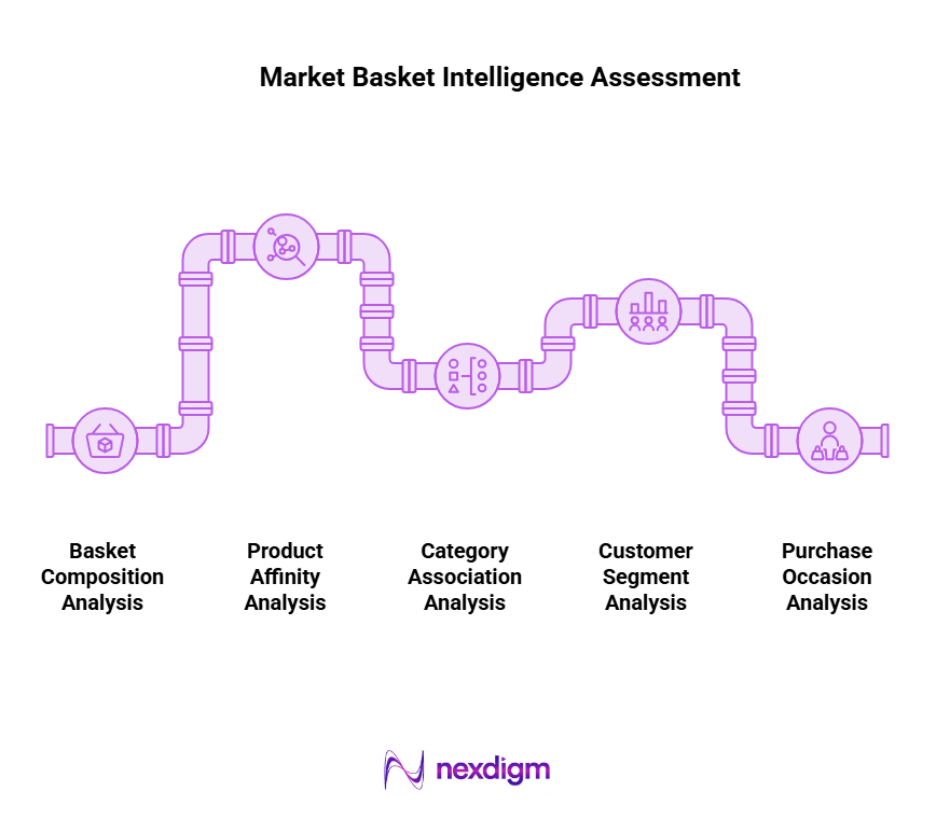
- Basket Composition Analysis: Nexdigm analyses basket size, item count, category mix, product combinations, transaction value, and purchase frequency to establish the structure of customer baskets.
- Product Affinity Analysis: The assessment identifies products and categories that frequently appear together, highlighting potential complementary relationships and cross-selling opportunities.
- Category Association Analysis: Nexdigm evaluates relationships between categories to determine whether purchasing one category increases the likelihood of purchasing another.
- Customer Segment Analysis: Basket relationships can be compared across customer segments to identify differences in product combinations, shopping missions, price sensitivity, and purchase frequency.
- Purchase Occasion Analysis: Nexdigm examines baskets by shopping occasion, season, promotion, and customer mission to distinguish routine replenishment from event-driven or impulse purchasing.
The assessment ultimately connects product relationships with customer behaviour and commercial outcomes, helping retailers understand not only what belongs in a basket but how those relationships can influence growth.
How Nexdigm’s Assessment Converts Basket Relationships to Category Growth
Identifying product associations is only the starting point. The greater value comes from understanding how these relationships can influence category performance, customer engagement, and retail economics. Nexdigm can translate basket-level findings into category-specific actions by:
- Identifying Category Growth Levers: Nexdigm can identify which product combinations contribute to higher basket value, greater purchase frequency, or stronger customer engagement, helping retailers prioritize cross-selling, bundling, and assortment opportunities.
- Reframing Category Roles: Basket analysis can reveal whether products function as traffic drivers, destination products, complementary purchases, or basket-building items. Nexdigm can use these relationships to support category-role definition and merchandising decisions.
- Finding Assortment Gaps: Frequently associated products that are unavailable, underrepresented, or poorly positioned can indicate opportunities to improve assortment. Nexdigm can compare basket relationships with existing product availability to identify potential gaps.
Nexdigm’s Case
Nexdigm conducted a consumer preference study covering 4,000+ respondents across 10 major Indian cities, examining purchase preferences, category perceptions, and shopping behaviour. The study generated segment-level insights that helped identify priority consumer groups and differentiated product preferences, supporting more targeted retail positioning.
To take the next step, simply visit our Request a Consultation page and share your requirements with us.
Harsh Mittal
+91-8422857704