

Launching a new retail concept can be an exciting growth opportunity. Whether it is a specialty store, lifestyle brand, experiential retail format, or multi-location expansion strategy, success depends on more than having a strong product offering. However, the real question is if the market is ready for a retail concept?
Many retail ventures fail not because the concept lacks merit, but because the market conditions, customer demand, competitive environment, or operational ecosystem are not yet aligned to support success. This makes a structured feasibility assessment an essential part of any market-entry decision.
Through retail market feasibility study consulting, businesses can evaluate demand, customer preferences, location suitability, competition, and commercial viability before investing in expansion. At Nexdigm, organizations are supported with comprehensive market insights that help determine whether a retail concept has the potential to succeed in a target market.
Is the Market Ready for Your Retail Concept?
Before investing in a new retail format, store expansion, or market entry initiative, businesses need to determine whether the target market can support their concept. Market readiness extends beyond customer interest and includes factors such as demand potential, competitive dynamics, location attractiveness, purchasing behavior, and commercial viability. Through a structured retail market feasibility study consulting approach, Nexdigm helps organizations assess these critical factors, enabling them to make confident entry decisions and reduce the risks associated with retail expansion.
Strategic Importance of Market Readiness
Retail success is influenced by a combination of market, customer, and operational factors. A concept that performs exceptionally well in one location may struggle in another due to differences in consumer behavior, purchasing power, competition, or accessibility. Before entering a market, businesses should assess:
- Customer demand and preferences: Evaluate customer needs, buying behaviors, product preferences, and expectations to determine whether the offering aligns with market demand.
- Market size and growth potential: Assess the current market opportunity and future growth prospects to understand the long-term potential of the target market.
- Competitive intensity: Analyze the number, strength, and strategies of competitors to evaluate market saturation and differentiation opportunities.
- Location attractiveness: Examine factors such as footfall, accessibility, demographics, and surrounding commercial activity to determine location suitability.
- Pricing acceptance: Measure customer willingness to pay and evaluates whether proposed pricing aligns with market expectations and perceived value.
- Retail infrastructure: Assess the availability of supply chains, logistics networks, retail facilities, and operational resources required to support business success.
Through its retail market feasibility study consulting services, Nexdigm helps businesses evaluate these critical factors and reduce uncertainty in expansion decisions.
Structured Framework for Retail Entry Decisions
Today, businesses need a systematic framework that assesses whether market conditions can support their retail concept. This can be done by thorough analysis of the following aspects:
Understanding Consumer Readiness
At the center of every successful retail strategy is the customer. A market may appear attractive based on demographics, but businesses must understand whether customers are genuinely interested in the proposed retail offering. Nexdigm helps organizations evaluate:
- Consumer preferences
- Shopping habits
- Purchase motivations
- Brand awareness
- Spending patterns
- Customer expectations
These insights help determine whether the retail concept aligns with local consumer needs and market demand.
Evaluating Market Potential
A feasibility assessment must determine whether sufficient opportunity exists to justify investment. Several key areas of analysis for evaluating market potential included by Nexdigm are:
- Market size
- Growth trends
- Demand drivers
- Emerging retail segments
- Customer spending potential
This analysis helps organizations quantify the opportunity and determine whether the market can support long-term business growth.
Assessing the Competitive Environment
Understanding who already operates within the market is essential before launching any retail concept. This helps businesses gain a deeper understanding of the competitive environment and tailor marketing strategies accordingly. Nexdigm conducts an insightful assessment to evaluate:
- Existing retail players
- Market leaders
- Store formats
- Product positioning
- Pricing strategies
- Customer experience models
By understanding current market dynamics, businesses can identify opportunities to differentiate their offerings and strengthen their market positioning.
Finding the Retail White Space
Retail white space refers to untapped market opportunities where customer needs are not fully addressed or where competition is limited, creating potential for business growth and differentiation. In many markets, opportunities exist within underserved customer segments or unmet shopping needs. Nexdigm helps businesses identify:
- Customer pain points
- Service gaps
- Product category opportunities
- Emerging consumer trends
- Untapped geographic markets
These insights can reveal opportunities where a retail concept can establish a stronger competitive advantage.
Building a Practical Entry Strategy for Retail Markets
Businesses need a clear roadmap before entering a new market. In such a case, entry planning strategy comes into account. It covers the following areas giving businesses a detailed overview of the market. Nexdigm supports businesses in this approach by defining the following elements:
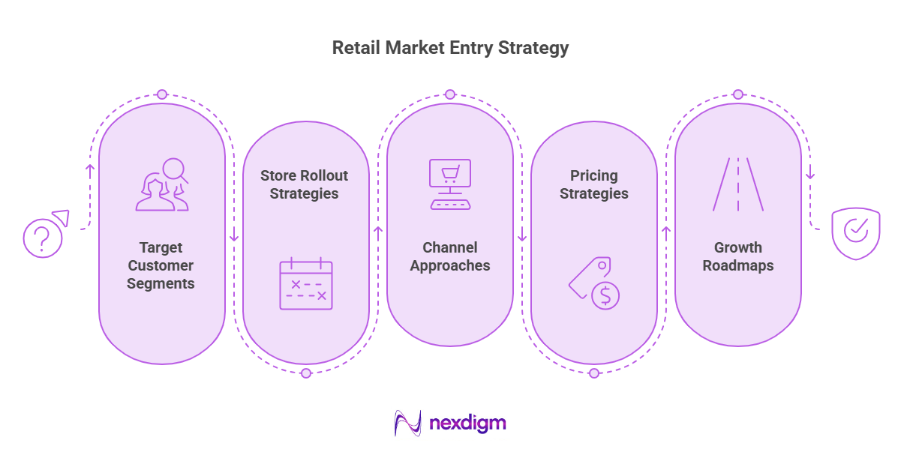
- Target customer segments: Identify the most relevant customer groups based on demographics, purchasing behavior, preferences, and market demand to ensure focused market entry efforts.
- Store rollout strategies: Determine the optimal sequence, scale, and timeline for opening stores, helping businesses expand efficiently while managing investment risks.
- Channel approaches: Evaluate the most effective sales channels, including physical stores, e-commerce platforms, franchise networks, and omnichannel models, to maximize market reach.
- Pricing strategies: Develop pricing frameworks that align with customer expectations, competitive dynamics, and profitability objectives within the target market.
- Growth roadmaps: Create a structured expansion plan outlining key milestones, investment priorities, scalability opportunities, and long-term growth objectives for sustainable retail success.
This helps businesses move from market evaluation to successful implementation with greater confidence.
How Nexdigm Supports Retail Market Feasibility Studies
What differentiates Nexdigm is its ability to combine market intelligence, consumer research, competitive analysis, and commercial evaluation into a single framework. Through its retail market feasibility study consulting services, Nexdigm helps organizations:
- Assess market readiness
- Validate retail concepts
- Evaluate location attractiveness
- Understand customer demand
- Identify competitive opportunities
- Determine commercial viability
- Support market-entry decisions
By integrating these elements, Nexdigm provides businesses with a comprehensive view of both opportunity and risk.
The Nexdigm Advantage in Retail Feasibility Assessment
A successful retail expansion depends on understanding whether a market can truly support a new concept. Nexdigm’s retail market feasibility assessment provides a holistic view of market readiness. This integrated approach helps businesses in:
- Validation of retail concepts before launch
- Clear visibility into market attractiveness
- Identification of underserved customer segments
- Assessment of revenue and profitability potential
- Stronger market-entry and expansion planning
Nexdigm’s Case
In a recent engagement, Nexdigm supported a retail client in evaluating market readiness for a new concept through a feasibility framework. Real-time assessment validated demand, improved entry decision confidence by 35%, reduced launch risks by 30%, and identified priority locations for expansion.
Nexdigm’s feasibility-led approach enabled the client to make informed entry decisions, align the retail concept with market realities, and pursue growth opportunities with greater confidence and clarity.
To take the next step, simply visit our Request a Consultation page and share your requirements with us.
Harsh Mittal
+91-8422857704