
Retail growth is becoming increasingly fragmented across categories, customer groups, geographies, and channels. Global trade reached a record US$35 trillion in 2025, while global goods trade rose approximately 12.5% year-on-year in Q1 2026. E-commerce is also expanding rapidly: business e-commerce sales across 46 economies exceeded US$28 trillion in 2024, with developing economies recording more than twice the average annual growth of developed markets since 2016.
These shifts make it increasingly difficult to identify retail growth through sales figures alone. Businesses need to understand which categories are expanding, which customers are driving demand, where channel preferences are changing, and which market spaces remain underserved.
Category Growth Is Becoming More Uneven
Retail categories rarely grow at the same pace. Within a broad segment, premium products may gain share while value offerings strengthen elsewhere, or demand may shift toward specific formats and occasions. Geographic differences add another layer, with the same category experiencing maturity in one market and rapid development in another. Identifying these differences helps businesses allocate resources toward the most promising opportunities.
White Spaces Often Sit Between Established Segments
Retail opportunities can emerge where customer needs are not fully addressed by existing products, pricing, assortment, or channels. These gaps may involve specific consumer groups, underserved locations, new formats, or digital-first purchasing journeys.
- Customer White Spaces: Unmet needs, changing preferences, and underserved customer groups can reveal opportunities for differentiated products and propositions.
- Market White Spaces: Gaps in category availability, channel coverage, geographic reach, or competitive offerings can indicate potential areas for expansion.
How Nexdigm Assesses Market Gaps and Retail Opportunities
Nexdigm combines retail and consumer-sector expertise with market research, consumer insights, competitive intelligence, pricing analysis, trade intelligence, and supply-chain assessment.
Our retail market intelligence approach can connect category performance with customer behaviour, competitor activity, product availability, pricing, channels, sourcing, and market conditions. This provides businesses with a broader view of where growth is occurring and what is driving it.
Experts at Nexdigm also integrate secondary research, primary research, company intelligence, consumer research, channel assessments, and market-level analysis to validate emerging opportunities and distinguish structural growth from temporary market movements.
Why Retail Businesses Trust Nexdigm
Nexdigm combines retail-sector expertise, consumer insights, market research, competitive intelligence, pricing analysis, trade intelligence, and supply-chain knowledge.
Our integrated approach allows businesses to examine retail growth from multiple perspectives rather than relying on sales data or market size alone. By connecting customers, categories, competitors, channels, pricing, sourcing, and market conditions, Nexdigm helps identify which opportunities are most relevant and commercially actionable.
Nexdigm’s Retail Market Intelligence Assessment Approach
Nexdigm’s assessment is designed to move from identifying market signals to understanding their commercial significance and prioritizing actionable opportunities. Rather than evaluating category size alone, it examines the following factors influencing retail growth:
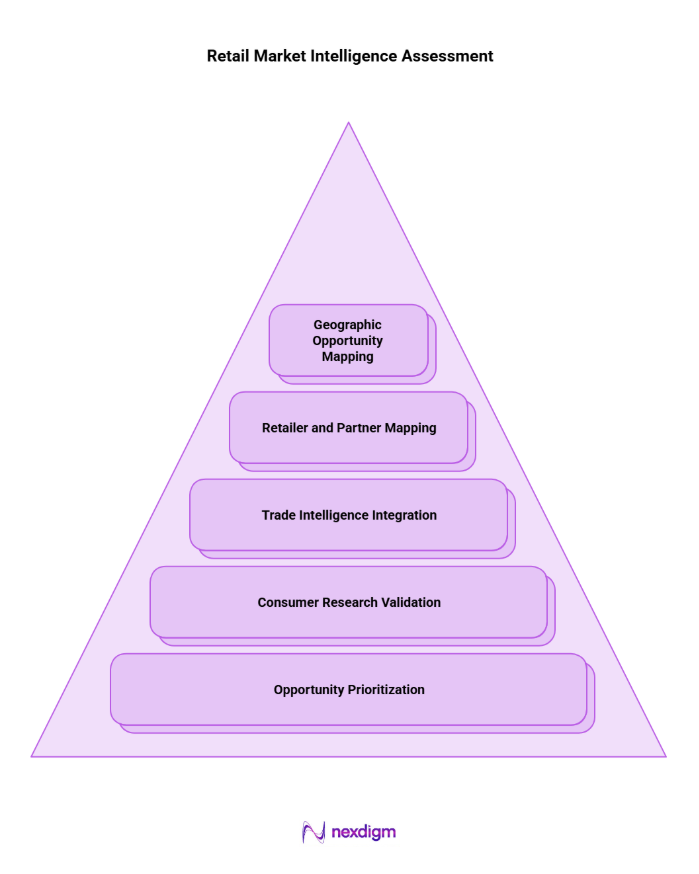
- Geographic Opportunity Mapping: Comparing demand, consumer characteristics, competition, channels, pricing, and accessibility across markets and locations.
- Retailer and Partner Mapping: Nexdigm identifies retailers, distributors, marketplaces, wholesalers, and other relevant organizations supporting market entry and channel expansion.
- Trade Intelligence Integration: Connecting import-export activity, supplier movements, product flows, and sourcing patterns with retail-market developments where relevant.
- Consumer Research Validation: Using interviews, surveys, focus groups, and other primary research to validate customer needs, preferences, purchase behaviour, and unmet requirements.
- Opportunity Prioritization: Nexdigm integrates market attractiveness, demand, competition, economics, accessibility, and strategic fit to rank opportunities for further investment.
This assessment helps businesses move beyond “where is growth?” toward “which growth is relevant, why is it occurring, and where should the business act?”
Benefits of Nexdigm’s Retail Market Intelligence
Nexdigm’s retail market intelligence helps businesses convert fragmented market, consumer, competitive, and channel information into clearer commercial priorities.
- Identify Growth Categories: Identify high-growth categories, subcategories, and product segments, helping businesses direct investment toward areas with stronger demand and future potential.
- Find Customer Opportunities: Nexdigm segments customers by demographics, behaviour, needs, and purchasing patterns to identify underserved groups and develop more relevant products and propositions.
- Discover White Spaces: Compare customer needs with existing products, pricing, assortment, and channel availability to identify gaps where differentiated offerings may gain traction.
- Benchmark Competitors: Nexdigm assesses competitor products, pricing, positioning, assortment, distribution, and market presence to identify competitive strengths, weaknesses, and opportunities for differentiation.
- Prioritize Markets: Compare markets using category demand, customer potential, competition, channel development, pricing, and accessibility to determine where expansion efforts should be concentrated.
Overall, Nexdigm’s approach helps businesses move from understanding what is happening in the retail market to determining where the opportunity lies, which customers to target, and what actions can support sustainable growth.
Nexdigm’s Case
Nexdigm supported a grocery retailer facing supplier price increases by benchmarking packaging and private-label costs and mapping alternative EU suppliers. The analysis identified 14-16% pricing gaps, enabling contract renegotiation and dual sourcing that stabilized procurement costs and protected category margins.
To take the next step, simply visit our Request a Consultation page and share your requirements with us.
Harsh Mittal
+91-8422857704